
Rumors coalesced around an unusually consistent narrative: Apple’s next Apple TV 4K looked finished in hardware yet sat in a holding pattern while a sweeping Siri overhaul matured under the Apple Intelligence banner, and that alignment shaped expectations for the product more than any spec sheet could. The current third‑gen box still streamed like a champ on its A15 Bionic with Dolby Vision, HDR10+, and Dolby Atmos, and its fanless design stayed whisper‑quiet, but the extended gap since release had reset the bar for what followed. Buyers had begun to expect console‑leaning graphics, faster local AI, and a home hub capable of orchestrating Matter and Thread without friction. Code hints, supply chain signals, and reporting from familiar names pointed to a device meant to push far beyond video playback, leaning on a new chip, more memory, and deeper tvOS hooks to make the living room feel smarter, faster, and more cohesive.
Siri-First Timing
Software as the Gating Factor
The clearest throughline in industry reporting tied the schedule to Siri’s readiness, not boards or bins, because a more conversational assistant required on‑device intelligence, a tighter tvOS stack, and a chip step beyond A15 to land with real impact across privacy, latency, and reliability. Apple Intelligence sat at the center of this calculus, since the platform’s local inference and contextual understanding demanded bigger neural throughput and memory headroom to avoid cloud round‑trips. Internally, that approach promised unified messaging: unveil a box timed with the same Siri that would guide playback, navigate apps, and run scenes in HomeKit with fewer hiccups. Publicly, the cadence made sense; a tvOS 27 class release paired with fall hardware maintained the drumbeat established by iPhone, keeping services, software, and silicon in sync while avoiding a “hardware now, brains later” split that tends to dilute attention and adoption.
This strategy also acknowledged how voice carved out value only when it could interpret messy, multi‑step requests—“pause the game, turn the lights to warm white at 30 percent, and show who’s at the door”—and return instant, confident results. Shipping the device before that capability reached parity with the pitch risked reviving an old criticism: that Siri felt brittle next to rivals when asked to string together actions or infer context across apps. By holding the line, Apple signaled that smart home control, service integration, and personal recommendations would be judged as a single experience. The decision carried retail costs—inventory planning, channel chatter, and buyer hesitation—but it kept the story intact. As chatter firmed up around a fall window aligned with iPhone 18, the intent became clear: land Siri’s leap on the biggest stage the company controlled, then let tvOS changes permeate across living rooms in one coordinated push.
What the New Box Enables for Siri
A move to A17 Pro—or possibly an A18‑series chip—paired with about 8 GB of RAM promised to reshape what Siri could do locally, from parsing natural language with heavier transformer models to executing chained tasks that blended apps, services, and device controls without phoning home. With the 3 nm process and a 6‑core GPU supporting hardware‑accelerated ray tracing, the system could sustain higher performance within a compact, fanless chassis while keeping thermals in check for longer sessions. That mattered for voice too: lower inference latency meant responses that felt immediate, even when juggling multiple parameters like user profiles, content restrictions, and queued automations. In parallel, tighter tvOS hooks signaled deeper cross‑service awareness—watch history, game progress, subscription entitlements—so requests like “continue the thriller from last night and set a 45‑minute sleep timer” resolved elegantly instead of spawning menus.
Crucially, the assistant’s competence in the living room hinged on the box acting as a resilient home hub. Siri’s value rose when it could understand context across cameras, locks, and scenes and then coordinate them with nuance: “arm perimeter sensors, silence indoor notifications, dim the hallway for the dog.” That demanded reliable radios, robust mesh behavior for Thread devices, and a controller that spoke Matter fluently. Local AI then layered personalization on top—learning when the household preferred ambient audio, anticipating a lighting preset on movie nights, and recognizing when to suppress prompts. By aligning silicon, memory, and software, Apple aimed to convert Siri from a voice veneer into a dependable conductor, one that remembered state, respected privacy, and stayed useful even when the broadband pipe wobbled. The new hardware was less a faster streamer than the substrate that made that transformation stick.
Hardware, Gaming, and the Home Hub
Core Specs and Media Features
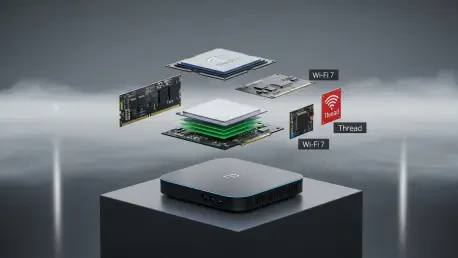
The media fundamentals looked set to remain uncompromised. HDMI 2.1 kept headroom for high‑bandwidth formats and advanced eARC scenarios, while AV1 decoding finally addressed efficiency and future‑proofing for major services ramping that codec on 4K content. Networking appeared to be a focal point: industry chatter pointed to Apple’s N1 connectivity silicon, bringing Wi‑Fi 7—or, at the least, a highly tuned Wi‑Fi 6E implementation—alongside upgraded Bluetooth and a stronger Thread border router role. The intent was concrete: knock down latency, harden reliability, and smooth handoffs between mesh nodes so smart home flows felt closer to a local bus than a best‑effort cloud relay. Physically, few expected fireworks; the compact, fanless, black puck had matured into a steady silhouette, and while a built‑in camera surfaced in some leaks, it remained lower confidence than radio and codec upgrades.
Pricing expectations trended conservative, tracking the current $129–$149 range, though analysts floated two bookends that framed strategic choices. A sub‑$100 entry model could broaden reach and treat the box as an on‑ramp to services, leaning on scale and attach rates. A pricier “Pro” variant could load Ethernet, extended storage, and premium networking for enthusiast setups, turning the device into a living room anchor akin to a compact console or a robust smart home bridge. Against that backdrop, talk of 8K read as more speculative than imminent; streaming ecosystems still grappled with bandwidth economics, catalog depth, and perceptual gain at living‑room distances. Far more credible were Dolby Vision refinements, scene‑based metadata handling, and bitrate optimizations that played well with AV1. The throughline: meaningful, targeted upgrades that users would notice every night, not spec trophies searching for content.
Gaming Push, Smart Home Ambitions, and Buyer Advice
The gaming story drew strength from precedent. Titles like Resident Evil 4 and Death Stranding already ran on A17 Pro iPhones; transplanting that class of game to the living room with better sustained thermals, more RAM, and stable networking opened a path to console‑like experiences without shoehorning compromises. Hardware‑accelerated ray tracing supported richer lighting and reflections, while expanded controller support—Xbox, PlayStation, and MFi pads with low‑latency Bluetooth—reduced friction. If Apple doubled down on shaders, memory bandwidth, and storage throughput, Apple Arcade could expand beyond casual hits, and third‑party publishers could view ports as sensible business rather than technical parlor tricks. Cloud gaming remained a wild card; stronger radios and low‑jitter links made it viable, but Apple’s services posture and regional policies would shape how far that avenue stretched on tvOS.
On the smart home side, a fortified Thread border router and Matter controller role positioned the box as the household’s message broker, not merely a TV accessory. Faster joins, more graceful fallbacks during router switchover, and cleaner device metadata propagation would mean less babysitting scenes and more trusting automations. For buyers deciding now, the calculus broke cleanly. The current third‑gen Apple TV 4K remained a safe pick for premium streaming, fluid UI, and steady app support; it paired well with Dolby Vision sets and Atmos soundbars and avoided the laggy pitfalls of cheaper sticks. Enthusiasts who cared about console‑grade games, next‑wave Siri features, and Wi‑Fi 7‑class networking had reason to wait for the aligned launch. Pragmatically, the next steps were simple: evaluate home network plans, confirm controller preferences, map out Matter and Thread upgrades, and consider storage needs, because those choices had informed which rumored configuration delivered the most lasting value.