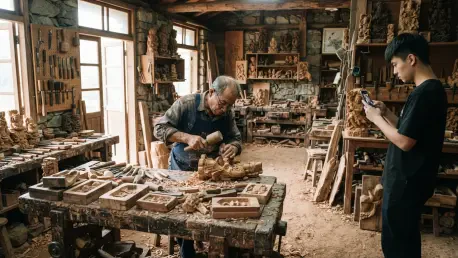

Integrating ethnographic fieldwork into mobile application development ensures that digital repositories maintain high levels of cultural fidelity for future generations. As traditional craftsmanship faces the threat of extinction, innovative digital platforms are emerging to bridge the gap between aging masters and a younger generation of digital natives. In the busy streets of Taiwan, the once-ubiquitous scent of freshly carved wood from pastry mold workshops has largely been replaced by the sterile smell of industrial plastic. This shift is not merely a change in material but a fundamental break in a cultural lineage that has persisted for centuries. Recent research into Taiwanese pastry mold making demonstrates how structured augmented reality (AR) applications can effectively transfer complex cultural and procedural knowledge once only shared through years of physical apprenticeship. By embedding deep ethnographic insights into a mobile interface, technology creators can now capture the cognitive foundations of a craft, providing a survival mechanism for heritage that would otherwise be lost to time. This approach transforms the smartphone from a source of distraction into a sophisticated tool for cultural transmission, allowing the intricate motifs of Hokkien and Cantonese traditions to reside in the pockets of the youth who will eventually become their primary stewards.
Vanishing Heritage: The Crisis of Craft Continuity
The traditional apprenticeship model, which relied on long-term physical proximity and observation, has largely collapsed in the face of rapid industrialization and shifting economic priorities. Wooden molds used for festive rituals and ceremonial worship are becoming obsolete in commercial settings, leading to a severe crisis of continuity within the artisan community. In contemporary Taiwanese society, these wooden molds represent a deep-seated cultural practice dating back to the Ming and Qing dynasties, serving as essential components for festive rituals. However, with mass-produced plastic alternatives now occupying 90 percent of the market, the traditional wooden mold has become nearly invisible to the average consumer. The danger of cultural amnesia is palpable, as the remaining practitioners are mostly over the age of sixty, leaving a narrow window of opportunity to document their techniques before they are forgotten. Digital intervention seeks to preserve the cognitive foundations of this craft, ensuring that even if physical apprenticeships are no longer viable, the underlying knowledge remains accessible to the public and future scholars.
By focusing on the cognitive-procedural knowledge of mold making, researchers aim to capture the specific rules of the craft before the current generation of masters retires. This involves documenting the specific sequences required for carving, the materials used, and the ritualistic significance of different designs. These artifacts are not merely tools; they are a language of symbolism, featuring motifs like turtles for longevity and coins for prosperity. The transition from physical mentorship to digital learning environments is a necessary response to the reality of the 21st-century labor market, where young people are rarely able to commit years to manual skill acquisition. By translating the tacit knowledge of master carvers into structured digital modules, the project creates a bridge that connects the history of migration and ritual to the contemporary digital landscape. This ensures that the cultural significance of the “Red Tortoise Kuih” and other traditional pastries remains understood even as the methods of their production undergo a technological transformation.
Architectural Design: The Modular Learning Environment
The architecture of the preservation tool is grounded in rigorous ethnographic fieldwork, including museum visits and extensive interviews with master craftsmen. The resulting mobile application is designed as a four-stage modular system that guides users from basic historical awareness to a complex understanding of the craft’s internal logic. It begins with a Virtual Museum that provides the ritualistic scaffolding and folklore necessary to understand why these molds exist. Without this context, the technical skills of carving would be divorced from their cultural meaning, reducing a sacred tradition to mere carpentry. By starting with the “why,” the application establishes a value proposition for the student, illustrating how these objects have facilitated community bonding and spiritual worship for centuries. This historical introduction acts as a conceptual anchor, ensuring that users recognize the molds as vital cultural artifacts rather than just historical curiosities.
Following the historical introduction, an Exhibition Hall uses high-fidelity digital documentation to showcase technical artifact typologies and carving sequences. This stage transitions the learner from theory to the technical specifics of the craft, providing a detailed look at the tools and techniques employed by experts like Taichung craftsman Zheng Yongbin. By capturing fine details that might be lost in lower-resolution media, the app ensures that the visual intricacies of the wooden molds are preserved for close study. Users can explore the subtle angles of chisel marks and the grain of the wood, gaining a visual familiarity with the production process. This modular approach allows for self-paced learning, which is essential for modern students who often juggle academic and personal responsibilities. The structure ensures that complex procedural knowledge is broken down into manageable segments, making the daunting task of learning a traditional craft feel approachable and achievable for a digital-native audience.
Interactive Systems: Engaging Users with Markerless Tracking
The centerpiece of the technological innovation is a markerless AR framework that utilizes real-time face mesh tracking to create an immersive environment. Unlike older AR systems that require physical QR codes or specific markers to function, this system anchors virtual objects directly to the user’s physical environment and movements. In a specific catching game, users must move their bodies to collect 3D pastry objects, a process that engages gross physical bodily participation to sustain motivation and focus attention on procedural review. This gamified element is not just for entertainment; it serves as a pedagogical tool that reinforces the visual identification of different mold patterns. By requiring physical movement, the application triggers a level of engagement that traditional video or text-based learning cannot match. This interaction helps to bridge the gap between passive observation and active participation, mimicking the physical presence required in a traditional workshop.
To ensure the knowledge is actually retained, the platform incorporates a gamified assessment module that challenges the user’s memory and comprehension. This interactive quiz measures both response speed and accuracy across domains such as production sequencing and iconographic symbolism. By rewarding quick and correct answers, the system can distinguish between users who are merely guessing and those who have truly internalized the cultural and technical information. The use of the Kahoot! platform within the app provides a familiar and competitive interface for students, encouraging them to master the content. This feedback loop is critical for learning, as it allows users to identify gaps in their understanding and revisit the earlier modules for clarification. The combination of high-tech tracking and gamified assessment ensures that the learning experience is both physically engaging and intellectually rigorous, providing a multifaceted approach to cultural preservation.
Statistical Validation: Measuring Educational Success
Implementation of this technology in a university setting has yielded significant quantitative results, with student knowledge scores jumping from an average of 50 percent to over 80 percent after a single session. Statistical analysis indicates a large effect size, suggesting that the AR intervention is a powerful catalyst for rapid knowledge acquisition in a relatively short timeframe. These gains were consistent across students regardless of their baseline knowledge, proving the tool’s accessibility for novices and those with some prior interest in the subject. The study, which involved undergraduate students in a science and technology track, demonstrated that even those with no background in traditional arts could achieve a high level of declarative mastery. This efficiency is crucial for mass cultural education, as it allows for a standardized and scalable way to introduce traditional subjects to a wide audience without requiring the constant presence of a master carver.
The research established that a well-designed AR platform can facilitate both declarative and procedural mastery, which involves knowing the facts and understanding the logical steps of a process. For example, students were able to correctly identify the sequence of carving tasks and the materials required for different types of molds with high precision. This level of success was achieved in a condensed 100-minute session, highlighting the potential for mobile AR to serve as a high-impact educational tool. The data suggested that the immersive nature of AR helps to reduce cognitive load by providing a direct visual representation of complex tasks. This allows students to build a mental model of the craft more effectively than they would through traditional lectures. By providing clear evidence of learning outcomes, the research validates the use of mobile technology as a primary medium for heritage preservation in academic and public settings alike.
Tacit Knowledge: Recognizing the Limits of Digital Tools
Despite the success in teaching facts and sequences, the technology revealed a profound pedagogical tension known as the cognitive-haptic gap. While students learned how a tool should be handled through a screen, they could not develop the fine motor skills or the “touch” required for actual carving. This highlights the concept of tacit knowledge, a term popularized by philosopher Michael Polanyi, which refers to the non-verbal judgments and muscular force that can only be developed through years of physical practice. As students became more aware of the complexities involved in mold making, they also became more aware of their own physical limitations. They understood the logic of the chisel’s path, but they lacked the sensory feedback that a master receives from the wood itself. This finding is essential for setting realistic expectations for digital preservation tools, acknowledging that they are part of a broader educational ecosystem rather than a total solution.
The study concluded that AR serves as a preparatory scaffold rather than a total replacement for traditional training. It moves a learner from a complete novice to an advanced beginner who understands the rules and symbols of the craft, but it cannot bestow the mastery of a seasoned artisan. This distinction is vital for the future of heritage preservation, as it suggests that digital tools should be used to build a foundation of knowledge that can later be refined through hands-on practice. By teaching the “rules” of the craft digitally, the application ensures that when a student finally does pick up a chisel, they are already familiar with the terminology, the sequences, and the cultural stakes. This preparatory work makes physical apprenticeships more efficient, as the master carver no longer needs to spend time on basic historical or procedural explanations. In this way, the technology supports the master-apprentice relationship rather than making it obsolete.
Blended Pedagogy: The Future of Global Heritage
The researchers concluded that the ultimate value of mobile AR lies in a blended pedagogical curriculum where digital systems handle the instruction of history, iconography, and logic. They determined that this approach freed up the limited time and resources of the remaining master craftsmen, allowing them to focus their teaching on the embodied, tactile mastery that technology cannot yet replicate. This study provided a clear roadmap for preserving vanishing crafts through a synthesis of cultural literature and expert interviews, establishing a new standard for digital heritage management. By identifying which aspects of a craft are “teachable” via AR and which require physical presence, the project created a sustainable model for heritage preservation that can be adapted for other traditions worldwide. The implementation of this framework ensured that the transition into the modern era did not result in a loss of cultural depth but rather a more structured form of knowledge transfer.
Moving forward, the research suggested that future iterations of the platform should focus on multi-user environments to simulate a digital apprenticeship that encourages social learning. The findings indicated that while the current model was highly effective for individual knowledge gains, the communal aspect of traditional workshops remains an area for further development. By integrating haptic feedback hardware and collaborative features, the next generation of these tools could begin to narrow the cognitive-haptic gap even further. The project successfully demonstrated that technology does not have to be an enemy of tradition; instead, it can be the vessel that carries it forward. This research established that the digital evolution of global heritage is not only possible but necessary to ensure that the stories, symbols, and skills of the past continue to resonate in a world that is increasingly defined by screens and virtual interactions.