
A significant advantage of this hardware is the Intel Core Ultra X7 358H processor, which utilizes a sophisticated mix of performance and efficiency cores for varied tasks. This compact powerhouse marks a pivot in how professionals perceive the modern Linux desktop, moving away from cavernous cases toward dense, efficient designs. By integrating the Panther Lake architecture, the device provides a versatile environment that balances high-intensity computational needs with low-power background processes. It effectively bridges the gap between portability and the raw performance required for complex software development or data analysis. As mobile professionals increasingly seek hardware that fits in a small bag without sacrificing throughput, this unit arrives as a direct response to the demand for localized computing power. The engineering feat here lies in housing a 16-core system within a frame that takes up less desk space than a standard coffee mug, fundamentally challenging the notion that a workstation must be an immobile, heavy piece of equipment.
Unleashing Performance: Memory and Processing Capacity
While the processor handles the logic, the true differentiator for this workstation is its unprecedented memory ceiling within the mini-PC category. Supporting up to 128 GB of DDR5-7200 RAM via dual SO-DIMM slots, the machine addresses a long-standing bottleneck for developers working with large datasets or local Large Language Models. Traditionally, such high memory capacities were restricted to full-sized ATX boards, but the ability to swap and upgrade these components ensures a lifecycle that exceeds typical integrated solutions. Complementing this is the dual M.2 SSD configuration, providing up to 10 TB of high-speed storage. This combination allows for massive Docker environments and multiple virtual machines to run simultaneously without the latency spikes often associated with cloud-based alternatives. For engineers who require a portable laboratory for network simulations or database testing, the density of these internal components provides a robust foundation that remains responsive under heavy sustained loads.
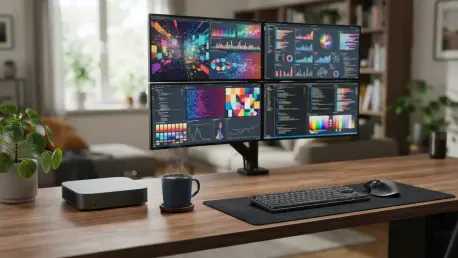
Beyond raw data processing, the integrated Intel Arc B390 graphics architecture represents a substantial leap in graphical throughput for non-discrete systems. This setup is specifically tuned to drive up to four 4K displays at once, catering to the multi-monitor setups favored by financial analysts and software architects. Although it is not marketed as a dedicated gaming rig, the hardware handles media encoding and light rendering tasks with surprising agility. Thermal management is critical in such a small enclosure, yet the design employs a sophisticated cooling solution that prevents thermal throttling during long compilation sessions. This reliability is vital for professionals who cannot afford performance dips during critical workflows. The balance of heat dissipation and noise control ensures that the workstation remains unobtrusive even when pushed to its limits. Consequently, the machine serves as a versatile tool for both technical computation and creative visual tasks, proving that a minimized physical footprint does not have to result in compromised utility.
Strategic Integration: Hardware and Linux Synergy
A defining characteristic of this device is the commitment to a Linux-first development philosophy, which ensures that every hardware component functions seamlessly from the first boot. Shipping with TUXEDO OS—a refined distribution based on Ubuntu with the KDE Plasma desktop—the system benefits from specific kernel optimizations that maximize the efficiency of the Panther Lake architecture. Unlike generic mini-PCs where users often struggle with firmware compatibility or Wi-Fi driver issues, this unit offers a polished experience where the hardware and software are co-engineered. However, potential users should note specific technical nuances regarding display outputs. While a Windows installation might unlock HDMI 2.1 features such as 4K at 120 Hz, the Linux implementation currently limits the HDMI ports to version 2.0b, capping the refresh rate at 60 Hz for 4K resolutions. This discrepancy highlights the ongoing challenges of proprietary versus open-source driver stacks, though the inclusion of USB4 provides an alternative path for high-bandwidth video and data transfers through DisplayPort protocols.
Connectivity remains a cornerstone of the professional experience, particularly for those operating in specialized networking environments or home labs. The inclusion of dual 2.5 Gigabit Ethernet ports allows for sophisticated network configurations, such as link aggregation or the isolation of management traffic from high-speed data transfers. This level of physical networking is complemented by modern wireless standards, including Wi-Fi 7 and Bluetooth 6.0, which provide low-latency communication with peripherals and external networks. Such a robust I/O suite is rare in ultra-small form factor devices, often forcing users to rely on cumbersome dongles. By integrating these ports directly into the chassis, the manufacturer facilitates a cleaner workspace and more reliable connections for mission-critical applications. Furthermore, the presence of multiple USB ports of varying generations ensures compatibility with legacy hardware while providing a bridge to the high-speed future of external storage and specialized sensors, making it an adaptable hub for diverse professional workflows.
Sustainability and Practical Implementation
In an era where many manufacturers move toward soldered components and non-repairable designs, this machine emphasizes longevity through accessibility. Removing only four screws from the base plate grants full access to the internal storage, memory, and wireless modules, allowing for straightforward maintenance or future upgrades. This approach not only extends the functional life of the hardware but also aligns with the ethical standards of many in the open-source community who value digital sovereignty and the right to repair. While the initial investment starting at $1,640 positions the unit as a premium product, the total cost of ownership is mitigated by the ability to swap parts as technology advances between 2026 and 2029. This modularity ensures that the system does not become obsolete prematurely, providing a sustainable alternative to the disposable consumer electronics cycle. For organizations prioritizing hardware that can be serviced in-house, this design choice represents a significant practical advantage over more restrictive competitors.
The introduction of this specialized hardware offered a clear path for professionals seeking to reconcile high-density computing with a minimal physical presence. Users who adopted the system found that the massive memory capacity and optimized Linux kernel transformed their ability to handle intensive local workloads without the overhead of traditional server racks. To maximize the utility of such a device, it was recommended that engineers focus on leveraging the dual Ethernet ports for secure, segregated network architectures while utilizing the USB4 expansion for external GPU enclosures if heavier rendering was required. Forward-thinking IT departments analyzed how these units could replace aging tower fleets, ultimately reducing the energy footprint of their office spaces without sacrificing the developer’s productivity. The move toward this compact standard signaled a broader shift in the industry toward specialized, high-performance appliances that respected the user’s choice of operating system. Investing in this ecosystem provided a reliable roadmap for those prioritizing privacy and local control.