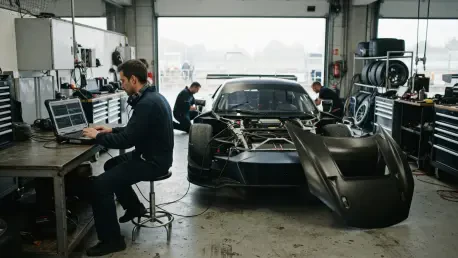

Mobile private networks are becoming essential tools for maintaining operational continuity in environments where public infrastructure is under heavy load. In the high-stakes world of professional motorsport, this necessity is magnified by the speed and complexity of the modern racing machine. The partnership between Verizon Business and Bosch Motorsport represents a foundational shift in how technical teams approach telemetry for vehicles moving at speeds exceeding two hundred miles per hour. No longer are these machines merely aerodynamic feats of engineering; they have evolved into sophisticated, mobile data centers that generate massive streams of diagnostic information in real time. By moving away from the fragmented and often unreliable country-specific network configurations of the past, this collaboration has established a software-defined connectivity model. This framework ensures that critical data remains fluid and accessible across international borders, providing a blueprint for modern industrial mobility.
Global Connectivity and eSIM Orchestration
Central to this technical evolution is Verizon’s Global IoT Orchestration, a system that leverages advanced embedded SIM technology to manage devices across more than one hundred and forty countries. Historically, racing teams faced a logistical nightmare when moving equipment between different nations, often requiring the physical swapping of SIM cards or laborious manual reconfigurations to match local carrier settings. The new architecture bypasses these antiquated hurdles by utilizing remotely provisioned eSIM profiles that maintain a consistent network configuration. This software-centric approach allows Bosch’s diagnostic kits and vehicle sensors to detect and connect to local supported networks automatically upon arrival at a venue. By standardizing the Access Point Name, or APN, the system eliminates the friction usually associated with international roaming, ensuring that the connection is active and stable the moment the car hits the track in a new region.
Beyond the convenience of automated connectivity, this global framework offers a level of reliability that was previously unattainable for teams operating on a tight international schedule. The ability to maintain a unified data pipeline means that engineers do not have to waste precious practice hours troubleshooting local cellular handoffs or dealing with inconsistent data rates. Instead, the software-defined nature of the connection provides a predictable environment for the transmission of engine parameters, tire pressures, and aerodynamic loads. This stability is particularly crucial during the IMSA WeatherTech SportsCar Championship, where the margin for error is razor-thin and technical failures must be diagnosed instantly to avoid catastrophic outcomes. By offloading the complexity of network management to an automated orchestration layer, Bosch allows its technical staff to focus entirely on performance optimization and the strategic nuances of the race.
Centralized Management and Digital Marshalling
To manage the vast and intricate fleet of sensors integrated into the RaceConnect system, Bosch utilizes the Verizon ThingSpace platform as a centralized administrative hub. This interface acts as a single pane of glass, providing engineers with a comprehensive view of the entire device lifecycle from a single location. Through the use of sophisticated Application Programming Interfaces, or APIs, technical staff can activate, monitor, or suspend individual sensors across the fleet with unprecedented speed. This level of control is essential for managing the logistics of a global racing season, as it allows for the dynamic scaling of resources based on the specific needs of a given event. Rather than juggling disparate contracts and management tools for various regional operators, teams benefit from a streamlined ecosystem where every diagnostic tool and vehicle sensor is visible and controllable, ensuring that no piece of equipment remains idle or unoptimized during a race.
The implications of this real-time data flow extend far beyond the mechanical tuning of the vehicle, as the telemetry is now an integral component of digital race marshalling. By transmitting data to a private cloud environment, the system provides race officials with near-instantaneous access to engine parameters and vehicle dynamics. This capability is used to enforce technical regulations and monitor safety compliance with a precision that was impossible in previous decades. When a vehicle exceeds a performance limit or experiences a mechanical failure that could endanger other competitors, officials receive immediate notification, allowing them to take corrective action before a minor issue escalates into a major accident. This integration of IoT into the governance of the sport creates a more level playing field while simultaneously raising the standard for driver safety, demonstrating that connectivity is as much a regulatory tool as it is a performance enhancer.
Overcoming Congestion and Strategic Industrial Shifts
One of the most persistent technical challenges on race day is the extreme network congestion created by the presence of tens of thousands of spectators. As fans utilize local cellular towers to stream video, upload photos, and access social media, the public infrastructure often becomes overwhelmed, leading to high latency and dropped connections. For a professional racing team, even a few seconds of data lag can result in missed strategic opportunities or undiagnosed mechanical risks. To mitigate this, Verizon deploys dedicated mobile infrastructure, including Cells on Wheels and Distributed Antenna Systems, to fortify the local network environment. These specialized assets create a robust communication layer that is isolated from the heavy traffic of the general public. By establishing this dedicated signal, the telemetry system can maintain the high throughput required for high-speed data transmission without competing for bandwidth with the devices of the crowd.
The partnership between Verizon and Bosch Motorsport established a clear standard for the future of mobile industrial telemetry. By prioritizing seamless global roaming and localized network density, the initiative proved that the hurdles of international borders and crowded environments could be overcome through software-defined orchestration. Strategic planners recognized that organizations needed to adopt a unified eSIM strategy to eliminate the logistical burdens of hardware swaps and manual network configuration. It was clear from these implementations that the most successful IoT deployments prioritized a hybrid infrastructure that combined public reach with private security. This approach provided the necessary reliability for mission-critical applications while remaining flexible enough to adapt to diverse international standards. As more sectors adopted these data-driven models, the focus remained on the actionable intelligence generated through these connections.