
Nia Christair has built a career at the vanguard of the mobile evolution, moving seamlessly from the intricate mechanics of device hardware to the sophisticated ecosystems of enterprise mobile solutions and high-stakes mobile gaming. Her perspective is uniquely shaped by a deep understanding of how hardware constraints dictate software possibilities, particularly in the rapidly maturing field of screenless wearables. Today, we delve into the shifting landscape of fitness trackers, specifically focusing on the recent developments surrounding the Amazfit Helio Strap. Our conversation explores the transition of the screenless category from a niche subscription-dominated market into a competitive arena of diverse hardware options, the technical nuances of bicep-worn optical sensors versus traditional wrist placements, and the significant implications of the latest firmware updates on athlete performance and data privacy.
With the latest firmware update, the Helio Strap has significantly expanded its repertoire. How does the addition of over fifty new workout modes change the value proposition for an athlete who might have previously overlooked a screenless band?
The rollout of firmware version 3.22.0.1 is a watershed moment for this device because it fundamentally shifts the Helio Strap from a specialized tool for HYROX athletes into a versatile multi-sport companion. By adding 51 new workout modes—ranging from ball sports to intricate dance routines—Amazfit is acknowledging that the modern athlete isn’t monolithic; they might do a heavy strength session in the morning and a competitive game of basketball or a dance class in the evening. Before this update, the device was very much centered on its 25 auto-recognized strength movements like burpees and deadlifts, but now, that 3.7 MB file delivered via the Zepp app opens the door for a much broader audience. It’s no longer just about the eight stations of a HYROX race; it’s about capturing the metabolic cost of a soccer match or a high-energy dance rehearsal. For the user, this means the $99.99 investment suddenly covers a much wider percentage of their active life, making it a far more compelling alternative to the traditional, higher-priced models that often lock these specific tracking modes behind a subscription wall.
There is a lot of technical debate regarding where a wearable should actually sit on the body. From a hardware engineering perspective, why does moving a sensor from the wrist to the bicep provide such a massive leap in heart rate accuracy during high-intensity training?
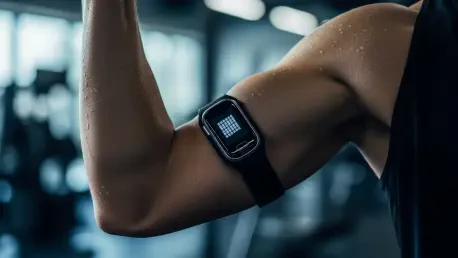
The physics of photoplethysmography, or PPG, really dictates that the bicep is a superior site for data collection during movement. When you wear a sensor on your wrist, you are dealing with a litany of “noise” factors—specifically cadence lock, where the rhythmic vibration of your footsteps during a run tricks the sensor into thinking your heart rate matches your stride. By moving that 460×460-pixel on-demand display and its underlying sensor pod to the bicep, you are placing the LEDs and the photodiode against a much more stable, well-perfused mass of tissue. In cold weather, your body naturally pulls blood away from the extremities through vasoconstriction, which makes the PPG signal at the wrist incredibly faint and prone to error. The bicep, however, maintains much better blood flow even when the mercury drops, and it’s physically further away from the jarring impact of your feet hitting the pavement. In rigorous independent testing, like the studies conducted by sports-tech analyst Ray Maker, the Helio Strap on the bicep was shown to rival the precision of gold-standard chest straps like the Polar H9 or the Garmin HRM-600. It effectively eliminates the “phantom” heart rate spikes that plague wrist-worn devices during heavy intervals.
The update also claims to refine the VO2 Max estimation algorithm. Given that these devices don’t actually measure gas exchange, how much stock should a serious athlete put into these numbers?
It is vital to understand that no wristband or arm-worn sensor is a gas analyzer; they are all using sophisticated regression models to guess your oxygen consumption. What Amazfit is doing with this algorithm refinement is tightening the linear correlation between your heart rate and your oxygen intake at submaximal efforts. The science here is based on population datasets, but as the INTERLIVE consortium’s meta-analysis pointed out, there is a substantial “random error” margin of approximately ±9.83 mL/kg/min. To put that in perspective, if your Helio Strap tells you that your VO2 Max is 48, your actual lab-tested value could realistically be anywhere between 38 and 58. That is a wide gap. However, the value of this update isn’t in providing a clinical, absolute number; it’s in the directional trend. By refining the algorithm, Amazfit is making the “relative” change more accurate over weeks and months of training. If the device shows you moving from 48 to 52 over a season, that improvement is likely real and can be used to calibrate your training zones more effectively, even if the absolute number would make a lab technician scoff.
When we look at the broader market, we see a shift away from the subscription-heavy model popularized by WHOOP. How is Amazfit able to offer these features for a flat $99.99 fee while competitors are charging hundreds of dollars a year in membership?
This really comes down to a deliberate engineering and business strategy that offloads costs from the hardware and the cloud onto the user’s existing ecosystem. The Helio Strap is a masterclass in cost-efficient design: it lacks a GPS chip and a persistent “always-on” display, two of the most expensive and power-hungry components in a wearable. This not only keeps the bill-of-materials low but also allows for a remarkable 10-day battery life. Furthermore, rather than maintaining massive server farms to process every heartbeat in real-time for coaching insights, Amazfit performs much of the heavy lifting—like the HybridCharge Energy Intelligence readiness scoring and sleep staging—locally on the paired smartphone via the Zepp app. This “no-subscription” model is a direct challenge to the recurring-cost paradigm. While WHOOP uses its fees to fund constant server-side biometric analysis and platform development, Amazfit delivers those same improvements through free firmware updates like 3.22.0.1. In the US, that $99.99 price point is incredibly aggressive, and in Europe, at around €99.90, it positions the device as a high-value entry point for athletes who are tired of being “rented” their own health data.
Independent testing has ranked the Helio Strap fourth in automatic workout detection behind WHOOP and Garmin. What is happening under the hood when the device “fails” to recognize a session, and how should a user compensate for that?
The failure mode in the Helio Strap’s auto-detection is quite specific: it tends to be overly aggressive or easily confused by rest periods. For example, during a high-intensity interval run, if you stop to catch your breath for sixty seconds, the algorithm might decide the workout is over and prematurely split your session into two separate records. It’s excellent at noticing that your heart rate has spiked—even for a quick cycling errand that other bands might ignore—but it lacks the “stickiness” of the WHOOP 5.0 or the Fitbit Air algorithms. For a serious athlete, this is more than just a nuisance; it’s a data integrity issue because if the band doesn’t register the workout, the calorie estimation model, which uses a static daily baseline, won’t credit you for those active calories. My advice for anyone using this for structured training, particularly in HYROX Race Mode, is to bypass the auto-detection entirely. Start your sessions manually. It requires one extra step, but it ensures that your training load and recovery data remain continuous and accurate, rather than fragmented by the algorithm’s indecision during your recovery intervals.
Data privacy has become a significant concern for users, especially with devices manufactured by companies subject to international intelligence laws. What are the specific risks that a Helio Strap user should be aware of regarding their biometric data?
This is a conversation that transcends hardware specs and moves into the realm of international law. Zepp Health, the manufacturer of the Helio Strap, is a subsidiary of Huami, a Chinese firm. Under Article 7 of China’s National Intelligence Law of 2017, all organizations are legally mandated to support and cooperate with national intelligence work. This obligation isn’t mitigated by where the servers are located or where the company is incorporated; it is a fundamental requirement of doing business under that jurisdiction. To date, we haven’t seen a public, independent security audit of the Helio Strap’s data transmission practices. While the device collects deeply personal information—from your heart rate variability to your sleep cycles and precise physical location via the phone’s GPS—there is a structural reality that this data could be subject to compelled access. Users who are in sensitive professions or who are simply cautious about their digital footprint need to weigh the $99.99 value against this legal framework. It’s a trade-off that every consumer in 2026 has to evaluate personally.
What is your forecast for the future of the screenless wearable category over the next few years?
I believe we are entering an era of “invisible” ubiquity where the screenless band becomes the primary source of truth for our health, while the smartwatch becomes a secondary notification hub. The screenless category is moving so fast that by late 2026, we’ll likely see the gap in sleep tracking and heart rate variability accuracy between the top five players vanish entirely. We are already seeing the Helio Strap hit a 505-step count on a 500-step ground-truth test, which is incredible precision for a bicep-mounted device. My forecast is that the “subscription-free” model will eventually force the major players like WHOOP to either significantly lower their entry price or offer a “lite” version of their platform. We will also see a massive push toward sensor fusion, where the data from your bicep-worn band and your smart shoes or bike computer are processed as a single, unified “athlete profile” in real-time. The Helio Strap 2 is already on the horizon for 2026, and if Amazfit can fix the fragmentation in their workout detection and maintain that $100 price point, they are going to make it very difficult for anyone to justify paying $30 a month just to see their own recovery score.