
Nia Christair stands at the intersection of hardware innovation and consumer experience, having spent over a decade dissecting the evolution of mobile ecosystems. From her early days refining app development frameworks to her more recent deep dives into enterprise-grade mobile solutions and wearable hardware design, she has become a pivotal voice in how we understand the devices strapped to our wrists. With the tech world turning its eyes toward the upcoming Unpacked event in London on July 22, the recent leaks surrounding the Galaxy Watch 9 and Watch Ultra 2 have provided a rare, high-definition look at a company in the midst of a massive strategic pivot. Nia joins us to unpack how a shift in silicon and a visual redesign of the Galaxy Wearable app are transforming these devices from simple smartphone extensions into independent, proactive AI health dashboards.
The conversation explores the technical leap necessitated by Qualcomm’s Snapdragon Wear Elite chip, which finally brings local, phone-free AI processing to the wrist through a dedicated neural processing unit. We delve into the aesthetic and functional overhaul of the companion app, which replaces a stark monochrome past with soft gradients and photo-realistic renders. Nia also provides a detailed breakdown of Samsung’s aggressive new health metrics, such as Daily Cardio Load and Sound Exposure, which signal a direct challenge to the deep-data dominance held by Garmin and Oura. Beyond the specs, we discuss the practicalities of hands-free Gemini interactions and what the discontinuation of the iconic rotating bezel means for the future of the Galaxy Watch lineup.
The shift from the internal Exynos W1000 to Qualcomm’s Snapdragon Wear Elite chip represents a significant hardware pivot for the Galaxy Watch 9 series. How does this new architecture change the fundamental relationship between the watch and the smartphone?
The transition to the Snapdragon Wear Elite is really about breaking the umbilical cord that has traditionally tied the watch to the phone’s processor. In previous generations, like the Galaxy Watch 8, the Exynos W1000 was a capable 3nm chip, but it lacked a dedicated neural processing unit, or NPU. This meant that every time you asked Gemini a question, the watch had to wake up your phone, relay the data, wait for the phone to process it, and then send the answer back. It felt sluggish and required your phone to be in your pocket or nearby. With the new Hexagon NPU, the Watch 9 and Ultra 2 can now run AI models with up to two billion parameters locally at a speed of 10 tokens per second. When you realize this chip is pumping out 12 trillion operations per second—what we call 12 TOPS—you understand that the watch is finally thinking for itself. This architectural shift allows for a much more fluid, sensory experience where the device responds to your voice or gestures in real-time, regardless of where your phone is or if it’s even turned on.
We’ve seen leaked screenshots of a massive visual overhaul for the Galaxy Wearable companion app. Beyond the new colors and gradients, what does this redesign tell us about how Samsung wants users to interact with their data?
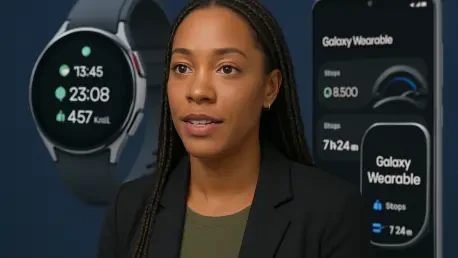
The move away from the old, dark monochrome interface to these soft blue-purple gradients and floating card elements isn’t just about looking pretty; it’s a total functional rethink that aligns with the upcoming One UI 9 design language. When you open the Home tab now, you aren’t greeted by a sterile list of settings but by a large, photo-realistic render of your specific watch model. It’s a very tactile, visual experience that includes a live battery percentage and a precise time-to-empty estimate, which removes the guesswork from your morning routine. By surfacing the four most-used controls—notifications, quick settings, Tiles, and apps—right at the top, Samsung is acknowledging that users want to spend less time digging through menus and more time acting on information. Even the Watch Faces browser has been updated to show your choice on a full image of the watch body, giving you a sense of the scale and light reflections you’ll see on your wrist before you ever hit “apply.” It transforms the app from a backend utility into a proactive dashboard that feels like a natural extension of the hardware.
The introduction of “AI Tiles” suggests a move toward a more dynamic, curated user interface. How do you see this feature changing the way a typical user manages their daily information at a glance?
AI Tiles represent a shift from manual curation to intelligent synthesis, where the watch takes over the heavy lifting of organizing your digital life. Instead of the user having to scroll through five different widgets to see the weather, their steps, and their stock portfolio, you can simply describe what matters to you, and Galaxy AI assembles a custom Tile around those specific data points. This is likely Samsung’s implementation of Google’s “Create My Widget” capability from Wear OS 7, but seeing it integrated into the Galaxy AI layer makes it feel much more personal. Imagine a morning where your watch automatically combines your sleep score, your first calendar appointment, and the current commute time into one unified view because it knows you’re about to head out the door. It reduces the cognitive load of interacting with a small screen, turning the watch into a device that anticipates your needs rather than one that just waits for your input.
The “Raise-to-Talk” feature for Gemini is being touted as a major productivity boost. What are the technical and practical challenges of moving away from button-activated AI to a gesture-based system?
Moving to a wrist-raise gesture for Gemini is a bold play for friction-free interaction, but it’s technically demanding because the watch has to distinguish between a casual glance at the time and an intentional command. On the Watch 9, a second, lower-power embedded NPU handles this background activity recognition without waking the main CPU, which is crucial for preserving battery life. When you lift the watch to your mouth, it immediately enters listening mode, allowing you to ask for a rain forecast or add items to a shopping list mid-stride. While we’ve seen similar features on the Pixel Watch 4, the Galaxy Watch 9’s advantage is that it doesn’t need a phone relay to resolve those queries thanks to the Snapdragon chip’s local inference. However, there is a lingering question about how Samsung will handle “false positives”—those moments when you just want to check the time and Gemini thinks you’re starting a conversation. It’s a sensory hurdle that requires very fine-tuned software polish to ensure the watch feels like a helpful assistant rather than an intrusive listener.
Samsung’s new health tools, like Daily Cardio Load and Vitals monitoring, seem to be targeting a much more serious athletic demographic. How do these features position the Galaxy Watch against established giants like Garmin?
Samsung is clearly tired of being seen as just a “lifestyle” watch and is going straight for the heart of the performance market with Daily Cardio Load. This tool calculates cardiovascular stress over time and gives you actionable recovery timing and intensity recommendations, which is a direct shot across the bow at Garmin’s Training Load and Body Battery features. By incorporating continuous overnight monitoring of five key signals—heart rate, HRV, respiratory rate, skin temperature, and blood oxygen—the Vitals app provides a holistic look at your recovery that rivals the depth of Oura or Whoop. It’s no longer just about counting steps; it’s about understanding the biological cost of your workouts. For an athlete, seeing these deviations from their personal baseline rather than just absolute numbers is the difference between an informed rest day and an injury. This move, combined with the discontinuation of the experimental Vascular Load in favor of Blood Pressure Trends, shows a focus on medical-grade accuracy and long-term wellness tracking that we haven’t seen from Samsung before.
The Galaxy Watch Ultra 2 includes several specialized features like a 5G RedCap radio and an automatic Dive Mode. What do these additions reveal about Samsung’s strategy for the high-end wearable market?
The Ultra 2 is a statement of independence, especially with the inclusion of 5G RedCap, which allows for standalone data and calls without the massive battery drain of traditional 5G. This is a watch designed for the person who wants to leave their phone at home while they go on a three-hour trail run or a deep-sea dive. Speaking of diving, the new automatic Dive Mode, which triggers at a preset depth, alongside a massive 784mAh battery—marketed as a beefy 800mAh—shows that Samsung is prioritizing rugged reliability. That battery is roughly 33% larger than what we saw in the original Ultra, which is a necessary upgrade when you consider the 12 TOPS of AI processing and the always-on background sensors. They are positioning the Ultra 2 as a professional tool for hikers and divers who need features like Waypoints and Trackback to navigate uneven terrain or retrace their steps in the wild. It’s a high-stakes entry into the $649 to $699 price range, where hardware durability and battery life are the only metrics that truly matter.
With the apparent removal of the Galaxy Watch “Classic” and its rotating bezel from the 2026 lineup, how do you think the core fan base will react to this shift in design philosophy?
The absence of a Classic model in the FCC and CMIIT databases is a bittersweet moment for many long-time Galaxy Watch enthusiasts who swear by the tactile precision of the rotating bezel. For many, that bezel was the defining characteristic of the Samsung wearable experience—a physical, mechanical way to navigate a digital space that felt superior to swiping on a tiny screen. By retiring the line after the Watch 8 Classic, Samsung is signaling a full-scale commitment to the touch-and-gesture-based future defined by One UI 9 and AI-driven interactions. While this allows for sleeker designs and larger batteries, there is an emotional loss there; the bezel provided a certain “clicky” satisfaction and a level of control that’s hard to replicate with software. Fans of the rotating bezel will likely cling to their Watch 8 units for as long as possible, especially since the $349 starting price of the Watch 9 doesn’t offer a direct hardware replacement for that mechanical experience.
Looking at the broader ecosystem, including the Galaxy Z Fold 8 and the new Galaxy Glasses, how does the Galaxy Watch 9 serve as the “connective tissue” for this new era of Samsung hardware?
The Galaxy Watch 9 is really the primary interface for the “ambient” AI world Samsung is building. When you pair it with the new Galaxy Glasses—their Gemini-powered audio-visual wearable—the watch becomes the control hub for a phone-free existence. The Snapdragon Wear Elite chip is the key here; it provides the 5× single-core CPU boost and 7× GPU performance needed to keep up with a high-speed, multi-device ecosystem. Even the fast-charge architecture, which gets you to 50% battery in just 10 minutes, is designed for a user who is constantly on the move and interacting with their Fold 8 or their glasses. We are seeing the watch evolve from a notification mirror into a sophisticated sensor node that feeds data into the Galaxy Health platform while acting as a voice-driven remote for your entire digital life. It’s a cohesive vision where the hardware disappears into the background, and the AI—locally processed and always ready—becomes the primary way you interact with the world.
What is your forecast for the future of on-device AI in wearables?
I believe we are entering a phase where the “smart” in smartwatch will no longer mean it has an internet connection, but rather that it possesses genuine on-device intelligence. Within the next two to three years, the 12 TOPS of compute we see in the Snapdragon Wear Elite will become the baseline, allowing for even more complex health diagnostics, like real-time fatigue detection or predictive stress management, without ever sending a single byte of personal data to the cloud. We will see wearables move away from being reactive devices that tell you what happened yesterday and toward being proactive coaches that suggest a glass of water or a breathing exercise before you even realize your heart rate variability is dipping. The independence provided by 5G RedCap and local NPUs will eventually make the smartphone an optional accessory for the majority of our daily tasks. As these chips get even more efficient, the boundary between our physical health and our digital assistants will blur until the watch isn’t just a gadget, but a vital, thinking part of our personal wellness infrastructure.