
Nia Christair is a powerhouse in the mobile and hardware landscape, bringing a wealth of expertise that spans from the intricacies of app development to the rugged demands of enterprise mobile solutions. Having navigated the evolution of mobile gaming and hardware design for years, she possesses a rare ability to see through the marketing gloss and understand the engineering trade-offs that define a successful wearable. Her insights are particularly valuable today as the smart ring market—a sector projected to skyrocket to nearly $9 billion by 2034—undergoes a radical design shift. With Casio’s latest entry into the space, Nia provides a veteran’s perspective on whether a device can truly be both a functional timepiece and a precision health monitor without losing its soul.
The following discussion explores the tension between minimalist design and functional utility in the wearable market. We delve into the bold engineering choices behind Casio’s dual-power architecture, which allows an LCD screen to coexist with high-fidelity health sensors. Nia explains the anatomical advantages of finger-based biometric tracking, the historical legacy of Casio’s “yubiwa” form factor, and the practical realities of data management in a globally connected ecosystem. We also analyze the competitive landscape, comparing this new 19-gram heavyweight against the 3-gram industry standard, while questioning if the market is ready for a smart ring that demands to be seen rather than hidden.
The smart ring industry has largely moved away from screens to maintain a slim, invisible profile, so how does Casio’s decision to include an LCD change the fundamental value proposition for the user?
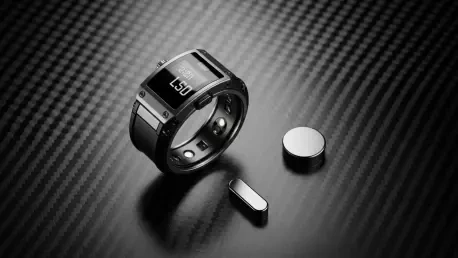
For years, the smart ring market has been dominated by a philosophy of invisibility, where players like Oura and Samsung have stripped away every external element to make the device disappear on the finger. By reintroducing a functioning LCD display, Casio is effectively challenging the idea that a ring must be a passive sensor that requires a smartphone to tell you even the simplest piece of information. The most basic question any wearable should answer is “what time is it?”, and yet, until now, no major smart ring could do that independently. Casio’s CRW-H001M-8 changes the game by offering immediate, glanceable data—not just the time, but heart rate and step counts—right there on the steel-and-ceramic band. This creates a much more autonomous user experience, where the wearer isn’t tethered to their phone screen just to check their pulse during a workout or see the time in a dark room thanks to that crisp white LED backlight.
Most smart rings weigh around 3 grams to remain discreet, yet this new model reaches a significant 19 grams; what does this weight increase mean for the daily experience and the hardware’s durability?
Jumping from the 2.3 to 3.3 grams of an Oura Ring 4 to the 19 grams of the Casio CRW-H001M-8 is a massive leap that completely changes how the device feels on the hand. You are moving from something that feels like a wedding band to something that has the tactile presence and heft of a piece of precision machinery. At 25.3 × 19.5 × 6 mm, it sits significantly higher off the finger, which could certainly lead to more accidental bumps against doorways or desks, but that’s where Casio’s heritage in rugged construction likely comes into play. That extra 3 grams over its non-smart predecessor comes entirely from the health-sensor hardware, suggesting that they haven’t compromised on the internal housing to save weight. While some might find the 0.67-ounce weight intrusive, others will appreciate the “tool-watch” aesthetic that has made Casio a legend, feeling that the weight signifies a more substantial and capable piece of technology.
Can you explain the engineering logic behind using a dual-power architecture and how it solves the traditional battery drain issues associated with wearable displays?
The dual-power architecture in this ring is a brilliant piece of engineering that sidesteps the “battery anxiety” that usually kills the idea of a screen-equipped ring. By separating the electronics, Casio allows the health module—which runs the Bluetooth radio, vibration motor, and optical sensors—to be rechargeable via magnetic pogo-pins, lasting about four to six days on a single charge. Meanwhile, the LCD display is powered by its own non-rechargeable cell that can keep the time for approximately two years because a segmented LCD draws power in the microwatt range. This is roughly 1,000 times less power than a color OLED or touch display would consume, meaning the “watch” part of the ring never competes with the “smart” part for energy. It’s a pragmatic solution that ensures even if you forget to charge your health sensors for a week, you still have a perfectly functional, accurate timepiece on your finger that doesn’t go dark.
From a biological perspective, why is the finger such a high-fidelity location for PPG sensors compared to the wrist, and what are the trade-offs involved in this placement?
The finger is an absolute goldmine for biometric data because the skin is relatively thin compared to the back of the wrist, and the capillary network is incredibly dense and close to the surface. Clinical studies have shown that finger-based photoplethysmography, or PPG, can achieve a heart rate correlation of r² = 0.996 against a gold-standard ECG, which is remarkably higher than the 0.97 or 0.98 we typically see with wrist-based sensors. However, the trade-off is that the ring must fit perfectly; if the ring rotates or the sensors lose contact with the skin, the LED-to-photodetector path is disrupted, and the data becomes noisy. Casio has addressed this by moving away from plastic spacers and offering three fixed sizes—Small, Medium, and Large—to ensure the sensors remain flush against the skin for accurate SpO2 and heart rate readings. It’s a delicate balance because a ring that is tight enough for medical-grade accuracy can become uncomfortable if your finger swells, yet the data quality you get from that fingertip is simply unparalleled in the consumer wearable space.
Casio has a long history with “finger-ware” dating back to 1946—how does that legacy influence the design of a high-tech device like the CRW-H001M-8?
There is a wonderful sense of continuity in Casio’s design language that traces all the way back to the “yubiwa pipe,” a ring-shaped cigarette holder that was the company’s first major commercial hit in 1946. That original product was about hands-free utility, and you can see that same DNA in a smart ring that allows you to monitor your health and manage your time without ever reaching into your pocket for a phone. The CRW-H001M-8 isn’t just a random tech experiment; it’s the third generation of their modern return to this form factor, following the wild success of the display-only CRW-001 which became a global collector’s item in 2025. By staying true to their digital watch aesthetics—including features like World Time, a 1/100-second stopwatch, and that iconic hourly time flash—they are appealing to a sense of nostalgia while packing in 21st-century health sensors. It feels less like a gadget and more like an evolution of a classic tool that has been refined over decades to fit the needs of a modern, health-conscious wearer.
The inclusion of the AIZO Ring app introduces some interesting data handling contexts; what should potential international users consider regarding the software ecosystem?
When a device launches in the Chinese market first, as the CRW-H001M-8 has done, the software ecosystem often reflects that region’s specific data handling and privacy frameworks. The AIZO Ring app is published by Shenzhen eIoT Technology, and users should be aware that health data processed through the app will be subject to Chinese data practices, which may differ from what users in the US or Europe are accustomed to. It’s a highly compatible app, supporting everything from Android 7.0 to iOS 13 and even HarmonyOS, which is great for accessibility, but the centralized nature of the data processing is worth noting for the privacy-conscious. As Casio prepares for a likely global rollout—following the pattern of their previous ring watches—we may see adjustments to how this data is stored or managed to meet international regulations like GDPR. For now, users get a robust suite of reports on sleep analysis, menstrual cycles, and training logs, but they must be comfortable with the cloud-based nature of the Shenzhen-developed platform.
Looking at the current market, how do you see this device competing with heavyweights like Oura or Samsung when it hits the global stage?
Casio is positioning itself in a very specific niche that essentially combines the utility of a classic digital watch with the power of a modern health tracker, all at a price point of around $294. This puts it head-to-head with the Oura Ring 4, which retails for approximately $299, but the two products couldn’t be more different in their execution. While Oura and Samsung are fighting over who can make the most invisible, fashion-forward accessory, Casio is embracing the “maximalist” wearable, betting that there is a significant segment of the 5.5 million people currently wearing smart rings who are tired of being tethered to their phones. The fact that the previous time-only model sold out repeatedly across the US, UK, and Germany suggests there is a massive appetite for this specific look and feel. It’s not just a health tracker; it’s a statement piece that provides immediate utility, and in a world where we are increasingly trying to reduce our screen time on smartphones, having a tiny, efficient LCD on your finger might be the ultimate solution.
What is your forecast for the smart ring industry?
I believe we are standing at the threshold of a “functionalist” revolution in wearables, where we will see a sharp divide between those who want “invisible” technology and those who want “active” tools. Over the next three to five years, I expect the smart ring market to split; we will see high-fashion brands continuing the screenless, jewelry-first approach, while tech-heavy brands like Casio and potentially even Garmin or Apple will experiment with haptic feedback and micro-displays. The success of the CRW-H001M-8 will likely prove that users are willing to accept a slightly bulkier profile—moving toward that 6 mm thickness—if it means they gain real-time data independence. Eventually, the technology will shrink further, and the 19-gram weight we see today will feel like a relic of the past, but the precedent of the “glanceable ring” is here to stay. We are moving toward a future where the ring isn’t just a sensor for your phone, but the primary interface for your digital life, and Casio has just fired the opening shot in that transition.