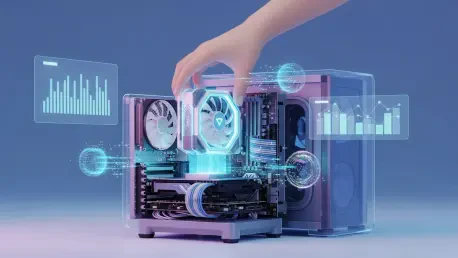

The massive gray towers that once anchored every suburban household have largely vanished, replaced by an invisible architecture of cloud servers and handheld glass slabs. This retreat from the mainstream center does not signal the death of the stationary PC, but rather its refinement into a highly specialized instrument for those who demand uncompromising performance. As we navigate the current technological landscape, the desktop has reclaimed its position as the “engine room” of the digital economy, providing the foundational power that mobile devices simply cannot emulate. This review examines how the stationary workstation has survived the mobile revolution by doubling down on its unique mechanical advantages.
The Shift from Universal Utility to Specialized Powerhouse
Historically, the desktop computer was the only gatekeeper to the digital world, required for everything from basic word processing to checking early email accounts. Today, the democratization of processing power means that a smartphone often possesses more raw speed than a high-end workstation from a decade ago. Consequently, the desktop has transitioned from a general-purpose necessity into a niche tool designed for high-stakes environments. This evolution is driven by the fact that as mobile hardware becomes “good enough” for the masses, the standard for professional-grade output continues to escalate, keeping the stationary PC relevant.
The narrowing functional gap between laptops and desktops has actually served to clarify the desktop’s true value proposition. While a modern ultrabook can handle most office tasks with ease, it operates within strict physical boundaries that limit its peak output. The desktop, free from the constraints of portability, serves as a benchmark for what hardware can achieve when size and weight are removed from the equation. It remains the anchor of the technological landscape, providing the heavy lifting required for the very infrastructure that mobile users rely upon daily.
Critical Architectural Advantages of Desktop Systems
Thermal Management and Sustained Performance
One of the most significant yet overlooked barriers to mobile computing is the laws of thermodynamics. As processors become more powerful, they generate intense heat that must be dissipated to prevent “throttling,” a process where the system slows down to protect its internal components. Desktop towers provide the physical volume necessary for expansive heat sinks, liquid cooling loops, and high-diameter fans that move vast amounts of air. This thermal headroom allows the CPU and GPU to maintain maximum clock speeds indefinitely, a feat that even the most advanced gaming laptops struggle to replicate during extended workloads.
Furthermore, the power delivery systems in a desktop are robust and direct, drawing consistently from a wall outlet rather than a fluctuating battery. This stability ensures that the hardware can handle sudden spikes in demand without compromising the integrity of the data being processed. For tasks like 8K video rendering or training complex neural networks, this sustained performance is not just a luxury; it is a requirement. The ability to run at full throttle for hours or even days makes the desktop the only logical choice for high-intensity production environments.
Modularity and the “Ship of Theseus” Lifecycle
The modular nature of a desktop workstation offers a sustainable alternative to the “planned obsolescence” prevalent in the mobile market. Most portable devices are effectively sealed units where a single component failure or the advancement of software can render the entire machine obsolete. In contrast, the desktop follows a “Ship of Theseus” philosophy, where parts are replaced incrementally. A user can swap a graphics card to keep up with new rendering engines or add more RAM as datasets grow larger, extending the functional life of the chassis and power supply for years.
This granular control over hardware allows for a highly customized user experience that adapts to shifting professional needs. By selecting specific components tailored to their unique workflow, enthusiasts can optimize their investment in a way that pre-configured laptops do not allow. This flexibility not only reduces long-term costs but also mitigates the environmental impact of electronic waste. The desktop remains a rare example of a technological investment that grows with the user rather than forcing them into a frequent and expensive replacement cycle.
Emerging Trends in Modern Computing Ecosystems
The boundary between portable and stationary computing has been blurred by the rise of sophisticated docking stations and external peripheral hubs. Modern professionals often utilize a hybrid setup where a high-end laptop serves as a portable brain that plugs into a desktop-like environment at a permanent desk. This trend emphasizes that while the “tower” might be optional for some, the workstation environment—featuring large displays and ergonomic inputs—remains essential for serious productivity. High-speed connectivity standards have turned the laptop into a modular component of a larger, fixed ecosystem.
Simultaneously, the industry is moving toward “lean hardware” through the integration of cloud-based processing. Many users now rely on remote servers to handle the heavy computational lifting once reserved for local hardware. This shift allows even low-powered notebooks to participate in high-end tasks like 3D modeling or complex simulations. However, this dependence on the cloud introduces latency and privacy concerns, reinforcing the need for local desktop power among those who require immediate, offline control over their digital assets and intellectual property.
Specialized Applications and Industry Implementation
In fields where time is literally money, the desktop remains the undisputed gold standard for industrial application. Professional CGI artists, architectural engineers, and data scientists require the multi-core processing power that only a dedicated workstation can provide. In these environments, a desktop is not just a tool but a force multiplier that allows for real-time manipulation of complex virtual environments. The reliability of these machines under heavy stress makes them the backbone of creative and scientific industries that cannot afford the downtime associated with mobile hardware failures.
Even for the “mobile professional,” the desktop often serves as a central home server or a “rendering farm” that works in the background while they are in the field. This hybrid approach allows users to capture data or write code on a portable device, then sync it back to a powerful desktop for the final, resource-intensive processing. In the world of professional e-sports, the desktop’s ability to drive high-refresh-rate monitors with zero input lag provides a competitive edge that defines the margin between winning and losing.
Barriers to Adoption and Market Challenges
Despite its raw power, the desktop faces significant hurdles in a world that increasingly values spatial efficiency and mobility. The physical footprint of a full-sized tower, along with the tangle of necessary cables, creates a friction point for urban residents living in smaller spaces. As web services and applications move toward “mobile-first” optimization, the native advantages of a large screen and physical keyboard are sometimes negated by software interfaces designed primarily for touch interaction and vertical scrolling.
Cost also remains a formidable barrier, as building or purchasing a high-performance desktop requires a significant upfront investment. For the average consumer, the convenience of a smartphone or a versatile tablet often outweighs the theoretical benefits of a stationary PC. When the majority of daily tasks can be accomplished on a device that fits in a pocket, justifying the expense and dedicated real estate for a desktop becomes a difficult proposition for anyone outside of the professional or enthusiast circles.
The Future of Stationary Computing
Looking ahead, desktop technology is likely to diverge into even more specialized categories, particularly as artificial intelligence becomes a local requirement rather than a cloud-based service. Future workstations may feature dedicated AI processing units designed to handle massive local datasets, keeping sensitive information off public servers. We are seeing a move toward decentralized home computing, where the desktop acts as a high-powered hub that streams its processing capabilities to every other “thin” screen in the house.
The long-term survival of the desktop depends on its ability to integrate with emerging technologies like augmented reality and real-time spatial computing. As these applications demand more local graphical horsepower, the desktop will likely remain the only platform capable of delivering the necessary frames and resolution. The hardware may become more compact and integrated, but the core principle of a high-power, locally-managed computing node is poised to remain a cornerstone of advanced digital interaction.
Final Assessment of the Computing Landscape
The evaluation of the desktop computing sector revealed a definitive transition from a ubiquitous household item to a specialized instrument of extreme performance. While the convenience of portable and cloud-integrated devices captured the majority of the market, the stationary workstation maintained its dominance in high-stakes professional and creative fields. The inherent benefits of thermal management, modularity, and raw power ensured that for those who refused to compromise, the desktop remained the only viable solution for complex digital workflows.
Industry leaders recognized that the desktop was not being replaced but was instead being repositioned as the apex of hardware capability. Moving forward, the focus shifted toward creating more efficient, AI-capable workstations that bridged the gap between local control and cloud flexibility. Stakeholders determined that the future of computing would not be defined by a single form factor, but by an ecosystem where the desktop serves as the high-powered foundation for a increasingly mobile world. The verdict confirmed that while portability is the standard for the masses, the desktop remains the gold standard for performance.