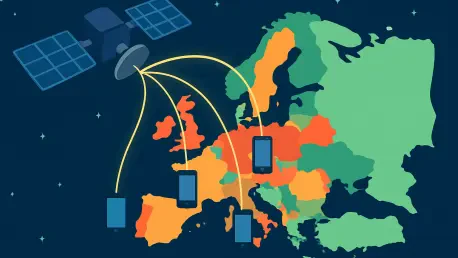

Telefónica’s involvement ensures that the initiative maintains strong political and economic support across Southern Europe and its diverse international business ties. This strategic commitment emerges as a cornerstone of the newly formed alliance between Deutsche Telekom, Orange, and Vodafone, who have collectively signed a Letter of Intent to revolutionize the European telecommunications landscape. By focusing on the acquisition of Mobile Satellite Services spectrum, these entities are moving beyond traditional terrestrial limitations to establish a unified satellite-to-phone framework. The primary objective centers on the deployment of Direct-to-Device technology, a breakthrough that enables standard mobile hardware to communicate directly with orbital assets without requiring intermediate ground relays or specialized handsets. This move signals a profound shift in infrastructure priorities, aiming to provide a seamless communication layer that functions across the entire continent, regardless of geography or terrestrial coverage gaps. This collective pursuit of spectrum is a geopolitical statement regarding the future of regional connectivity.
Strategic Infrastructure: The Hybrid Partnership Model
The alliance is constructed upon a sophisticated hybrid operational structure that avoids the exorbitant capital expenditures associated with launching proprietary satellite constellations. Instead of transitioning into space hardware manufacturers, the four telecommunications giants intend to build and manage the essential terrestrial components, including ground stations, coordination functions, and monitoring systems located within European borders. This approach allows these companies to focus on their established core strengths, such as customer lifecycle management, advanced billing systems, and the navigation of complex regulatory environments across multiple jurisdictions. By maintaining control over the ground segment, the operators ensure that data remains subject to European privacy standards while integrating space-based signals into their existing high-speed fiber and cellular cores. This creates a resilient backbone that can adapt to the evolving demands of both consumer and industrial users in a hyper-connected economy.
To bridge the gap between Earth and orbit, the alliance seeks to partner with specialized satellite operators that possess the necessary flight-proven hardware. This partnership model is intentionally non-exclusive, granting the participating telcos the flexibility to maintain their individual satellite projects while contributing to the broader European mission. By combining the vast market reach of established mobile network operators with the technical agility of satellite firms, the initiative fosters an ecosystem capable of delivering high-bandwidth connectivity from low-Earth orbit. This synergy is designed to scale rapidly, allowing for the integration of new orbital technologies as they become available. Furthermore, the collaborative framework ensures that no single entity carries the full burden of space-based risk, distributing the technical and financial requirements of the satellite overlay across a broader group of stakeholders, which ultimately enhances the long-term stability and reliability of the service for end-users.
Market Access: Fostering Competition and Universal Connectivity
A fundamental pillar of this joint effort is the unwavering commitment to an open and non-discriminatory access model for the entire European telecommunications market. The four signatories have meticulously designed a framework that permits all mobile network operators, including smaller regional providers and virtual operators, to offer satellite-based services to their own customer bases. This inclusive strategy is vital for preventing the monopolization of precious spectrum by a few dominant firms, thereby encouraging a competitive retail environment where innovation thrives and service prices remain stable for the public. By opening the infrastructure to a wider range of participants, the alliance ensures that the benefits of space-integrated connectivity are distributed equitably across the continent. This prevents the emergence of new digital divides and ensures that the most remote regions have access to the same technological advancements as major metropolitan business hubs.
This unified approach also addresses the historical fragmentation of the European telecom market, which has long been divided by distinct national borders and varying technical standards. By securing a continent-wide spectrum allocation through a joint bid, the operators are establishing a singular standard for satellite connectivity that transcends traditional boundaries. This move not only expands the range of choices available to consumers but also facilitates seamless roaming and service continuity for travelers and logistics companies moving across the European Union. Effectively bridging the digital divide through space-based technology requires this level of cross-border coordination to ensure that a smartphone user in a remote mountain village receives the same reliability as an office worker in a capital city. The strategy ultimately positions Europe as a single, cohesive digital market, enhancing the region’s overall economic competitiveness against other global tech powers.
Technical Objectives: Eliminating Communication Gaps Through Innovation
The technical core of this ambitious project resides in the seamless integration of satellite signals into the existing mobile ecosystem to permanently eliminate cellular “dead zones.” Direct-to-Device technology utilizes specific frequency bands that allow everyday smartphones to maintain a connection in environments where building traditional towers is economically or physically impossible. This includes dense forests, rugged mountain ranges, and expansive maritime territories where consistent coverage has historically been a challenge. Beyond providing convenience for travelers and outdoor enthusiasts, this satellite overlay offers a critical secondary layer of network resilience. In the event that terrestrial infrastructure is compromised by natural disasters or hardware failures, the satellite-to-phone link ensures that emergency services and citizens remain connected. This fail-safe mechanism is essential for modern public safety, providing a robust communication fabric that remains operational even under extreme conditions.
The success of this satellite revolution is further bolstered by the immense scale and operational experience of the participating companies. Deutsche Telekom and Vodafone bring a combined customer base of nearly 650 million users, alongside deep expertise in digital transformation and the rapidly expanding Internet of Things sector. Simultaneously, Orange and Telefónica contribute significant research and development capacity, holding thousands of patents and maintaining a dominant presence across Europe, Africa, and Latin America. Together, these global leaders are leveraging their footprints to ensure that the next generation of mobile connectivity is built upon rigorous European standards. Their combined data suggests that integrating satellite layers into terrestrial networks is the most efficient way to achieve universal coverage without the environmental impact of thousands of new ground towers. This collaborative effort transforms mobile phones into universal communication tools capable of reaching the stars.
Future Directions: Actionable Insights for Digital Sovereignty
Stakeholders prioritized the development of standardized protocols that allowed for the smooth transition of signals between terrestrial towers and low-Earth orbit constellations. By focusing on a shared spectrum model, the initiative dismantled the technical silos that previously hindered pan-European communication projects. The collaborative effort demonstrated that digital sovereignty required more than just local infrastructure; it necessitated a proactive approach to space-based governance. Looking ahead, companies were advised to maintain the non-exclusive nature of these partnerships to encourage further innovation and avoid the pitfalls of vendor lock-in. This strategic positioning ensured that the European telecommunications sector remained a formidable force in the global space economy. The transition to this integrated model was viewed as a necessary evolution for maintaining security and economic competitiveness on the world stage, reflecting a maturing market that valued cooperation over isolation.
To ensure the continued success of the satellite-to-device ecosystem, industry leaders focused on the selection of satellite partners capable of meeting strict European data protection standards. The next phase involved the formalization of bidding processes and the rigorous testing of ground-based network coordination functions. It was crucial for regulators to foster an environment where spectral allocations remained open to all market participants, thereby preventing the concentration of power among a few large entities. As the integration progressed, the emphasis shifted toward expanding satellite coverage into the maritime and aviation sectors, providing a truly universal communication fabric. The initiative set a precedent for how public policy goals and private enterprise interests could align to solve complex infrastructure challenges. This foundational work paved the way for a more resilient and autonomous digital future for the entire continent, proving that orbital assets were essential to terrestrial stability.