
The announcement from Cupertino marks a decisive shift in the trajectory of the professional laptop, moving beyond incremental updates to introduce features once considered purely experimental for the platform. A custom-etched nano-texture glass option utilizes atomic-level surface processing to disperse ambient light while maintaining the deep contrast levels of the OLED panel. This specific advancement is just one component of a broader reimagining of the MacBook Pro, which now features the PROLED XDR Display and an integrated Multi-Touch interface across both 14-inch and 16-inch models. By transitioning to the M5 Pro and M5 Max silicon, the lineup addresses the growing demand for localized artificial intelligence processing while maintaining a form factor that is thinner and lighter than its predecessors. This convergence of hardware and software sets a new benchmark for what professionals can expect from a portable workstation, blending the tactile immediacy of touch with the raw power required for heavy computational tasks such as 3D rendering and large-scale data analysis. The move to tandem OLED technology effectively resolves the long-standing trade-offs between high brightness and panel longevity, ensuring that these machines can withstand the rigors of professional use over several years.
PROLED XDR Display Technology
Advancements in Tandem Organic Light-Emitting Diode Architecture for Enhanced Display Performance and Efficiency
The transition from Mini-LED to a tandem OLED architecture represents a major leap in display longevity and efficiency for the high-end computing market. By stacking two layers of light-emitting diodes, the display achieves superior luminance without overstressing individual pixels, which has historically been a point of failure for standard OLED panels. This dual-layer approach allows the hardware to distribute the electrical load more evenly, effectively extending the lifespan of the panel while reducing the risk of permanent image retention. The efficiency gains are equally notable, as the tandem structure requires less power to reach higher brightness levels compared to single-layer alternatives. This technical breakthrough is particularly important for users who require consistent performance over long work sessions, as it maintains color stability and brightness uniformity across the entire surface of the screen. The integration of this technology into the 14-inch and 16-inch models ensures that the most critical tool for visual professionals is no longer limited by the physical constraints of traditional backlighting systems, providing a more responsive and durable visual experience.
This architecture allows the MacBook Pro to reach a staggering 2,000 nits of peak brightness for both HDR and SDR content, a feat that was previously unattainable in a portable form factor without significant thermal penalties. Such high luminance for standard workflows enables creative professionals to work outdoors or in brightly lit environments without losing visual fidelity or struggling with washed-out colors. For photographers and print designers, the inclusion of the Adobe RGB gamut alongside P3 wide color ensures that the screen functions as a viable portable reference monitor. The display boasts an industry-leading contrast ratio of 10,000,000:1, providing absolute blacks and immense shadow detail that brings a new level of depth to video editing and 3D modeling. By covering over 80 percent of the Rec. 2020 gamut, the panel meets the rigorous standards required for high-end color grading in film and broadcast. The result is a display that not only looks more vibrant but also provides the precision necessary for professional-grade output, bridging the gap between mobile workstations and high-end studio reference displays that often cost significantly more than the laptop itself.
Precision Motion and Glare Reduction
Driven by a specialized display engine within the M5 silicon, the screen offers sub-millisecond control over every pixel, allowing for near-instantaneous transitions and the elimination of motion blur. The refined ProMotion technology provides a variable refresh rate that spans from 10Hz to 120Hz, ensuring fluid motion during high-intensity tasks like video scrubbing or gaming while preserving battery life during static activities such as reading or coding. This intelligent scaling is handled entirely by the hardware, meaning the user experiences a seamless transition between different types of content without manual intervention. The display engine also compensates for the unique characteristics of OLED, such as potential color shifting at extreme angles, ensuring that the image remains accurate regardless of the viewer’s position. This level of control is essential for creative tasks where timing and fluidity are paramount, as it allows for a more direct connection between the user’s input and the visual feedback on the screen. The technological sophistication of the display engine highlights the benefits of vertical integration, where the chip and the panel are designed to work in perfect harmony.
To assist those working in challenging lighting conditions, the nano-texture glass option provides a sophisticated solution to the problem of screen glare without the blurring effect common in traditional matte coatings. This feature disperses ambient light to eliminate reflections while maintaining the inherent sharpness and deep contrast levels of the OLED panel, making it ideal for professionals who move between different environments throughout the day. Unlike traditional anti-reflective treatments that can dull the vibrancy of a screen, the atomic-level etching process preserves the clarity of the text and the richness of the colors. This makes the MacBook Pro more versatile than ever, allowing for high-precision work in locations that were previously considered unusable due to overhead lighting or direct sunlight. The durability of the nano-texture surface has also been improved, ensuring that it remains resistant to fingerprints and smudges even with the addition of multi-touch functionality. By offering this as a configuration option, the hardware addresses the specific needs of diverse professional roles, from field engineers and location photographers to developers who prefer working in non-traditional office spaces where light control is often limited or non-existent.
The Evolution of Multi-Touch
Integrating In-Cell Touch Technology
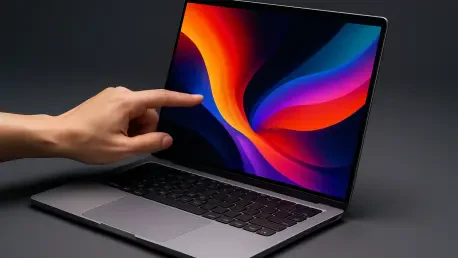
The most historic update in this release is the arrival of touch on the Mac, implemented through a sophisticated “in-cell” integration that avoids the bulk of traditional touch layers. By placing the touch sensors directly within the display panel rather than on top of it, the physical gap between the user’s finger and the pixels is eliminated, resulting in a zero-latency experience. This design choice also prevents the optical degradation that typically occurs when adding a touch digitizer, ensuring that the OLED panel’s clarity and brightness are fully preserved. The touch sensitivity is tuned to recognize subtle pressures and gestures, providing a level of precision that matches the existing trackpad experience. This integration represents a fundamental shift in how the operating system is navigated, allowing users to interact with their content in a more direct and intuitive manner. The engineering required to achieve this without increasing the thickness of the display lid is a testament to the advancements in materials science, particularly in how thin-film transistors and sensing elements are layered within the tandem OLED stack to maintain structural integrity.
System-level gestures have been expanded to include natural scrolling, pinching to zoom, and new window management shortcuts that take full advantage of the expanded screen real estate. Users can now double-tap the display to maximize windows or flick them to the side for instant tiling, making multitasking more fluid than it has ever been on a traditional laptop. These gestures are designed to feel like a natural extension of the macOS interface, reducing the cognitive load required to manage complex workflows involving dozens of open applications. Hardware adjustments were necessary to support this new interaction method, including a redesigned, high-rigidity hinge that prevents the screen from moving when pressure is applied during touch input. This mechanical stability is crucial for maintaining focus, as it ensures that the screen remains exactly where the user puts it, even during vigorous interaction. Software enhancements work in the background to filter out accidental palm touches or peripheral contact, ensuring that only intentional inputs are registered. This meticulous attention to the physical and digital aspects of touch interaction ensures that the feature feels like a core part of the system rather than an afterthought.
Professional Workflow and Interface Tools
The touch interface is designed to augment rather than replace the keyboard and trackpad, particularly for creative professionals who require multiple modes of input. Musicians can now manipulate polyphonic keyboards and sliders in Logic Pro with their fingers, while video editors can use the display for precise range marking and clip manipulation in Final Cut Pro. This multimodal approach allows for a faster and more organic creative process, as users can switch between typing, clicking, and touching depending on the task at hand. For instance, a designer might use the trackpad for fine-tuned cursor movements while using their other hand to zoom in or rotate the canvas directly on the screen. This style of interaction mimics the way professionals work with physical tools, providing a more tactile connection to digital assets. The software ecosystem is already catching up, with specialized API updates that allow developers to create touch-aware interfaces without compromising the density of information required for professional-level software. This ensures that the transition to touch does not lead to a “simplified” or “dumbed-down” version of professional applications, but rather a more capable and flexible one.
Migrating from the iPhone, the Dynamic Island now serves as an interactive hub at the top of the Mac display, providing a centralized location for persistent system information. This feature provides a dedicated space for Live Activities, AirDrop progress, and media playback controls, keeping the user focused on their primary workspace without the need for intrusive pop-up notifications. The Dynamic Island can expand and contract based on the context of the user’s work, offering quick access to secondary controls that would otherwise be buried in menus. For example, during a screen recording session, the island can display the elapsed time and audio levels, allowing for quick adjustments with a simple tap. This integration streamlines the user interface by consolidating high-priority status indicators into a single, cohesive element that feels like a deliberate part of the design. By leveraging the deep blacks of the OLED panel, the island blends perfectly into the top of the display when not in use, only appearing when there is relevant information to convey. This subtle but effective use of screen space demonstrates how hardware and software can be synchronized to improve productivity and minimize distractions in a professional environment.
M5 Series Silicon and AI
The M5 series silicon represents a significant leap in computing performance by integrating advanced artificial intelligence capabilities directly into the architecture of the processor.
Computational Power and Neural Acceleration
The latest MacBook Pro is powered by the M5 Pro and M5 Max chips, which are built on a next-generation architecture specifically optimized for the burgeoning field of artificial intelligence. These chips feature a massive increase in both single-core and multi-core performance, making them exceptionally well-suited for heavy computational tasks like 3D rendering and complex genomic sequencing. The M5 Max, in particular, utilizes a high-bandwidth architecture that allows for the rapid movement of data between the CPU, GPU, and specialized neural components. This architectural efficiency is key to maintaining high performance during sustained workloads, as it minimizes the bottlenecks that often plague traditional laptop processors. By moving to a more advanced fabrication process, the chips deliver more power per watt, allowing for high-performance computing without the excessive heat or power draw that would typically require a much larger machine. This makes the MacBook Pro a formidable tool for scientists, engineers, and developers who need to run simulations or compile massive codebases while on the go, providing a level of performance that was previously reserved for desktop workstations.
A dedicated neural accelerator is integrated into every GPU core, allowing the laptop to run large language models with hundreds of billions of parameters entirely on-device. This shift toward on-device AI processing ensures data privacy and significantly reduces latency for developers using AI coding agents or researchers working with sensitive datasets. By keeping computation local, the system avoids the delays and security risks associated with cloud-based AI services, making it a more reliable tool for professional environments where data integrity is paramount. The GPU also includes third-generation hardware-accelerated ray tracing and dynamic caching to provide photorealistic lighting and shadows in real time. This benefits 3D artists using engines like Unreal or Blender, as well as high-end gamers looking for desktop-class performance in a portable form factor. The synergy between the neural accelerator and the GPU cores allows for advanced features like AI-driven denoising and upscaling, which can significantly speed up the rendering process for visual effects and animation. This localized AI capability transforms the laptop into a powerful node for machine learning development, providing the necessary resources for training and deploying sophisticated models.
A Comprehensive Overview of Modern Digital Memory Capacity and the Technical Limitations of the Storage Ceiling
To support massive AI models and high-resolution video editing, the architecture now supports up to 128GB of unified memory, which is a critical requirement for memory-intensive professional applications. This high-bandwidth memory pool is accessible to all components of the chip, allowing for the seamless transfer of data between the CPU, GPU, and Neural Accelerator without redundant copying. This approach is particularly effective for workflows that involve large datasets, such as 8K video editing or complex architectural visualizations, where the ability to keep everything in memory can drastically improve system responsiveness. The unified memory architecture also benefits AI developers, as it allows for the loading of larger models that would typically require specialized server hardware. By providing this much memory in a laptop, the hardware effectively removes one of the most common barriers to professional productivity, enabling users to keep multiple heavy applications open simultaneously without any performance degradation. This makes the machine more than just a portable computer; it becomes a versatile workstation capable of handling the most demanding tasks in modern digital production.
Storage options have also seen a significant increase, with configurations now reaching up to 16TB of ultra-fast SSD storage, which effectively eliminates the need for many professionals to carry external drives. This high capacity allows users to keep entire project libraries, high-resolution media, and vast databases directly on their machines, providing instant access to their data regardless of location. The speed of these drives ensures that even the largest files can be opened and saved in seconds, minimizing downtime and allowing for a more efficient workflow. For video professionals, this means they can edit multiple streams of raw footage without the stuttering or lag that often occurs with slower storage solutions. The inclusion of such high-capacity storage also reflects the changing needs of the industry, where file sizes continue to grow as resolutions and data complexity increase. By offering a 16TB ceiling, the MacBook Pro provides a future-proof solution for professionals who need to manage massive amounts of data without the logistical headaches of external storage arrays or cloud dependencies. This internal storage capability, combined with the massive memory overhead, solidifies the laptop’s position as a standalone professional hub.
Industrial Design and Efficiency
The Evolution of Modern Device Technology Focuses on Thinner Physical Dimensions and Increasingly Larger Immersive Display Screens
The design team has leveraged the inherent thinness of the OLED stack to reduce the overall weight and physical footprint of both the 14-inch and 16-inch models. The 14-inch model now weighs only 3 pounds, while the 16-inch model has been reduced to 4 pounds, making them the lightest professional laptops in their respective categories for several years. This reduction in weight does not come at the expense of structural integrity, as the chassis continues to be milled from a single block of high-strength aluminum. The thinner profile makes the machines much easier to transport, catering to the needs of professionals who frequently travel or work from various locations. This emphasis on portability is a direct response to the modern workforce’s demand for high-performance tools that do not become a physical burden during a long commute or an international flight. The engineering required to fit such powerful components into an even smaller space is considerable, involving a complete rethink of how internal components are laid out and how the various subsystems interact with the outer shell to provide both protection and cooling.
By shrinking the bezels to their absolute minimum, the actual viewable area of the screens has been increased without growing the physical size of the laptop itself. The 14-inch model now features a 14.2-inch display, and the 16-inch version has been expanded to a 16.3-inch panel, providing more screen real estate for complex software interfaces and detailed creative work. This extra space is particularly valuable for applications with dense toolbars and multiple floating panels, as it allows for a more organized and less cluttered workspace. The increased screen-to-body ratio also creates a more immersive visual experience, drawing the user into their work and minimizing peripheral distractions. This design philosophy focuses on maximizing the utility of every square millimeter, ensuring that the user gets the most possible value out of the device’s footprint. The result is a machine that feels both more compact and more expansive at the same time, a paradox that is only possible through the precise integration of modern display technology and advanced manufacturing techniques. This refinement of the industrial design ensures that the MacBook Pro remains the standard-bearer for professional aesthetics and functionality.
Thermal Management and Battery Life
A completely redesigned thermal architecture ensures that the M5 chips can maintain their peak performance for extended periods without overheating the slim chassis. This system uses a combination of advanced heat pipes and high-efficiency fans that move heat away from internal components with minimal noise, allowing for sustained high-intensity workloads in quiet environments like libraries or recording studios. The thermal management system is also designed to be more intelligent, using an array of sensors to monitor temperatures in real time and adjust the cooling profile based on the specific task being performed. This prevents the “thermal throttling” that often limits the performance of thinner laptops, ensuring that the user gets the full power of the M5 silicon when they need it most. By optimizing the airflow and the heat dissipation surfaces, the hardware can handle the increased thermal output of the high-performance GPU and Neural Accelerator without the need for a bulky or noisy cooling system. This balance of power and silence is a key differentiator for the MacBook Pro, making it a more pleasant tool to use for long stretches of time.
Despite the reduction in thickness, the efficiency of the M5 silicon and the OLED panel delivers up to 24 hours of battery life, representing the longest duration ever seen in a professional Mac. This incredible endurance is made possible by the granular power management of the M5 chips, which can shut down unused cores and components in microseconds to save energy. The OLED display also contributes to this efficiency, as it only uses power to illuminate individual pixels, meaning that dark mode or low-light content can significantly reduce energy consumption. For professionals who are constantly on the move, this means they can work through an entire day and night without ever needing to look for a power outlet. This provides a level of freedom and reliability that is essential for fieldwork, long-distance travel, or back-to-back meetings. The battery chemistry itself has also been improved to provide more charge cycles and better performance in extreme temperatures, ensuring that the laptop remains a dependable partner over the course of its entire lifespan. This focus on efficiency ensures that the machine’s high performance does not come at the cost of its practical utility as a portable device.
Audio and Connectivity Standards
Immersive Sound and Recording Quality
The six-speaker sound system has been completely overhauled with a new woofer design that delivers 50 percent deeper bass, providing a rich and immersive audio experience that is rare for a laptop. These speakers use a force-canceling configuration to prevent vibrations from distorting the sound or shaking the chassis, ensuring that the audio remains clear even at high volumes. For audio professionals, this provides a more accurate representation of their work when they are away from their studio monitors, allowing for rough mixes and sound design on the go. A new “closed-lid audio tuning” feature automatically adjusts the sound profile when the laptop is connected to an external monitor and the lid is closed, maintaining a high-fidelity output by compensating for the change in the physical acoustics of the device. This attention to detail ensures that the audio quality remains consistent regardless of how the laptop is being used, providing a premium experience for both creative work and media consumption. The tweeters have also been redesigned to provide a wider soundstage, making spatial audio content feel more expansive and realistic.
For communication and content creation, the device includes studio-quality microphones with a significantly lower noise floor, allowing for professional-grade voice recordings and crystal-clear video calls. These microphones use advanced beamforming technology to focus on the user’s voice while filtering out background noise, which is essential for remote work in busy environments. The 12MP Center Stage camera is also a major highlight, keeping the user perfectly centered in the frame even as they move around during a call. Enhanced by AI, the camera provides better low-light performance and more natural skin tones, ensuring that the user always looks their best in a professional setting. The integration of the camera and microphone system with the M5’s neural engine allows for real-time background blurring and noise cancellation that is both more accurate and less power-intensive than software-only solutions. This makes the MacBook Pro an ideal tool for the modern professional who relies on video conferencing for collaboration and client presentations, providing a level of quality that matches the high standards of the rest of the hardware.
High-Speed Networking and Ports
The inclusion of three Thunderbolt 5 ports provides massive data transfer speeds and supports up to four external displays on the M5 Max model, making it the ultimate hub for a complex desk setup. These ports offer double the bandwidth of the previous generation, allowing for the connection of high-speed storage arrays, external GPUs, and multiple high-resolution monitors through a single cable. This simplifies the workspace while providing the throughput necessary for the most demanding data-driven tasks. In addition to these modern ports, the device retains the SDXC card slot, HDMI port, and MagSafe 3 charging to ensure compatibility with existing professional peripherals and workflows. This blend of cutting-edge and legacy connectivity is a hallmark of the Pro lineup, acknowledging that professionals often rely on a variety of tools to get their work done. The HDMI port has been updated to support the latest standards, allowing for 8K output at high refresh rates, which is essential for presenting high-resolution video content on external screens.
Wireless connectivity is handled by the new N1 chip, which brings Wi-Fi 7 and Bluetooth 6 to the MacBook Pro for the first time. These new standards provide the fastest possible wireless connections with significantly reduced interference and lower latency, which are critical for tasks like tethered shooting or large file transfers in congested network environments. Wi-Fi 7 allows for much higher peak speeds and better stability, ensuring that cloud-based workflows and remote collaborations are as fast as possible. Bluetooth 6 improves connection quality for wireless peripherals like headphones and mice, providing a more reliable and responsive experience. The N1 chip also handles seamless integration with other devices in the ecosystem, making features like Handoff and Universal Control faster and more robust. This focus on high-speed networking ensures that the MacBook Pro remains a powerful and versatile tool in an increasingly connected world, where the ability to move data quickly and reliably is just as important as the ability to process it. By including the latest wireless standards, the hardware is prepared for the next generation of networking infrastructure and professional accessories.
Software and Sustainability Goals
A Comprehensive Overview of the Integration Between the Upcoming macOS 27 Operating System and Creator Studio Software
The new macOS 27 “Golden Gate” introduces “Liquid Glass” design elements that take full advantage of the vibrant OLED display, featuring translucent windows and deep shadows that create a sense of physical depth. Under-the-hood optimizations for Safari and Spotlight ensure that the operating system feels as fast as the hardware it runs on, with near-instant search results and faster page loading. The software has been specifically tuned for the M5 architecture, allowing for smoother animations and more efficient task scheduling. A new window management system allows for more complex tiling configurations, which is particularly useful when combined with the new multi-touch interface. These refinements are designed to improve the overall user experience by making the system more intuitive and responsive to the user’s needs. The deep integration between the hardware and software is evident in every part of the interface, from the way the colors are calibrated to the way the touch gestures are processed with zero perceived lag.
Apple has also launched Apple Creator Studio, a new software suite optimized for Multi-Touch and M5 performance, providing a unified workspace for creative projects ranging from graphic design to video editing. This application is designed to act as a bridge between different creative disciplines, allowing for a more seamless workflow when moving between various types of media. It takes full advantage of the neural accelerator for features like automatic object removal and AI-assisted color grading, which can significantly speed up the production process. Third-party developers like Adobe, Blackmagic Design, and Maxon have already updated their core applications to support the new touch interface and PROLED XDR display modes, ensuring that professionals have access to their favorite tools from day one. This robust software ecosystem is a key part of the MacBook Pro’s value proposition, as it ensures that the powerful hardware is put to good use by the applications professionals rely on. The launch of Creator Studio represents a renewed commitment to providing first-party tools specifically designed for the latest hardware innovations, further solidifying the company’s position in the creative market.
Environmental Impact and Materials
In line with the 2030 carbon-neutral goal, the latest MacBook Pro is composed of 55 percent recycled content, which is a significant increase over previous generations. This includes 100 percent recycled aluminum in the enclosure and 100 percent recycled cobalt in the battery, demonstrating a commitment to reducing the environmental impact of the manufacturing process. The first-of-its-kind use of 100 percent recycled tantalum in the capacitors highlights the ongoing efforts to find sustainable alternatives for even the smallest and most complex components. By focusing on the entire life cycle of the product, the company is working to ensure that the high performance of its machines does not come at an unacceptable cost to the planet. These material choices are backed by a rigorous certification process, ensuring that the recycled content meets the same high standards for durability and performance as virgin materials. This approach allows for the creation of a premium product that is also environmentally responsible, catering to the values of a modern professional workforce that increasingly prioritizes sustainability in its purchasing decisions.
Manufacturing processes now utilize 45 percent renewable electricity, and the packaging is entirely fiber-based, eliminating all plastic wraps and moving closer to the goal of removing plastic from all product packaging by the end of the decade. This transition to fiber-based packaging is not only better for the environment but also provides a more premium unboxing experience, with custom-molded inserts that protect the device without creating unnecessary waste. The supply chain has also been optimized to reduce the carbon footprint of shipping and logistics, with a greater emphasis on using low-emission transportation methods. These efforts are part of a broader strategy to become carbon neutral across the entire business, from the design and manufacturing of products to their end-of-life recycling. By setting these ambitious goals and reporting on progress in detail, the company provides a model for how the tech industry can address the challenges of climate change while continuing to innovate and produce world-class products. This focus on sustainability is woven into the very fabric of the MacBook Pro, making it a machine that users can feel good about owning and using for their most important work.
Market Positioning and Availability
Pricing Tiers for Professional Users
The 14-inch M5 Pro model starts at $2,899, while the 16-inch M5 Pro begins at $3,399, reflecting the significant investment in new technologies like Tandem OLED and Multi-Touch. For those requiring the ultimate performance of the M5 Max, prices start at $4,499 and $4,799 respectively, positioning these machines as premium tools for the most demanding professional users. While these prices represent an increase over previous models, they are justified by the inclusion of features that were previously only available in much more expensive, specialized equipment. For many professionals, the ability to have a reference-grade display, high-end touch interaction, and massive on-device AI power in a single portable device provides a value proposition that easily outweighs the initial cost. The various configuration options allow users to tailor the machine to their specific needs, whether they require more memory for AI development or more storage for video production. This flexible pricing structure ensures that there is a MacBook Pro for a wide range of professional roles, from independent creators to large-scale enterprise teams.
Pre-orders for the new lineup began on October 28, with global availability following shortly after on November 6, ensuring that the latest technology is available for users in time for the busy end-of-year season. To support professional users, a new support plan called AppleCare One has been introduced, which covers multiple devices under a single subscription and provides prioritized technical support and on-site repair options. This new plan is designed to minimize downtime for professionals who rely on their gear to make a living, providing a more comprehensive and streamlined service experience. The trade-in program has also been expanded, allowing users to receive significant credit for their previous machines, which helps lower the barrier to upgrading to the latest technology. This ecosystem of support and purchasing options makes it easier for professionals to stay at the cutting edge of the industry, ensuring that they always have the best tools for their work. The launch is backed by a global retail presence that allows users to experience the new touch interface and PROLED XDR display in person before making a purchase, providing the hands-on verification that many professional buyers require.
Establishing a Comprehensive New Industry Standard for High-Performance Professional Computing and Advanced Enterprise Technology Solutions
The launch of the latest MacBook Pro demonstrated that hardware-software synergy remains the defining characteristic of professional tools in the late 2020s. By integrating tandem OLED technology and on-device neural acceleration, the company provided a clear path for developers seeking to implement complex AI features without relying on cloud-based infrastructure. This shift addressed long-standing concerns regarding data privacy and latency in professional environments, allowing for a more secure and efficient creative process. The introduction of Multi-Touch on the Mac was executed with a focus on professional utility, avoiding the pitfalls of consumer-grade overlays in favor of a zero-latency, high-precision system that enhances existing workflows. This approach ensured that the feature was a meaningful addition to the platform rather than a mere novelty. The decision to prioritize both portability and raw power reflected a deep understanding of the modern professional’s needs, providing a versatile machine that can handle the most demanding tasks in any environment.
Moving forward, the industry will likely see a broader adoption of tactile interfaces and localized AI in traditional computing form factors as the distinction between creative tablets and high-performance workstations continues to blur. The MacBook Pro with the PROLED XDR Display has effectively established a new gold standard for the industry, pushing competitors to reconsider their own approaches to display technology and user interaction. For professionals, the next steps involve exploring how these new capabilities can be integrated into their daily routines to improve productivity and unlock new creative possibilities. Whether through the use of touch for more organic sound design or the leverage of the neural accelerator for real-time data analysis, the tools are now in place to redefine what is possible in portable computing. This release was more than just a successful product launch; it was a foundational update that prepared the platform for the next decade of professional innovation, ensuring that the Mac remains the primary choice for those who demand the very best from their technology.