
Nia Christair is a powerhouse in the mobile technology sector, bringing a wealth of experience that spans the entire lifecycle of a device. Her background in hardware design and enterprise mobile solutions gives her a unique perspective on the intersection of portability and power management. Whether she is advising on high-performance mobile gaming setups or developing robust app ecosystems, Nia understands that the most sophisticated piece of technology is only as good as its remaining battery life. Her deep technical knowledge makes her the perfect expert to help us navigate the anxiety-inducing moments when we find ourselves miles away from a wall outlet without our primary power brick.
In this conversation, we explore the versatile world of USB-C technology and the practical ways users can keep their laptops running using unconventional power sources. We delve into the critical differences between phone chargers and laptop requirements, the unexpected utility of gaming console adapters, and the specific technical benchmarks one must look for in a high-capacity power bank. Nia explains the nuances of Power Delivery standards and provides a roadmap for streamlining a tech kit to ensure you are never truly disconnected, even when your main charger is left behind.
How can users effectively utilize their existing smartphone accessories when they realize they have accidentally left their primary laptop power adapter behind?
The immediate realization that your laptop is dying and its dedicated power brick is sitting miles away can be incredibly stressful, but the commonality of USB-C has changed the game for the better. While it is technically possible to use a phone charger, you have to understand the power dynamics involved, as most standard phone blocks only output between 5W and 20W. In contrast, even a modest laptop typically requires a minimum of 45W to charge with any degree of efficiency or to simply maintain its current battery level during use. If you plug in a low-power phone cord while the laptop is running, you might notice the battery percentage continues to drop, albeit at a much slower rate, or simply remains stagnant. For the best results in this pinch, I suggest powering the laptop down completely; this allows that small 5W to 20W trickle to actually replenish the cells without the hardware competing for every milliamp. It is also worth noting that if you are carrying a lightweight ultrabook or a Chromebook, these devices are much more forgiving and can often survive on those lower-wattage phone chargers much better than a high-performance workstation would.
Beyond the standard smartphone charging block, what other common household or gaming gadgets might serve as a surprising lifeline for a dying laptop battery?
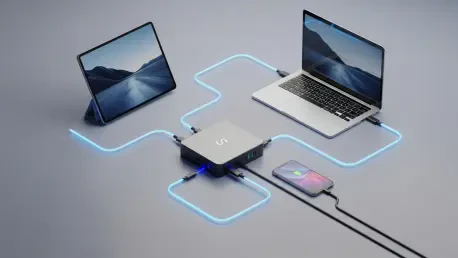
When you are scrounging through your bag or looking around a friend’s house, you should keep an eye out for high-powered USB-C peripherals belonging to other electronics, as they often pack more punch than a standard phone adapter. For instance, many tablet power bricks are designed to output 30W or more, which provides a significantly faster trickle charge for a computer than a basic phone block ever could. One of the most surprising heroes in this scenario is the Nintendo Switch charger, which outputs a respectable 39W and is often enough to keep a mid-range laptop alive while you finish your work. To make these alternative sources work effectively, I always recommend keeping a high-quality cable that supports Power Delivery, or PD, such as the UGREEN USB-C PD 240W cable. Seeing that charging icon flicker to life on your screen when using a gaming console’s power cord provides a massive sense of relief, proving that the move toward universal charging standards is a massive win for consumer convenience.
For those who find themselves working off the grid, what specific technical benchmarks must a portable power bank meet to effectively revive a modern laptop?
Charging a laptop from a portable battery is a completely different beast than topping off a smartphone, and you really need to look at two specific numbers to ensure you aren’t just carrying around a heavy paperweight. First, the power bank must have a USB-C PD port that is capable of outputting at least 45W to meet the baseline demand of most modern portable computers. Second, capacity is king; you should look for a “hefty” unit with at least 20,000mAh, though something like the INIU 140W battery bank with its 27,000mAh capacity is much better suited for a full recharge. In my professional experience, trying to use a standard small-capacity bank is a lesson in futility because the laptop will likely drain the bank’s entire reserve before it even gains a 10% charge. When you have the right combination of high wattage and high capacity, you gain a sense of freedom, knowing that you are no longer tethered to a wall or limited by the bulky brick that came in the box.
What is your forecast for the future of universal charging standards?
I believe we are rapidly approaching a reality where the “original charger” becomes a relic of the past, as the industry standardizes around high-wattage USB-C ecosystems that serve every device from your wireless earbuds to your high-end workstation. We are going to see a shift where consumers stop buying a new power brick with every device, instead investing in a single, high-capacity 240W PD cable and a 20,000mAh or higher battery bank that handles everything. This transition will not only reduce electronic waste but will also eliminate that frantic messenger-bag-search for a specific proprietary cable, making the “dead laptop” crisis a much rarer occurrence in our professional lives. Within the next few years, the distinction between a “phone charger” and a “laptop charger” will likely vanish entirely, leaving us with a truly unified power experience.