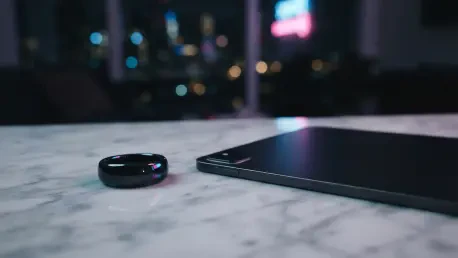

A tap-and-hold gesture on the Modstrip simplifies the process of switching active connections between various paired devices like laptops and smart television sets. This level of seamless integration marks a departure from the conventional dependence on physical docking stations or manual Bluetooth re-pairing sequences. As modern professionals and creative specialists increasingly move between diverse hardware environments, the need for a unified input method has become a central challenge in ergonomic design. The Prolo Ring addresses this demand by condensing the core functionality of high-performance peripherals into a compact, finger-mounted form factor. Constructed from a lightweight polycarbonate with a refined metallic finish, the device weighs between 4.1 and 5.2 grams, ensuring that users can maintain high productivity without the strain associated with traditional desktop mice. By placing a spacious 18 by 30 millimeter capacitive touch surface directly on the thumb’s natural path, the hardware effectively bridges the gap between tactile feedback and digital precision.
Versatile Operational Modes: Redefining User Control
At the core of this technological shift lies the proprietary Modstrip, a top-mounted interface that enables users to cycle through four distinct operational states: Cursor, Navigation, Touch, and Air. Each mode is specifically calibrated to handle different digital scenarios, from standard desktop pointing to immersive gesture-based interactions. The Cursor mode provides the high-fidelity tracking required for detailed graphic design or spreadsheet management, while the Navigation mode optimizes the experience for media consumption and web browsing. Furthermore, the Touch and Air modes expand the peripheral’s utility into the realms of mobile operating systems and augmented reality headsets. This versatility ensures that a single wearable device can replace multiple specialized controllers, reducing the physical footprint of a workspace while maintaining a consistent user experience across platforms. The implementation of these modes reflects a broader trend in 2026 toward software-defined hardware that adapts to the specific needs of the professional user.
A significant innovation that distinguishes this wearable from its predecessors is the Joystick Assist feature, which introduces a new logic for cursor movement on small surfaces. Traditional trackpads often require repetitive swiping motions to move a cursor across expansive high-resolution displays, leading to thumb fatigue over extended periods. In contrast, this feature allows for continuous cursor movement when a user swipes and holds their thumb against the edge of the capacitive trackpad. The speed of the movement is dynamically adjusted based on the distance between the thumb and the center of the surface, mimicking the responsive feel of an analog joystick within a touch-sensitive interface. This design choice effectively resolves the spatial limitations inherent in ring-based controllers, providing a level of fluidity that was previously exclusive to full-sized desktop mice. By prioritizing these ergonomic considerations, the device establishes a new standard for how micro-input technologies handle complex navigation tasks with minimal physical effort.
The Pro Edition of this wearable controller unlocks a deeper layer of professional productivity through the dedicated Prolo Studio application. This software suite empowers advanced users to configure over 40 customizable gestures, macros, and shortcuts tailored to specific digital workflows. For instance, creative professionals can map complex timeline scrubbing or tool selection directly to a series of thumb taps, significantly accelerating high-end production processes. Beyond tactile control, the hardware incorporates push-to-talk functions for immediate voice-to-text dictation and seamless interaction with AI assistants. By storing multiple hardware profiles internally, the device allows for consistent performance across Windows, macOS, Linux, and mobile operating systems without the need for manual re-pairing. This cross-platform consistency is essential for the hybrid work models that define the current landscape, turning the finger-mounted ring into a unified command center for any ecosystem.
Adopting this wearable technology required a proactive approach to reimagining the modern workstation. Organizations that transitioned to these compact controllers found that workspace clutter was drastically reduced, allowing for more flexible office layouts and enhanced mobility. To maximize the benefits of this shift, IT departments focused on integrating the specialized software into enterprise environments, ensuring that employees could leverage custom macros for specialized tasks. Future considerations for developers involved expanding the gesture library to include more complex spatial movements for three-dimensional modeling and virtual reality environments. The success of these devices hinged on the user’s willingness to move away from legacy peripherals and embrace a minimalist, gesture-oriented lifestyle. As the industry continued toward more discreet solutions, the lessons learned from this generation of rings provided a clear roadmap for next-generation interfaces. Stakeholders prioritized the refinement of battery density to further enhance resilience.