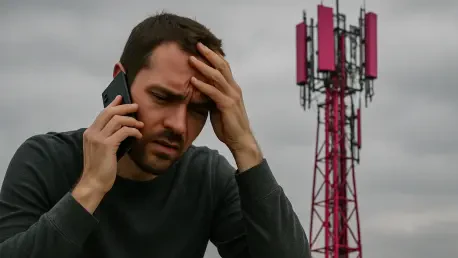

Business operations in major tech corridors like Los Angeles are being hampered by a sudden and unexplained lack of mobile internet, forcing many to rely solely on local Wi-Fi networks. This abrupt disconnection has rippled across the nation, turning routine digital interactions into logistical hurdles for millions of subscribers who anticipate seamless connectivity as a baseline standard. As the number of reported service interruptions climbs into the tens of thousands, the narrative surrounding the carrier has shifted from one of minor maintenance glitches to a broader discussion regarding infrastructure reliability. The dependency on mobile data for everything from navigation to financial transactions means that even a temporary lapse creates significant economic and social friction. Observations from various monitoring platforms indicate that this is not merely a regional hiccup but a systemic event that challenges the perceived robustness of modern 5G networks. For many, the frustration stems not just from the silence of their devices, but from the lack of immediate clarity regarding the timeline for a full restoration.
Major Metropolitan Areas Hit the Hardest
The scope of the current disruption is most visible within the nation’s primary urban centers, where the density of users amplifies the consequences of any network instability. In New York City and Chicago, subscribers have reported a total evaporation of cellular signals, with mobile devices frequently defaulting to “SOS” mode. This specific status indicates that while the device can see other available networks for emergency services, the primary carrier’s authentication and data routing systems are effectively unreachable. Such a concentrated failure in high-traffic markets suggests that the problem likely resides within core network hubs or regional switching centers rather than isolated cell towers. When massive swaths of a metropolitan area lose connectivity simultaneously, it points to a breakdown in the software-defined networking layers that manage traffic distribution across the vast 5G landscape. These hubs are critical for maintaining the handoffs between towers, and any failure at this level can paralyze the entire local ecosystem.
Extending beyond the East Coast, the technical turmoil has hit major Texas metropolitan areas like Houston and Dallas with surprising intensity, sparking a wave of digital complaints. For residents in the Lone Star State, this event carries a stinging sense of repetition, as similar widespread issues occurred just weeks prior, leading to concerns about the long-term stability of the regional infrastructure. The geographic spread, reaching as far as Philadelphia and Detroit, confirms that the outage is a multi-region crisis that defies simple localized explanations. It highlights a potential vulnerability in how the carrier routes data through its central gateway systems, which are supposed to provide redundancy in the event of a localized failure. The fact that secondary and tertiary markets are feeling the squeeze alongside the primary hubs suggests a cascading effect where the failure of one central component triggers a logjam elsewhere. This leaves millions of commuters and remote workers struggling to find alternatives in an era where persistent mobile access is often treated as a vital utility.
Technical Symptoms and Recent Network History
The technical symptoms experienced by users were remarkably diverse, illustrating a complex failure that affected multiple layers of the communication stack simultaneously. While some individuals reported a complete “no signal” notification, others found themselves in a digital limbo where signal bars were visible, yet data packets failed to move, and outgoing texts remained perpetually stuck in a sending state. This disparity in symptoms often indicated a failure in the IP Multimedia Subsystem or the Home Subscriber Server, which are the databases responsible for managing user identities and authorizing service sessions. When these backend systems became congested or unresponsive, the phone believed it had a physical connection to a tower, but the network refused to acknowledge the device’s requests for data or voice services. This specific type of “zombie” connection was often more frustrating for the consumer than a total blackout because it provided a false sense of functionality while essentially leaving the device useless for actual communication.
Contextualizing this event requires looking back at the carrier’s recent performance history, which was marred by several high-profile incidents that eroded consumer confidence. Specifically, a massive nationwide outage on July 27 served as a haunting predecessor to the current situation, as that event also saw a rapid spike in reports that took several hours to resolve. The reoccurrence of such a large-scale failure within a short timeframe raised serious questions about whether the initial patches were merely temporary fixes or if the network struggled with deeper integration issues. As the company continued to upgrade its 5G core to handle higher capacities, the complexity of these software-driven networks increased the surface area for potential errors. Maintaining a legacy 4G backbone while simultaneously rolling out advanced 5G standalone architecture created a hybrid environment where a small configuration error had a disproportionate impact. These recurring themes of instability suggested that the push for faster speeds often came at the expense of consistent reliability.
Tracking the Outage and Finding Solutions
In the absence of immediate official updates from the service provider, many users turned to crowdsourced monitoring platforms to gauge the severity of the situation. Digital tools like Downdetector provided a real-time heatmap of service failures, often reflecting the reality on the ground much faster than corporate PR channels responded. This data-driven approach allowed the public to identify whether a problem was unique to their hardware or part of a broader trend, offering a sense of community-driven clarity during a blackout. While these platforms were not official, they served as a vital early-warning system that helped businesses and individuals make informed decisions about pivoting to alternative communication methods. Watching the report count climb into the thousands provided a visceral look at how quickly a digital network faltered, prompting many to reconsider their reliance on a single carrier. This transparency, fueled by user-submitted data, became an essential part of navigating the modern technological landscape when traditional support channels were overwhelmed.
While the carrier’s engineering teams worked toward a full resolution of the underlying issues, several practical strategies emerged to mitigate the impact on daily operations. One of the most effective workarounds involved the activation of Wi-Fi calling, a feature that bypassed the traditional cellular infrastructure by routing voice and text traffic through a local internet connection. This allowed individuals with access to fiber or cable-based networks to remain reachable even while the cell towers remained unresponsive. Furthermore, the practice of toggling airplane mode or performing a hard restart of the device proved necessary as the network began to stabilize, forcing the phone to re-authenticate with the system. Looking ahead, these events suggested that a more robust strategy for mobile redundancy, such as maintaining a secondary eSIM from a different provider, became a standard precaution. Ultimately, the industry moved toward prioritizing network hardening to ensure that future upgrades did not come at the cost of essential service continuity.