
Hidden beneath the turquoise waters of the Red Sea lies a vulnerable network of glass fibers that currently serves as the primary nervous system for the digital economy of Europe. This narrow maritime passage carries a staggering 90% of all data traffic between European hubs and Asian markets, creating a precarious dependency on one of the most volatile regions on Earth. As regional conflicts intensify and the threat of physical interference grows, the European Union has recognized that its digital existence is tethered to a single, fragile point of failure.
The Geopolitical Chokepoint: Beneath the Red Sea
The current reliance on the Suez Canal and the Gulf of Aden for telecommunications infrastructure has become an unacceptable strategic liability for Brussels. In an age where digital connectivity is as essential as electricity, the constant risk of sabotage or accidental damage in these congested waters looms large over the continent. The influence of regional actors and the potential for arbitrary taxation or surveillance by unfriendly regimes further complicate this reliance, pushing European leaders to seek a radical alternative.
By prioritizing a northern shift, the EU is effectively attempting to insulate its data flows from the unpredictability of the Middle East. The existing southern routes are not only physically crowded but are also subject to the shifting political whims of transit nations that may not share European values regarding data privacy and open access. This geographic vulnerability has catalyzed a move toward the Arctic, where the challenges are environmental rather than purely political.
Why Digital Sovereignty: Demands a Northern Shift
Achieving true digital sovereignty requires more than just local data centers; it necessitates the control of the physical pathways that transport information across the globe. Relying on transit routes that skirt the borders of Iran or traverse Russian landmasses introduces risks that European policymakers are no longer willing to tolerate. The “Polar Connect” initiative is born out of this necessity to decouple European communications from infrastructure that could be weaponized by the Kremlin or disrupted by non-state actors in the south.
Moreover, the shift toward the Arctic represents a proactive defense against the “splinternet,” where global data flows are fragmented by geopolitical rivalries. By establishing a route that remains largely within the jurisdiction of democratic allies and international waters, the EU ensures that its connectivity remains robust even during times of heightened global tension. This strategic move signals that Europe is ready to invest in its own independence, rather than remaining a passive user of risky transit corridors.
The Architecture: Of the Polar Connect Initiative
The technical blueprint for this northern data highway involves laying massive subsea cables across some of the most remote parts of the planet to link Scandinavia with Japan and South Korea. One primary route under consideration is the Northwest Passage, which would utilize Canadian waters to create a Western-aligned corridor, while another ambitious path suggests a direct traversal of the North Pole. These routes promise the lowest possible latency for international communications, providing a competitive edge for European financial and tech sectors.
Financing such a gargantuan task requires a collective commitment of approximately €2 billion, with the goal of having the network fully operational by 2030. This investment is not merely about speed; it is about creating a “clean” route that bypasses Russian territory entirely. By avoiding the land-based cables that cross the Russian Federation, the EU can guarantee that its data is protected from the sophisticated electronic warfare and surveillance capabilities of the Russian state.
Navigating the Physical: Hazards of the High North
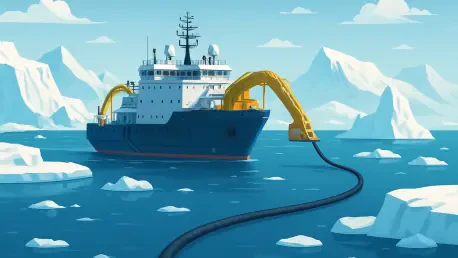
Securing data in the Arctic is a battle against the elements, as the frozen frontier presents obstacles that are vastly different from the sandy floors of the Mediterranean. The phenomenon of “ice scour” remains a primary concern, where the deep-reaching hulls of massive icebergs can drag along the seafloor and snap fiber-optic lines with ease. Lessons from early projects in Alaska have shown that without deep burial and specialized shielding, the environment can be just as destructive as any geopolitical adversary.
The logistical complexity of maintaining these cables is equally daunting, as repair operations in the high Arctic are restricted by seasonal windows. In the event of a cable break during the dead of winter, specialized ice-breaking vessels must be deployed, often at a staggering cost and with significant delays. However, a strange irony of the current era is that thinning polar ice, while a global climate disaster, has made these northern maritime passages more accessible for cable-laying and maintenance than ever before.
A Framework: For Building Resilient Digital Infrastructure
To mitigate the inherent risks of the Arctic environment, engineers are developing advanced deep-burial techniques that tuck the cables into trenches far beneath the reach of shifting ice. This physical hardening is complemented by a mesh network strategy, ensuring that if one segment of the Arctic line is damaged, data can be instantly rerouted through redundant paths. This level of resilience is essential for a network that aims to provide the backbone for Europe’s digital future over the next several decades.
Collaborative financing models between EU institutions and private telecommunications firms have already begun to distribute the financial burden of the €2 billion price tag. Beyond the hardware, new sovereignty protocols were established to ensure that all data traversing these northern paths remained under strict legal protections. These frameworks prioritized long-term autonomy, ensuring that the icy expanse of the north became a permanent sanctuary for the continent’s most sensitive digital assets.