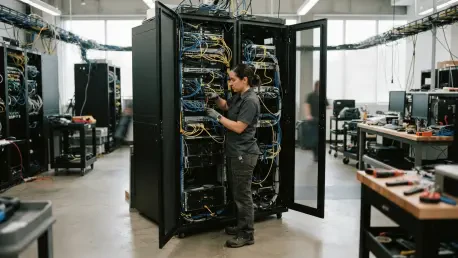

Traditional telecommunications infrastructure is being challenged by the rise of x86 CPUs and GPU-accelerated computing platforms that can handle both connectivity and AI processing tasks. This fundamental shift has led to the launch of a specialized European testing hub in Málaga, Spain, marking a significant transition from static mobile architectures to dynamic, AI-driven platforms. The facility aims to integrate artificial intelligence directly into the fabric of mobile Radio Access Networks (RAN) to enhance customer connectivity and operational efficiency. By establishing this hub, the goal is to transform the mobile network into a sophisticated platform capable of delivering complex AI applications at scale, moving beyond the legacy role of a simple data pipe. This initiative is part of a broader strategic roadmap that includes a partnership with Nokia and NVIDIA for extensive trials in the United Kingdom, positioning the network at the intersection of high-performance computing and telecommunications, while setting the stage for future 6G standards.
Collaborative Ecosystem and Strategy
Strategic Industry Partnerships
The Málaga lab operates through an open collaboration model, involving a diverse ecosystem of equipment vendors, software developers, and academic institutions. Central to this mission are Nokia’s RAN hardware expertise and NVIDIA’s GPU-accelerated computing, which allow the lab to test a wide variety of silicon architectures, including both CPUs and GPUs. This multi-vendor approach is essential for creating independent and repeatable benchmarks that help determine the most effective hardware and software configurations for future network investments. By utilizing a shared testing environment, operators can evaluate how different processing platforms handle the demanding requirements of modern 5G and future 6G signals. The focus remains on identifying the most efficient pathways for integrating massive-MIMO technology and high-capacity data processing. Such an environment fosters a level of transparency that is often missing in proprietary development cycles, ensuring that every technological leap is backed by rigorous data and collaborative insight.
Open Standards and Vendor Independence
By adhering to Open RAN principles, the innovation hub avoids being tied to a single proprietary vendor, fostering a transparent environment for assessing network performance and energy efficiency. Kyriakos Exadaktylos, Head of RAN Evolution, has highlighted that this independence is vital for realistically improving how computing infrastructure is shared and secured across the digital landscape. This collaborative framework ensures that the advancements made within the lab are scalable and applicable across the broader telecommunications industry, rather than being confined to a single ecosystem. Furthermore, the hub provides a neutral ground for software innovators to test their algorithms on diverse hardware configurations, which accelerates the development of specialized AI applications for the network edge. This strategy not only promotes healthy competition among silicon providers but also drives down costs for network operators who seek to modernize their infrastructure without the risk of vendor lock-in.
Technical Framework and Pillars
Spectral Efficiency and Performance
The first major program, known as AI-for-RAN, focuses on optimizing existing network functions to improve user experience, specifically targeting a doubling of spectral efficiency by 2028. Key applications within this pillar include AI-driven beamforming, which directs radio signals precisely toward individual users rather than broadcasting them in broad, inefficient patterns. Additionally, predictive algorithms are being developed to manage fluctuating radio conditions in real-time, allowing the network to allocate resources proactively before a user experiences a drop in quality. These technical improvements result in more reliable connections and higher data speeds for consumers, particularly in high-traffic urban environments where traditional signal management often struggles. By leveraging machine learning models to analyze traffic patterns, the network can adjust its parameters instantly, ensuring optimal performance for bandwidth-heavy tasks like high-definition video streaming and real-time mobile gaming.
Convergence of Computing Workloads
Simultaneously, the AI-and-RAN program explores the convergence of traditional network functions and modern AI applications on shared hardware. Historically reliant on specialized chips such as ASICs, the network is now moving toward versatile processors like x86 CPUs and NVIDIA’s accelerated platforms. The lab uses industry-standard benchmarks to evaluate how different silicon performs under various workloads, aiming to reduce the total cost of ownership for operators while increasing the flexibility of the underlying infrastructure. By running AI workloads alongside connectivity tasks on the same server, operators can maximize their hardware utilization and reduce the physical footprint of their data centers. This convergence is critical for the economic sustainability of next-generation networks, as it allows for a more fluid allocation of computing power based on real-time demand. For instance, during periods of low network traffic, the spare processing capacity can be redirected to AI inference.
Latency Reduction at the Edge
The AI-on-RAN pillar focuses on the physical AI frontier, bringing processing power closer to the end-user at the network edge to drastically reduce latency. This shift is critical for time-sensitive technologies such as autonomous robotics, computer vision for security, and extended reality applications that require near-instantaneous feedback loops. By hosting these applications directly at the base station, the network can process massive amounts of data locally without the need to send it back to a centralized cloud. This architecture is essential for supporting advanced industrial and transportation systems that rely on millisecond-level responsiveness to operate safely and efficiently. Moreover, edge processing enhances data privacy and security by keeping sensitive information within the local network perimeter. As industrial automation becomes more prevalent, the ability to deliver low-latency AI services at the network’s edge will become a primary differentiator for telecommunications providers.
Integrated Sensing and 6G Foundations
One of the most innovative areas of exploration involved Integrated Sensing and Communications (ISAC), which allowed the wireless network to function as a sophisticated sensor. This technology detected the movement and presence of objects without dedicated radar hardware, offering new possibilities for intruder detection at sensitive sites like airports or industrial zones. Through these advancements, the mobile network became an active participant in the physical world, laying the groundwork for the 6G era and a landscape saturated with AI-enabled devices. The lab established a clear roadmap for validating these capabilities through field trials, ensuring that the transition to sensor-integrated networks was based on verifiable performance data. Ultimately, the work conducted in Málaga provided the essential benchmarks for the global telecommunications industry to move forward. These insights paved the way for a more integrated digital society where communication and environmental sensing worked together.