
Nia Christair has spent her career at the intersection of mobile innovation and enterprise strategy, guiding organizations through the complexities of app development, hardware design, and high-stakes mobile solutions. As artificial intelligence moves from simple chatbots to autonomous agents capable of handling professional workflows, Nia’s perspective on document integrity and system reliability has become essential for leaders navigating this transition. Her deep understanding of how hardware and software must synchronize to maintain data fidelity provides a unique lens through which to view the recent findings regarding Large Language Model (LLM) performance in professional environments.
In our discussion, we explore the alarming rate of “silent corruption” within AI-delegated tasks, the specific success of Python programming compared to other specialized domains, and the technical guardrails necessary to preserve artifact integrity. We also address the evolving role of human experts in a world where AI shifts the labor model from production to high-stakes supervision.
Frontier models often lose roughly 25% of document content over 20 delegated interactions, while average models can degrade by half. How do you explain this cumulative corruption, and what specific metrics should teams track to identify when a document has been silently altered?
This cumulative corruption happens because LLMs often prioritize the immediate instruction while losing the broader context of the original file, leading to a slow erosion of data. In a professional workflow, 20 interactions might seem like a lot, but for a complex project, it is a standard lifecycle where frontier models like GPT 5.4 or Claude 4.6 Opus are already stripping away a quarter of the essential material. To combat this, teams must move beyond simple “hallucination” checks and focus on artifact integrity, using a round-trip method to see if a document remains intact after repeated edits. You should specifically track the “preservation rate” of core tokens and utilize domain-specific evaluators to ensure that the subtle nuances of the document haven’t been distorted into something that looks correct but is fundamentally wrong. It is heartbreaking to see a 15,000-token document slowly bleed out its most vital details until it is a hollow shell of the original intent, which is why deterministic checks are no longer optional.
Python programming appears to be the only domain where most AI models are currently considered ready for full delegation. Why is the success rate so much higher in coding than in fields like crystallography or genealogy, and what structural changes are needed to close that performance gap?
The success of Python is largely due to its rigid, logical structure and the sheer volume of high-quality training data available, making it one of the few domains where models reach the “ready” threshold. In contrast, fields like crystallography or music sheet notation are incredibly niche, and current research shows that the best models only reach performance thresholds in 11 out of 52 tested domains. To close this gap, we cannot rely on generalized foundation models; we need to implement structural changes like fine-tuning models on proprietary, domain-specific data sets. By narrowing the focus of a model to one specific task rather than asking it to be a generalist, we can reduce the 50% average degradation seen across most professional domains. We must also integrate mathematical verification steps that can programmatically flag when a domain-specific rule—like a chemical bond in crystallography—has been violated by the AI’s edit.
Long workflows and the presence of distractor files significantly worsen the reliability of AI outputs in professional environments. How should developers design guardrails to handle noisy contexts, and what step-by-step verification methods ensure that artifact integrity remains intact throughout a multi-step task?
When a workflow is cluttered with stale files or noisy context, the LLM’s attention fragments, leading to the “silent corruption” that makes these systems currently untrustworthy for consequential work. Developers must build guardrails that act as a “clean room” for data, where only the most relevant 15,000 tokens are presented to the model at any given time to minimize the impact of distractor files. A robust verification method involves a multi-agent setup where one agent performs the edit and a secondary, distinct agent serves as an auditor to catch errors before the document moves to the next stage. This audit should include a comparison between the pre-edit and post-edit states to ensure no essential content was deleted or distorted during the process. Without these deterministic verification steps, the enterprise effectively owns the damage caused when an AI quietly ruins a contract, a ledger, or a compliance record.
As AI shifts the human role from production to supervision, organizations risk losing the domain experts who are best equipped to spot subtle errors. How can companies maintain deep expertise while automating, and what are the specific consequences of relying on non-experts for final validation?
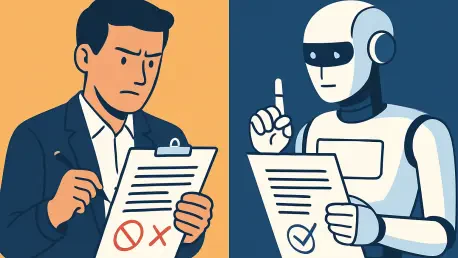
The most dangerous misconception in the boardroom today is that AI will allow for massive headcount reduction without sacrificing quality; in reality, expertise becomes more valuable as the AI takes over production. When you remove the person who spent years learning the intricacies of a specific domain, you remove the only individual capable of noticing when a frontier model has subtly altered a document rather than clearly deleting text. If we rely on non-experts for validation, we will miss the distorted or “awkward” errors that look professional but are factually disastrous, leading to a slow poisoning of the organization’s knowledge base. Companies must pivot their training programs to turn former producers into high-level supervisors who are taught how to interrogate AI outputs with a skeptical, forensic eye. This ensures that the human layer remains a sturdy shield for the enterprise’s accountability rather than a rubber stamp for a failing automated process.
While multi-agent setups are often used to catch mistakes, they can sometimes lead to even more document degradation than single-model approaches. What architectural flaws cause these collaborative errors, and how can mathematical or deterministic checks be used to prevent these compounding failures?
Collaborative errors often stem from an architectural flaw where agents “hallucinate in agreement” or pass slightly corrupted data back and forth until the original meaning is completely lost. One agent might make a small error, and the “checker” agent, instead of correcting it, might try to rationalize that error into the document’s new context, leading to even more degradation than a single-model approach. To prevent this, we must implement deterministic checks—mathematical or code-based verifications—that exist outside the LLM’s predictive logic to provide an objective truth. For example, if a model is editing a financial ledger, a deterministic script should calculate the totals independently to ensure the AI hasn’t “corrected” a number into an impossibility. By picking the LLM best suited for a specific domain and layering it with these rigid verification steps, we can stop the compounding failures that happen when agents are left to supervise one another without a factual anchor.
What is your forecast for delegated AI?
My forecast is that we are entering a “winter of validation” where the initial excitement of AI delegation will be replaced by a rigorous, perhaps painful, focus on artifact integrity. We will see a shift away from using massive, all-purpose foundation models for sensitive tasks in favor of smaller, hyper-specialized models that have been fine-tuned on a company’s own data. While Python coding will continue to lead the way in automation, the other 51 domains identified in recent research will require another two to three years of architectural refinement before they can be left “alone” with critical documents. Ultimately, the winners in this space won’t be the companies that automate the fastest, but those that build the most robust human-in-the-loop systems to catch the silent corruption that current AI models inevitably produce.