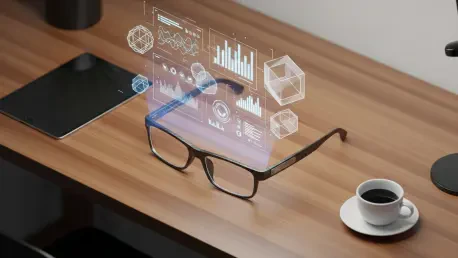

The rapid evolution of spatial computing hardware has reached a pivotal moment where bulky headsets are no longer the industry standard for high-performance immersive experiences in professional environments. This shift is perfectly exemplified by the arrival of the URXR One, a device that prioritizes wearer comfort without sacrificing the high-fidelity visual output required for complex digital workflows. By focusing on a form factor that closely mirrors traditional eyewear, the designers at Unseen Reality managed to condense advanced optical systems and sensor arrays into a frame that weighs significantly less than traditional enterprise headsets. This development addresses the primary complaint of long-term fatigue which has historically hindered the widespread adoption of augmented reality in daily office tasks. Consequently, the glasses offer a seamless transition between physical and digital spaces, providing users with a persistent overlay of information.
Optical Engineering: Design and Comfort
To achieve such a slim profile, the URXR One utilizes state-of-the-art micro-OLED technology combined with specialized pancake lenses that minimize the distance between the display and the eye. This optical configuration ensures that images remain sharp across the entire field of view, eliminating the blurriness often found at the edges of older holographic displays. The clarity is further enhanced by a high refresh rate that reduces motion sickness, making it feasible for designers and architects to work on intricate 3D models for hours at a time. Beyond the screens, the frame construction incorporates lightweight magnesium alloys and carbon fiber composites to provide structural integrity while maintaining a feather-light feel on the bridge of the nose. Such material choices reflect a commitment to durability in industrial settings where equipment must withstand frequent movement. This approach allows the hardware to disappear, letting the digital content take center stage.
Thermal management represents another critical hurdle that the designers overcame by implementing a passive cooling system that channels heat away from the face through the temple arms. Unlike previous generations of wearable tech that relied on noisy internal fans, this silent solution ensures that the device remains comfortable even during processor-intensive tasks like real-time data visualization. Furthermore, the integration of distributed processing means the glasses can offload heavy computational loads to a tethered puck or a synchronized mobile device, thereby preserving battery life and reducing the heat signature of the headset itself. This architecture enables a much thinner silhouette than standalone units while still delivering the low-latency performance necessary for spatial awareness. The result is a device that fits into a standard pocket, bridging the gap between high-end workstations and portable mobile accessories for the modern professional.
Strategic Implementation: Utility and Security
Spatial intelligence lies at the core of the URXR One experience, powered by an array of miniaturized cameras and depth sensors that map the environment in real-time with millimeter precision. These sensors allow for rock-solid anchoring of digital objects, ensuring that a virtual monitor or a floating control panel stays exactly where the user placed it, regardless of head movement. Hand-tracking algorithms have also seen significant refinement, allowing for gesture-based interactions that feel intuitive and responsive without the need for physical controllers. Professionals in the medical and engineering fields can now manipulate virtual blueprints or anatomical models using natural movements, which significantly lowers the learning curve for new users. Moreover, the device supports advanced eye-tracking, which optimizes the rendering process by focusing processing power only on the area where the user is looking. This foveated rendering improves visual fidelity and also extends operational longevity.
Strategic implementation of these spatial tools required organizations to rethink their current digital infrastructure to accommodate persistent augmented layers in shared workspaces. Companies that began integrating these lightweight systems into their daily operations found that the reduced friction of the URXR One encouraged higher engagement levels among staff compared to previous hardware iterations. Stakeholders determined that the most effective path forward involved training teams to develop context-aware applications that leveraged the unique mobility of this platform, rather than simply porting existing legacy software. The industry moved toward a landscape where digital and physical realities merged into a single environment, necessitating a shift in how data security and privacy were managed within spatial contexts. By adopting these glasses as a standard tool, enterprises positioned themselves at the forefront of the spatial computing era. The transition proved that clunky headsets finally ended.