
The current technological landscape has undergone a radical transformation as augmented reality transitions from a niche enterprise tool into a fundamental component of daily consumer interaction. This shift is primarily driven by the aggressive investment strategies of Silicon Valley’s largest players, who have spent the last several cycles refining hardware and developing robust spatial operating systems. Market data suggests that from 2026 to 2028, the penetration of smart eyewear will likely surpass early smartphone adoption rates, signaling a permanent change in how individuals consume digital information. Unlike the initial waves of bulky headsets, the latest iterations emphasize comfort and aesthetic appeal, blurring the lines between traditional fashion and high-end computing. The focus has moved beyond mere novelty toward providing genuine utility in navigation, communication, and real-time data visualization. As these platforms mature, the competition between proprietary ecosystems intensifies.
Hardware Evolution: The Race for Lightweight Wearables
Following this market-wide momentum, Apple has maintained its dominance in the premium segment by iterating on the Vision Pro lineage, focusing heavily on weight reduction and optical clarity to ensure all-day wearability. The current generation features advanced micro-OLED displays and a refined glass-and-aluminum chassis that feels significantly lighter than its predecessors. By decoupling the battery pack and optimizing thermal management, the company has managed to pack desktop-level processing power into a form factor that mimics high-end sunglasses. This hardware evolution is not just about aesthetics; it is about the seamless integration of the digital and physical worlds through high-fidelity passthrough. The introduction of gesture-based navigation, which relies on a sophisticated array of sensors and eye-tracking technology, has eliminated the need for physical controllers in most consumer scenarios. These advancements have solidified a standard for user experience that competitors must now strive to meet.
While Apple targets the luxury consumer, Meta continues to challenge the high-end market by offering a more accessible entry point into the augmented reality space through its Ray-Ban collaboration and the latest Orion prototypes. Their strategy centers on social connectivity and the democratization of spatial computing, ensuring that smart glasses are viewed as an extension of the mobile social experience. By leveraging lightweight waveguide optics and localized AI processing, these devices allow users to access real-time translation and contextual reminders without looking at a screen. Meta’s heavy investment in their Horizon OS ensures that developers have the tools necessary to create immersive social environments that exist on top of the physical world. The goal is to create a ubiquitous wearable that replaces the smartphone for primary communications by the end of this current cycle. This approach has forced a rethink of how social media functions when the interface is integrated.
Ecosystem Strategy: Integrating AI and Enterprise Utility
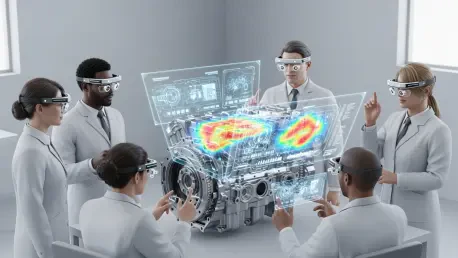
Beyond physical devices, Google and Microsoft have bifurcated the software landscape, with the former championing open-source Android XR and the latter solidifying its grip on high-end enterprise solutions. Google’s reliance on generative AI, specifically through the Gemini framework, has allowed it to create a cognitive layer that interprets the physical world in real-time for billions of users. Meanwhile, Microsoft’s Mesh platform has become the standard for industrial collaboration, enabling engineers to project complex holographic data onto physical machinery with precision. This duality ensures that whether a user is looking for consumer-grade convenience or professional-grade reliability, the software ecosystem is capable of supporting those needs. The focus has shifted from simply running applications to creating a persistent, shared digital layer that exists on top of reality. This infrastructure relies heavily on cloud-to-edge computing, where latency is minimized for users.
The rapid acceleration of the augmented reality market demanded a complete re-evaluation of digital strategy across all major technology sectors. Organizations that prioritized the development of spatial-first content and invested in robust data governance policies successfully navigated the transition away from traditional screen-based interfaces. It was essential for leaders to embrace three-dimensional UX frameworks and open standards like OpenXR to ensure their digital assets remained relevant in a decentralized ecosystem. Stakeholders who integrated 5G capabilities and prioritized low-latency bandwidth were able to deliver the high-fidelity experiences that consumers eventually came to expect. By addressing privacy concerns transparently and focusing on genuine utility rather than novelty, these pioneers established a foundation for sustainable growth in the spatial era. The transition marked the end of the mobile-first paradigm, proving that the most effective way to engage audiences was through a truly integrated reality.