
More than 2,500 backers have already committed to a vision of health tracking that favors a minimalist user interface and sophisticated materials over the tech-heavy appearance of standard fitness bands. This transition reflects a broader cultural shift where consumers increasingly view wearable technology as an extension of personal style rather than just a utility. As the market saturates with oversized smartwatches that demand constant attention through notifications and glowing screens, a subset of users is pushing back. They seek the benefits of continuous physiological monitoring—such as heart rate variability and blood oxygen levels—without the visual clutter of a digital interface. By embedding advanced biosensors into rings, necklaces, and bracelets, manufacturers are successfully merging high-end craftsmanship with data-driven insights. This trend signifies a move toward ambient technology, where the hardware disappears into the background of daily life while still providing critical health data. High-grade titanium and hypoallergenic ceramics now house miniaturized circuit boards that are nearly indistinguishable from traditional luxury pieces.
The move toward quiet technology has forced a total reimagining of the materials used in health tracking. Unlike the rubber and plastic synonymous with early fitness bands, modern smart jewelry utilizes medical-grade titanium and scratch-resistant sapphire glass. These materials are chosen not only for their durability but for their ability to sit against the skin for extended periods without causing irritation or losing sensor contact. Designers have abandoned the one-size-fits-all approach, opting instead for custom-sizing kits that ensure a perfect biometric fit, which is essential for the accuracy of light-based heart rate sensors. By integrating these high-end finishes, the industry has successfully bridged the gap between luxury watchmaking and high-performance bio-analytics. Consequently, the device is no longer an accessory that one remembers to put on; it becomes a permanent fixture of one’s persona, functioning continuously in the background of professional and social interactions. This permanence is key to collecting the longitudinal data necessary for truly personalized wellness.
The Synthesis: Fashion Meets Precision Biometrics
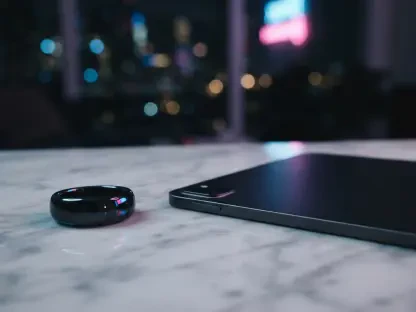
The engineering required to compress complex medical-grade sensors into the slim profile of a ring or a pendant represents a significant leap in manufacturing. Unlike wrist-based devices that often struggle with signal noise during movement, smart rings utilize the dense capillary network of the fingers to obtain highly accurate arterial pulse readings. Current models feature infrared photoplethysmography sensors, skin temperature thermistors, and 3D accelerometers, all shielded within durable outer shells. These devices prioritize passive data collection, synchronizing with mobile applications only when necessary to preserve battery life and minimize electromagnetic exposure. Consequently, the user experience shifts from reactive monitoring to long-term trend analysis. This technical evolution ensures that the aesthetic appeal does not come at the cost of data integrity, allowing for 24/7 wearability that captures a complete health picture throughout the day and night. The result is a device that offers professional-grade insights while remaining entirely invisible to the casual observer.
Beyond the hardware, the appeal of smart jewelry lies in its psychological impact on the user’s relationship with health metrics. Traditional fitness trackers often induce notification fatigue, where the constant buzzing of alerts can increase stress levels rather than manage them. In contrast, smart jewelry adopts a philosophy of calm technology, providing insights only when the wearer chooses to engage with a smartphone or tablet. This approach is particularly effective for sleep tracking, as the lightweight and non-intrusive nature of a ring is far more comfortable for overnight use than a bulky watch. By focusing on recovery scores and readiness metrics, these devices help users interpret biological signals without the pressure of closing digital rings or meeting gamified goals. The discretion offered by these pieces also makes them suitable for formal environments, ensuring that the tracking of vital signs remains a private matter rather than a public display of athletic intent or technological obsession.
The market’s maturation demonstrated that luxury and utility were not mutually exclusive, leading to a surge in partnerships between fashion houses and silicon firms. Consumers who sought to improve their physical state found that the most effective strategy involved choosing devices that emphasized long-term biometric consistency rather than flashy, battery-draining visual displays. It was observed that users achieved better outcomes when they viewed their wearable as a diagnostic tool for life patterns rather than a high-performance athletic speedometer. This shift empowered individuals to invest in high-quality materials like gold-plated finishes and custom-fitted bands, ensuring that the device remained comfortable enough for permanent wear. Ultimately, the successful adoption of health-tracking jewelry depended on the user’s ability to integrate data into a holistic lifestyle change. This era proved that when technology became invisible, the focus finally returned to the person behind the data points.