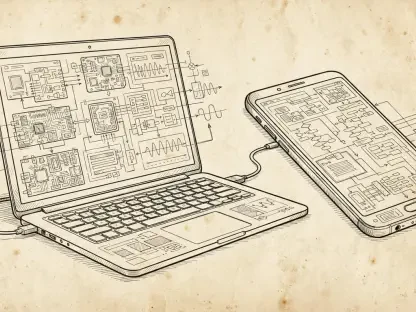

The rapid acceleration of hardware manufacturing has created a mountain of electronic waste that threatens to overwhelm global recycling systems and contaminate vital natural resources. While consumer demand for high-performance artificial intelligence and lightning-fast connectivity drives the release of new models every year, millions of functional processors are discarded prematurely. This throwaway culture presents a dual crisis: the depletion of rare minerals and the introduction of toxic heavy metals into the soil and water. However, a collaborative effort between researchers at the University of California San Diego and Google has revealed a transformative path forward by repurposing decommissioned smartphones into high-efficiency data centers. By treating these pocket-sized devices as sophisticated compute nodes, the project demonstrates that discarded hardware can be successfully clustered to manage enterprise-level workloads, offering a cost-effective and environmentally friendly alternative to traditional server farms. This initiative not only mitigates the environmental impact of technology but also provides a second life for high-value silicon.
Engineering Sustainable Computing Infrastructure
Transforming Mobile Hardware: From Devices to Nodes
Converting a consumer-oriented mobile device into a reliable server node requires a meticulous process of physical and digital deconstruction to ensure long-term stability and safety. The engineering team began by removing non-essential components that contribute to bulk and potential failure, such as high-resolution screens, fragile camera modules, and chemical batteries. Removing the lithium-ion batteries was particularly crucial, as it eliminated fire risks associated with constant high-wattage charging in a dense rack environment. Once the devices were reduced to their core motherboards and system-on-a-chip architectures, they were flashed with a specialized Linux-based operating system designed for server applications. To manage these hundreds of independent nodes, the researchers implemented Kubernetes, an industry-standard orchestration platform. This setup allowed the team to automate the deployment, scaling, and management of application containers across the mobile cluster as if it were a single system. The result was a streamlined, high-density computing array.
Beyond the software layer, the physical architecture of these repurposed data centers necessitated unique solutions for thermal management and power distribution. Standard server racks are designed for large cooling fans and massive power supplies, but a cluster of mobile motherboards requires a much more granular approach to electricity delivery. The researchers engineered custom power rails that provide stable voltage directly to the processor pins, bypassing the inefficient charging circuits usually found in mobile phones. Heat dissipation also posed a challenge, as mobile chips are typically passively cooled. By arranging the motherboards in a specialized vertical orientation and using low-noise industrial fans, the team maintained optimal operating temperatures even under heavy computational stress. This physical optimization ensures that the repurposed hardware can run continuously for years without the degradation typically seen in consumer use, effectively extending the lifecycle of the silicon indefinitely within a controlled environment. This approach turns a fragile gadget into a rugged, enterprise-grade component.
Validating Computational Strengths: Efficiency and Scaling
Evaluating the performance of these mobile clusters revealed that older processors possess remarkable capabilities that are often overlooked in the consumer market. While a single mobile chip cannot compete with a multi-thousand-dollar enterprise CPU in terms of total raw throughput, the collective power of a 50-phone array is surprisingly competitive for specific tasks. Mobile processors are specifically optimized for power efficiency and single-core performance, which aligns perfectly with the requirements of modern microservices. In testing, the researchers found that these ARM-based architectures could handle the modular components of web applications, such as database queries and API routing, with significantly less energy consumption than traditional x86 servers. The results showed that as more nodes were added to the cluster, the performance scaled almost linearly, suggesting that there is no inherent technical ceiling to how large these recycled data centers can become. This efficiency makes them ideal for the distributed architectures common in today’s cloud.
Building on the success of smaller prototypes, the project is moving toward the assembly of a massive 2,000-device array specifically designed to support the global education sector. This large-scale infrastructure aims to provide a robust cloud computing environment for schools that lack the budget for expensive commercial services or specialized server hardware. By pooling the resources of thousands of recycled processors, this system can host hundreds of virtual classrooms simultaneously, giving each student access to a dedicated cloud instance. Such a resource allows students to run complex simulations, practice programming, or host their own web applications in a sandbox environment that was previously inaccessible to underfunded institutions. This approach turns what was once considered junk into a powerful pedagogical tool, demonstrating that technological equity can be achieved through clever reuse rather than just through the acquisition of new products. It offers a blueprint for how other sectors can leverage decommissioned hardware to bridge the digital divide.
The successful implementation of smartphone-based data centers established a new paradigm for how the technology sector managed its environmental impact and resource allocation. Researchers proved that the life cycle of a processor did not have to end when a consumer purchased a newer model; instead, those chips became the building blocks for a more inclusive and sustainable digital future. Moving forward, the industry adopted standardized modular designs that allowed for the easy integration of diverse hardware types into unified computing fabrics. Organizations that embraced this circular philosophy reduced their capital expenditures while simultaneously meeting aggressive sustainability targets. The project ultimately demonstrated that creative engineering provided a viable solution to the e-waste crisis, turning the remnants of yesterday’s consumer gadgets into the backbone of tomorrow’s cloud infrastructure. This evolution served as a reminder that true innovation was found in how existing resources were used, rather than relying solely on the constant production of new ones.