
The domestic landscape has undergone a radical transformation as the traditional television transitions from a passive display into a sophisticated neural center for the entire household. Recent consumer sentiment data indicates that a significant majority of users now view artificial intelligence not as an intrusive novelty, but as a practical necessity for managing the increasing complexity of a connected existence. With over 2,600 Americans surveyed in recent industry reports, the evidence suggests a profound willingness to adopt AI-powered platforms that can streamline fragmented digital lives. This shift is particularly evident in how families interact with their primary living room screens, which have become far more than mere portals for streaming movies or broadcasting live events. Instead, these devices are being repurposed as intuitive interfaces that bridge the gap between digital entertainment and the physical management of home security, energy usage, and personal wellness routines.
The Transformation of Domestic Control Interfaces
Centralizing the Smart Home Experience
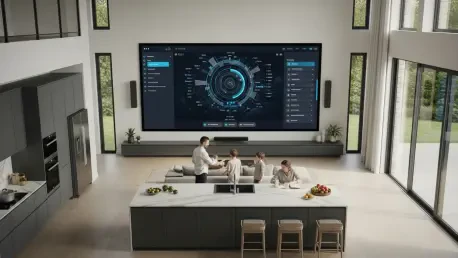
The physical placement and inherent visibility of the large-format screen make it the most logical candidate for a centralized command post. While smartphones offer portability, the smart TV provides a shared visual canvas that everyone in a household can access and understand simultaneously, creating a communal point of interaction. This preference is driving manufacturers to move away from simple app grids toward dynamic, AI-driven dashboards that anticipate a user’s needs before a command is even issued. By integrating various communication protocols, these televisions now serve as the “brain” of the home, allowing residents to monitor security cameras, adjust climate settings, and check the status of kitchen appliances without ever leaving their seats. This consolidation addresses a long-standing frustration with the “app-silo” problem, where users were forced to toggle between dozens of individual programs to manage different hardware brands.
Furthermore, the demographic shift toward younger homeowners is accelerating this integration, as individuals under thirty-five are vocal about their desire for unified ecosystems. These digital natives expect their hardware to be proactive rather than reactive, favoring systems that can automate repetitive household tasks through learned behaviors. For instance, a smart TV might automatically dim the lights and lock the front door when a specific movie genre is selected, or display a notification from a smart washing machine during a commercial break. This level of synchronization is no longer a futuristic concept but a standard expectation in the current market. As technology providers continue to refine these capabilities through 2026 and 2027, the focus is shifting toward making these interactions feel as natural as a conversation, reducing the cognitive load on the user and making the technology effectively invisible.
Integration of Generative Intelligence
Leading technology giants are responding to this demand by embedding large language models directly into the operating systems of their hardware. Google has notably deployed its Gemini AI to handle sophisticated, knowledge-based queries that go far beyond basic voice commands like “play music” or “find comedies.” Users can now engage in complex dialogues, asking for detailed health information, historical context about a film, or even real-time cooking advice that utilizes the screen as a visual guide. This transition from a basic assistant to a comprehensive knowledge engine allows the television to function as a household consultant. By separating routine technical tasks from high-level cognitive assistance, these systems ensure that the user experience remains fast and reliable while still offering the depth of information previously reserved for specialized computing devices.
In a similar vein, other major players like Samsung are leveraging advanced metadata partnerships to move beyond generic content suggestions. By analyzing viewing patterns alongside external data points, these systems can provide highly personalized recommendations that reflect a household’s specific tastes and schedule. This evolution is crucial because it transforms the interface from a static menu into a living entity that grows more accurate over time. When an AI understands that a user prefers documentaries on weeknights but lighthearted animation on Saturday mornings, it creates a friction-less environment that encourages longer engagement. This predictive capability is becoming the primary differentiator in a crowded market, as consumers gravitate toward the platforms that most accurately reflect their unique lifestyles and preferences without requiring manual input.
Future-Proofing the Connected Ecosystem
Consolidation through Content Aggregation
The fragmentation of the streaming market has led to a counter-movement toward unified platforms that simplify both discovery and financial management. Consumers are increasingly favoring “hub” models, such as those provided by Amazon and Roku, which aggregate multiple third-party services into a single interface with a consolidated billing structure. This trend highlights a broader desire for simplicity in a world saturated with digital choices. By acting as the gatekeeper for various media streams, the smart TV becomes an essential financial and administrative tool, not just a hardware peripheral. This centralized relationship gives hardware manufacturers a unique advantage, as they become the primary point of contact for the consumer’s entire entertainment budget, allowing them to offer bundled services that include home security or healthcare monitoring.
Moreover, the success of these aggregation models suggests that the future of the smart home lies in the intersection of utility and entertainment. When a service provider can offer a seamless package that combines a premium movie library with a professional home security monitoring system, the value proposition becomes much stronger than a standalone subscription. This “all-in-one” approach is particularly attractive to busy families who prioritize convenience and cost-efficiency. As we look toward the developments planned for 2027, the industry is likely to see even more unconventional partnerships between media companies and service providers in sectors like telemedicine and insurance. These collaborations will further solidify the smart TV’s role as the indispensable anchor of the modern digital residence, turning it into a portal for every essential service a family requires.
Enhancing User Experience through Natural Interaction
The ultimate goal of AI integration in the home is to make technology feel intuitive and human-centric rather than mechanical and complex. Competitive brands like LG and Amazon are investing heavily in natural language processing and computer vision to ensure that interactions are as fluid as possible. This means a television might recognize who is in the room through facial detection and automatically load that person’s specific profile and security settings. Such advancements remove the need for cumbersome passwords or remote control navigation, making the technology accessible to everyone from small children to the elderly. The move toward “zero-UI” environments—where the interface only appears when needed—represents the pinnacle of this design philosophy, ensuring that the technology serves the inhabitants rather than dominating the space.
To remain competitive in this evolving landscape, hardware manufacturers and software developers must prioritize interoperability across different platforms and brands. The next logical step involves the creation of open standards that allow various AI agents to communicate more effectively, ensuring that a “smart” home does not become a collection of isolated gadgets. Stakeholders should focus on building flexible, modular systems that can adapt to new AI capabilities as they emerge, rather than locking users into rigid, proprietary ecosystems. For the consumer, the most effective strategy is to invest in platforms that demonstrate a commitment to cross-brand compatibility and long-term software support. This approach was instrumental in shifting the industry away from the hardware-first mindset of previous decades toward the service-oriented, AI-driven model that currently defines the modern living room.