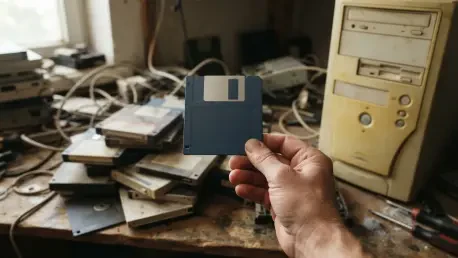

The evolution of data storage technology often mirrors a high-stakes survival drama where the most ubiquitous icons frequently face a brutal and unceremonious displacement by more agile competitors. For nearly three decades, the 3.5-inch floppy disk stood as the unrivaled monarch of personal computing, providing a physical bridge for data transfer that shaped the early digital experience. However, as the 1990s introduced high-resolution graphics, complex software suites, and the first waves of digital audio, the 1.44MB capacity of the standard diskette transformed from a reliable standard into a restrictive technical bottleneck. This period of transition sparked a fierce industrial rivalry as companies scrambled to define the next generation of removable media, leading to a decade of mechanical marvels and market misfires that eventually paved the way for the silent, solid-state world that defines 2026.
The Quest for Space Beyond the 1.44MB Barrier
The shift from the floppy disk to its eventual successors was driven by a fundamental change in how users interacted with their computers. In the early days of personal computing, a 1.44MB disk was more than sufficient to store an entire word processing application or a collection of simple spreadsheets. As the industry moved toward multimedia environments, a single high-quality image or a minute of compressed audio could easily exceed the entire capacity of a traditional diskette. This created a profound “storage gap” that threatened to stall the growth of the home computing market. Engineers recognized that the traditional magnetic recording techniques used in floppies had reached their physical limits, necessitating a radical rethinking of how data could be packed onto a removable surface.
This storage war was not merely about raw capacity; it was a battle for the very soul of data portability. Users demanded a solution that felt as familiar as the floppy but offered the performance of a fixed hard drive. Market analysts at the time observed that the winner would likely be the format that could balance affordability with reliability, yet the 1990s landscape became a graveyard of proprietary designs that failed to achieve universality. From 2026, looking back at this volatile era reveals how the desperation for space led to innovations like floptical drives and high-speed removable platters, each attempting to solve the same problem through vastly different mechanical philosophies.
The competition of this era served as a critical turning point because it forced a move away from the slow, fragile nature of low-density magnetic media. The struggle for a successor involved a complex interplay between backward compatibility and revolutionary new designs. While some companies attempted to extend the life of the floppy through hybrid engineering, others sought to miniaturize hard drive technology into portable cartridges. These mechanical experiments were the necessary precursors to the modern flash drive, proving that the market was ready for high-density storage even if the specific mechanical delivery systems of the 1990s were destined for obsolescence.
The Battle for the Desktop: Magnetic and Mechanical Contenders
High-Capacity Pioneers and the Shadow of the Click of Death
The most significant early challenger to the floppy disk’s dominance arrived in the form of the Iomega Zip drive. Launched with an aggressive marketing campaign, the Zip drive provided 100MB of storage on a disk that was only slightly thicker than a standard floppy. For millions of users, this was a transformative leap forward, allowing for the backup of entire directories and the easy transport of large design projects. Technologists praised the Zip drive for its relatively low cost and high speed, which made it the first viable candidate to replace the floppy in both professional and home environments. Its success was so pronounced that for a brief period, many computer manufacturers began including Zip drives as standard equipment alongside traditional diskette drives.
However, the Zip drive’s legacy was eventually tarnished by a catastrophic mechanical failure that came to be known as the “Click of Death.” This phenomenon occurred when the drive’s read-write heads became misaligned, causing them to clip the edge of the flexible magnetic media. The resulting sound was a rhythmic clicking that signaled the total loss of data and the physical destruction of the disk. More dangerously, a faulty drive could damage every disk inserted into it, and a damaged disk could potentially misalign the heads of a healthy drive. This mechanical contagion decimated consumer confidence, highlighting the inherent risks of pushing flexible magnetic media to such high speeds and densities without the robust protection found in fixed hard drives.
The volatility of the market attracted other competitors who hoped to capitalize on Iomega’s reliability issues. One such contender was the Caleb UHD144, which offered 144MB of storage and sought to undercut the Zip drive on price. While the UHD144 was marketed as a more stable alternative, it struggled to overcome the massive market lead Iomega had already established. This struggle illustrates a recurring theme in the storage wars: technical reliability and capacity often took a backseat to the timing of market entry. By the time alternative high-capacity magnetic drives reached a state of maturity, the initial excitement for the format had begun to sour, leaving a vacuum that other, more rigid technologies were eager to fill.
Removable Hard Disks and the Pursuit of Professional Speed
As the Zip drive targeted the average consumer, companies like SyQuest and Iomega looked toward rigid platter technology to satisfy the demands of high-end professionals. These devices, such as the Iomega Jaz and the SyQuest EZ135, were essentially removable hard drive cartridges. By using rigid platters that spun at thousands of revolutions per minute, these drives could achieve data transfer rates that rivaled internal storage. This made them indispensable in industries like computer-aided design (CAD), professional video editing, and desktop publishing, where the ability to work directly off a removable disk was a requirement rather than a luxury. The Jaz drive, eventually reaching a 2GB capacity, represented the pinnacle of magnetic removable storage during its peak.
Despite their performance advantages, these removable hard disks were burdened by significant financial and manufacturing hurdles. The precision required to maintain a stable “flying height” for the read-write heads over a removable platter was immense. Any microscopic particle of dust that entered the cartridge could lead to a head crash, destroying the data and the hardware. Because of this, the manufacturing costs remained high, and the cartridges themselves were often priced over one hundred dollars. Professional users were willing to pay this premium for the speed, but the average home user found the price of entry prohibitive, preventing these formats from ever achieving the mass-market ubiquity enjoyed by the floppy disk.
The rivalry between SyQuest and Iomega in this space was particularly fierce, leading to a series of legal battles and aggressive price wars that ultimately drained both companies. SyQuest, despite having a reputation for superior technical performance and faster seek times, struggled with internal financial instability and a high rate of product returns due to “stiction” issues. This mechanical failure, where the heads would physically stick to the platters, proved to be the undoing of SyQuest’s hardware. The company eventually filed for bankruptcy, leaving Iomega as the sole survivor in the high-capacity removable market for a time. This outcome underscored the reality that in the world of computer hardware, financial logistics and manufacturing yields were just as important as the megabytes per second on a spec sheet.
The Compatibility Dream of the Super-Floppy Hybrid
A recurring obstacle to the adoption of new storage formats was the “Compatibility Paradox,” where users were hesitant to buy drives that could not read their existing library of floppy disks. The Imation LS-120 SuperDisk and Sony’s HiFD were engineered specifically to solve this problem by creating a “super-floppy” that was backward compatible with the standard 1.44MB diskette. The LS-120 was a marvel of optical-magnetic engineering; it used a laser to guide the magnetic head with extreme precision, allowing for 2,490 tracks per inch. This technology enabled a storage capacity of 120MB on a disk that looked nearly identical to a standard floppy, while the drive itself remained capable of reading and writing traditional media at normal speeds.
Industry experts initially believed that the SuperDisk would be the logical successor to the floppy because it offered a seamless transition path for both manufacturers and consumers. However, the engineering complexity required to maintain backward compatibility introduced its own set of problems. The LS-120 drives were significantly slower than Zip drives when handling high-capacity media, and they were more expensive to produce. By the time the SuperDisk reached the market in significant numbers, many users had already committed to the Zip ecosystem or were beginning to experiment with recordable CDs. The convenience of using old floppies was not enough to outweigh the higher cost and lower performance compared to more specialized high-capacity alternatives.
Sony’s attempt at a hybrid, the HiFD, faced an even more difficult path. Although it offered a superior 200MB capacity and aimed to provide the performance of a hard drive with the compatibility of a floppy, the initial launch was plagued by reliability issues. Sony was forced to recall many of the first-generation drives, a move that dealt a fatal blow to the format’s reputation before it could gain a foothold. This failure demonstrated that backward compatibility, while highly valued by consumers in theory, often required too many engineering compromises. The hybrid dream eventually collapsed as users realized that it was more efficient to have a fast, dedicated high-capacity drive and simply keep a cheap, legacy floppy drive for their old data.
Niche Experiments and the Transition to Solid-State
While the desktop battle raged, a different set of challenges emerged in the burgeoning world of portable electronics. Digital cameras and early handheld devices required storage that was smaller and used less power than the bulky Zip or Jaz drives. Sony attempted to adapt its successful MiniDisc audio format into a data storage medium known as MD Data. These 140MB disks were incredibly durable and featured a protective shutter that made them ideal for mobile use. However, the proprietary nature of Sony’s ecosystem and the relatively slow access times of the magneto-optical technology limited their appeal. While MD Data found some success in specialized Japanese markets, it failed to capture the global imagination as a general-purpose computer storage medium.
Iomega also entered the miniaturized market with the Clik! drive, later renamed the PocketZip. These tiny 40MB disks were designed to fit into the PC Card slots of laptops and the expansion ports of digital cameras. The engineering was impressive, managing to shrink a mechanical magnetic drive into a form factor smaller than a credit card. Despite the innovation, the PocketZip arrived just as solid-state memory was beginning to drop in price. Unlike mechanical disks, which had moving parts that could break and heads that could crash, solid-state cards like CompactFlash and SmartMedia were virtually indestructible and required far less power. This shift marked the beginning of the end for the era of moving-part storage in portable devices.
The transition from mechanical “micro-disks” to solid-state cards was a significant milestone in the storage wars. It signaled a broader realization within the industry that the physical limitations of spinning magnetic media were fundamentally incompatible with the needs of the mobile future. Technologists noted that as memory density increased and costs fell, the mechanical complexity of a tiny disk drive became an unnecessary liability. The failure of niche experiments like MD Data and PocketZip served as a clear warning: the future of portable data would not be found in the refinement of the magnetic disk, but in the complete abandonment of moving parts in favor of the silent reliability of silicon.
Lessons from the Storage Wars
Reflecting on the history of the floppy disk successors provides several critical insights into how technology lifecycles operate and why certain formats fail despite technical brilliance. One of the primary takeaways is the “Compatibility Paradox,” which suggests that being too tied to the past can hinder the progress of the future. The LS-120 and HiFD failed because they tried to do two things at once, resulting in hardware that was too expensive and too slow. In contrast, the Zip drive succeeded initially because it prioritized a clean break toward higher capacity, even if it meant requiring a second drive in the computer. This lesson remains relevant in 2026, as developers of cloud and physical storage solutions continue to balance the need for legacy support against the demands of modern performance.
Another vital lesson involves the hidden costs of mechanical complexity. The “Click of Death” and the “stiction” issues that plagued SyQuest are reminders that as storage density increases, the margin for error in mechanical systems shrinks toward zero. Manufacturing a high-speed mechanical drive that is also removable and cheap is a nearly impossible engineering feat. This history teaches us that technical superiority on a spec sheet does not guarantee market survival if the manufacturing process cannot produce reliable units at a mass-market price point. The bankruptcy of SyQuest serves as a stark warning to any hardware manufacturer that ignores the financial risks of low yields and high return rates.
For those navigating the current landscape of digital storage, these historical format wars emphasize the strategic importance of universal standards. The floppy disk lasted as long as it did because every computer in the world could read it. The successors failed, in part, because they were proprietary; a Zip disk was useless if the recipient did not have a Zip drive. This fragmentation allowed the CD-R and the USB flash drive to eventually sweep the market, as they offered standardized interfaces that were not tied to a single manufacturer’s hardware. Applying these lessons today involves prioritizing interoperability and open standards over closed ecosystems, ensuring that data remains accessible across different platforms and through shifting technological eras.
The Ghost in the Machine: Legacy of the Lost Formats
The ultimate demise of the magnetic diskette and its various successors was not caused by a single better disk, but by a fundamental shift in the computing environment. The simultaneous rise of the recordable CD and the high-speed USB flash drive created a “pincer movement” that rendered all magnetic removable media obsolete. CD-Rs provided massive capacity for mere cents per disc, making them the perfect medium for distribution and long-term archiving. Meanwhile, USB flash drives offered the physical durability and “plug-and-play” convenience that magnetic disks could never match. By the time the dust settled, the mechanical complexity of the Zip, Jaz, and SuperDisk felt like a relic of a bygone era, replaced by the simplicity of laser pits and floating-gate transistors.
The legacy of these lost formats is most visible today in the “Save” icon, a digital monument to the 3.5-inch floppy disk that remains embedded in the user interface of almost every modern application. This icon serves as a permanent reminder of a time when data was a physical object that could be held in the hand and protected with a sliding metal shutter. The failure of the floppy’s successors highlights the fragility of digital history; as these proprietary drives disappeared and the disks degraded, the data stored on them often became inaccessible. This has led to a modern focus on data migration and the preservation of universal standards to prevent a “digital dark age” where information is lost due to the obsolescence of its physical medium.
Looking forward from the current vantage point of 2026, the history of the storage wars provides a sobering insight into the strategic importance of data longevity. The era of moving-part storage taught the industry that the most successful technologies are often the ones that are the most invisible and the most reliable. The transition to cloud-based storage and high-speed solid-state memory has largely solved the problems of capacity and physical fragility, but the core challenge of maintaining a universal standard remains. The ghost of the floppy disk reminds us that while hardware is temporary, the need for a stable and accessible way to preserve our digital lives is a permanent feature of the human experience. The storage wars were not just about megabytes; they were about finding a reliable way to carry the weight of our digital world into the future.