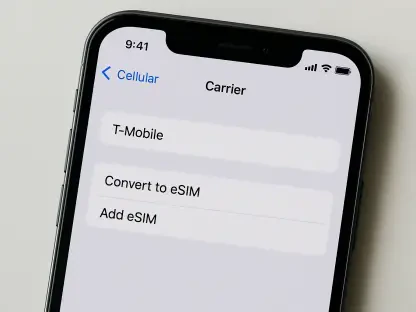

The arrival of mainstream consumer eSIM services in late 2025 forced China’s three state-owned telecom giants to confront a massive overhaul of their existing registration frameworks. This pivotal moment in the mainland’s mobile telecommunications history was catalyzed by the domestic launch of the iPhone Air, the first Apple device in the region to rely entirely on an embedded SIM architecture. By the beginning of 2026, the industry’s major players—China Mobile, China Unicom, and China Telecom—had successfully deployed the technical infrastructure necessary to support pure digital provisioning. The transition promised a future where users were finally liberated from the physical constraints of plastic cards, enabling sleeker hardware designs and the ability to switch between wireless carriers with a few taps on a screen. However, as the initial novelty fades, early adopters have encountered a landscape where theoretical convenience is frequently hampered by rigid institutional protocols and technical friction.
Administrative Barriers and the User Experience
Why Does Digital Activation Require Physical Visits?
The primary allure of eSIM technology lies in its capacity for instant, over-the-air activation, yet the current regulatory climate in China has effectively neutralized this benefit for many. Despite the digital nature of the service, the nation’s stringent real-name registration laws, governed by the Ministry of Industry and Information Technology, often require a level of identity verification that current remote systems struggle to satisfy. Many users attempting to activate new plans or transfer existing numbers find that they are still legally mandated to visit a physical service center to complete the process. This creates a jarring paradox where a technology designed to eliminate physical barriers requires a trip to a brick-and-mortar store, often resulting in long wait times and bureaucratic hurdles that contradict the essence of a “digital-first” experience.
Furthermore, the disconnect between corporate telecommunications strategy and retail execution has left a significant portion of the frontline workforce ill-equipped to handle the nuances of eSIM management. Early adopters have frequently reported that staff members at offline service centers lack the specialized training required to troubleshoot activation errors or manage cross-carrier transfers for embedded chips. In many instances, customers who were promised a seamless transition have spent hours watching technicians navigate unfamiliar software interfaces or consult printed manuals for a technology marketed as a standard feature. This lack of institutional readiness has transformed a sophisticated technical upgrade into a logistical burden, discouraging less tech-savvy consumers from making the jump to a cardless mobile setup.
How Do Restrictions Impact Number Management?
One of the most persistent frustrations for power users in the 2026 mobile market is the artificial limitation placed on active profiles within the eSIM environment. While the hardware itself is theoretically capable of storing multiple digital credentials, devices specifically tailored for the Chinese market are often restricted to maintaining only two active profiles at any given time. This limitation represents a significant functional downgrade for a demographic that previously relied on swapping physical SIM cards to manage various domestic and international accounts. For those who travel frequently, the current system forces a compromise: the user must often delete a primary domestic number to make room for a temporary international data plan, only to face the daunting prospect of re-authenticating their main account upon their return.
The ripple effect of these storage restrictions extends into the realm of data security and identity management, as the process of re-acquiring a deleted profile is far from automated. Because the digital credential is tied so closely to a specific hardware identifier and verified identity, the security protocols governing reactivation are intentionally cumbersome to prevent fraudulent account takeovers. Consequently, the “freedom” to manage numbers digitally has, in practice, led to a more rigid ecosystem where users are hesitant to experiment with different service providers for fear of losing access to their primary communication lines. This environment has cultivated a sense of caution among consumers, who view the current eSIM implementation as a supplemental tool for secondary devices rather than a robust replacement for the traditional, dependable physical card.
The Fragmented Device Landscape and Manufacturer Strategy
What Challenges Do Android Users Face?
While Apple has acted as the vanguard for the pure eSIM movement in China, the experience within the Android ecosystem remains considerably more fragmented and inconsistent. High-end flagship devices from manufacturers like Samsung and Huawei have integrated the necessary hardware to support embedded SIMs, but the supporting service infrastructure is notably optimized for iOS products. Android users often find themselves at a disadvantage when visiting carrier service centers, where they may encounter “gatekeeping” by staff who incorrectly claim that eSIM services are restricted to Apple hardware. This uneven support structure creates a significant barrier to entry for a large portion of the market, effectively making the adoption of eSIM on Android an experimental choice rather than a practical one for the average consumer.
The underlying issue for Android users is the lack of a unified standard for how these digital credentials interact with various manufacturer-specific operating systems and security layers. Unlike the centralized control Apple exerts over its ecosystem, the diverse range of Android skins and security architectures means that China Mobile or China Telecom must validate services for dozens of different models, each with its own technical quirks. This complexity leads to slower rollout times for new features and a general lack of consumer confidence in the reliability of the service. Consequently, many high-end Android owners continue to rely on physical slots as their primary means of connectivity, viewing the eSIM feature as a dormant capability that is not yet ready for daily reliability within the current service landscape.
Why Are Smaller Manufacturers Hesitant?
For mid-tier and smaller smartphone manufacturers, the decision to include dedicated eSIM chips is often a matter of strict cost-benefit analysis that currently favors the status quo. Adding a dedicated secure element to support eSIM technology increases the cost of materials for each unit, a cost that is difficult to justify when consumer demand remains low due to service-side friction. These manufacturers operate in a highly competitive market where every dollar saved in production can be reinvested into more tangible features that consumers prioritize, such as faster charging speeds, larger battery capacities, or advanced camera optics. Without clear and widespread demand from the general public, most domestic brands are content to wait for the ecosystem to mature before committing to a cardless future.
This strategic hesitation has created a market divide where eSIM is increasingly viewed as an exclusive luxury feature reserved for ultra-high-end flagship models. By limiting the technology to premium models, manufacturers are signaling that eSIM is not yet an essential utility but a status symbol for early adopters who are willing to navigate a difficult service environment. This approach prevents the technology from reaching the critical mass necessary to force carriers to streamline their activation protocols. Until more mid-range devices adopt the standard and pressure the state-owned giants for better remote provisioning tools, the technology will likely remain a niche offering that fails to disrupt the dominance of the traditional physical SIM card slot in the broader consumer market.
Market Trends and Future Projections
Is the Hybrid Model the Best Option?
Industry analysis throughout 2026 has confirmed that the “hybrid” model—combining a physical SIM slot with eSIM capability—represents the current gold standard for the Chinese mobile market. This configuration, found in devices like the iPhone 18 Pro and recent Huawei Mate series models, provides users with the best of both worlds: the reliability of a physical card for their primary domestic number and the digital versatility of eSIM for secondary services. This dual approach has proven to be the most resilient against the administrative hurdles of the current ecosystem, as it allows users to maintain a permanent connection that is immune to software activation glitches while enjoying the convenience of scanning a QR code for international roaming or temporary data boosters.
The success of the hybrid model highlights the pragmatic nature of Chinese consumers, who value reliability over aesthetic minimalism. While the industry pushed for a pure eSIM world to save internal space for larger batteries or better haptics, the reality of the service environment made the physical slot a necessary insurance policy. Users have shown a clear preference for devices that do not force them into a digital-only existence, viewing the physical card as a tangible anchor in an increasingly complex digital landscape. As long as the process of remote identity verification remains tied to physical service center visits, the hybrid model will likely continue to dominate the market, serving as the bridge between traditional telecommunications security and the eventual goal of a fully virtualized mobile identity.
Navigating the Path toward Digital Maturity
The evolution of the mobile ecosystem in late 2025 and into 2026 demonstrated that while the technology was mature, the surrounding administrative and service structures were not yet prepared for a total transition. The initial rollout phase revealed a critical need for telecommunications operators to synchronize their high-level corporate goals with the technical proficiency of their retail staff. The real measure of progress in the coming years will not be found in the number of eSIM-compatible devices sold, but in the implementation of a truly remote, secure, and user-friendly registration system that eliminates the need for physical store visits. Only when the “digital loop” is closed will the technology fulfill its promise of providing a truly frictionless experience for the hundreds of millions of mobile users across the country.
In looking back at the first major wave of adoption, it became clear that the physical SIM card was far from obsolete, acting instead as a vital component of a transitional period. The collective experience of users during this timeframe suggested that the move toward a pure eSIM future would require several more years of policy refinement and a fundamental shift in the carrier-client service model. The path forward involves leveraging advanced biometrics and secure cloud-based identity verification to satisfy real-name registration requirements without the logistical headaches of the past. Until these systemic improvements are fully integrated, the physical SIM slot remains a cornerstone of mobile hardware, providing the stability and ease of use that the digital alternative has yet to consistently deliver in a complex regulatory environment.