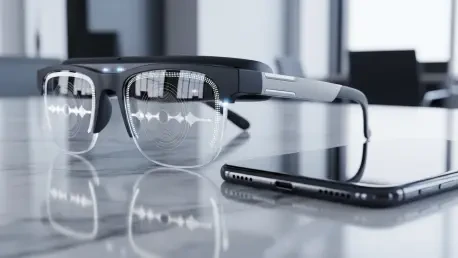

The ubiquity of smartphones is finally facing its most formidable challenge as lightweight augmented reality glasses transition from niche novelties into indispensable tools for daily productivity. While hand-held devices have dominated the digital landscape for decades, the current shift toward spatial computing suggests that the screen in the pocket is being superseded by a natural, heads-up interface. This transition is not merely about miniaturization but represents a fundamental change in how information is synthesized with the physical world. Developers are prioritizing wearable hardware that blends digital overlays with the human field of view, creating a persistent layer of data that remains accessible without the need to glance down. As the underlying technology reaches a critical state of maturity, the focus has shifted toward refining user experiences that feel intuitive rather than intrusive. The era of tactile glass interaction is gradually making way for a world defined by gaze, voice, and subtle gesture control.
Engineering the Invisible Computer: Hardware Foundations
Breakthroughs in Optical Waveguides and Display Engineering
The engineering hurdles involved in creating high-fidelity displays within the form factor of standard eyeglasses have necessitated significant breakthroughs in waveguide technology and micro-LED efficiency. Current optical systems utilize intricate diffractive waveguides that allow light to travel through thin glass lenses before being projected directly into the wearer’s retina. This approach ensures that digital content remains sharp and vibrant even in high-contrast outdoor environments, solving one of the most persistent issues of early prototypes. Moreover, the integration of silicon carbide and gallium nitride in the manufacturing of displays has enabled higher brightness levels with significantly lower power consumption. These advancements are critical for maintaining the thermal stability required for all-day wear, as heat dissipation remains a primary concern for high-performance wearable devices. By balancing optical clarity with energy efficiency, manufacturers achieved a design that users can comfortably wear for hours.
Advanced Sensory Integration and Spatial Mapping
Beyond the visual element, the success of augmented reality depends heavily on the ability of the device to understand and interact with the surrounding physical environment in real time. Modern glasses are equipped with sophisticated arrays of cameras and LiDAR sensors that perform simultaneous localization and mapping, allowing digital objects to appear anchored to specific locations. This spatial awareness is further enhanced by low-latency hand tracking and eye-tracking sensors that remove the need for external controllers or physical buttons. When a user looks at a smart appliance or a document on a physical desk, the system recognizes the context and provides relevant information or control options instantly. The precision of these sensors has reached a point where virtual interfaces feel as stable as their physical counterparts, minimizing the cognitive load required to navigate complex digital tasks. This seamless blending enables the glasses to serve as a primary interface for complex daily work.
Societal Integration: Navigating the Spatial Computing Era
Redefining Professional Collaboration and Virtual Workspaces
The professional landscape has undergone a radical transformation as companies replace traditional multi-monitor setups with infinite virtual canvases provided by augmented reality. This shift allows employees to project dozens of windows into their physical workspace, varying in size and position according to the specific demands of the task at hand. Unlike fixed screens, these virtual displays can be rearranged instantly, fostering a more ergonomic and adaptable environment for software developers and creative professionals. Collaboration has also moved beyond two-dimensional video calls into spatial telepresence, where remote team members appear as life-sized digital avatars within the same room. These interactions facilitate a level of non-verbal communication and shared spatial context that was previously impossible in a digital-only setting. As a result, the physical constraints of the traditional office are dissolving, allowing for a more fluid and distributed workforce.
Privacy Frameworks and Public Data Ethics
As augmented reality glasses become common in public spaces, the dialogue surrounding digital privacy and data security has become increasingly focused on the protection of peripheral bystanders. Manufacturers have responded by implementing hardware-level indicators, such as visible lighting rings, that signal when cameras or sensors are actively processing environmental data. There is also a growing emphasis on on-device processing, which ensures that sensitive visual information is analyzed locally rather than being uploaded to centralized cloud servers. This architectural choice addresses concerns regarding the potential for constant surveillance while still allowing for the rich contextual features that define the experience. Cultural norms are simultaneously evolving to establish a new etiquette for wearable tech, similar to the protocols that once governed the use of smartphones in social settings. Establishing clear boundaries for data collection remains a cornerstone for the wide adoption.
Strategic Guidelines for Seamless Platform Adoption
Strategic preparation for this transition involved several decisive steps taken by organizations to ensure that the shift from hand-held to head-worn computing remained productive and socially responsible. Technical leaders prioritized the development of spatial-first content, moving away from simple mobile porting to create experiences that utilized the full three-dimensional field of view. Data governance policies were overhauled to address the continuous stream of environmental information, placing user consent at the forefront of the digital experience. Furthermore, companies invested in comprehensive training programs that helped personnel adapt to gesture-based controls and spatial navigation, effectively reducing the initial learning curve. These proactive measures successfully laid the foundation for a seamless integration of augmented reality into the daily workflow. By focusing on ergonomic design and ethical data practices, early adopters managed to transform the wearable interface from a technical experiment into a reliable utility.