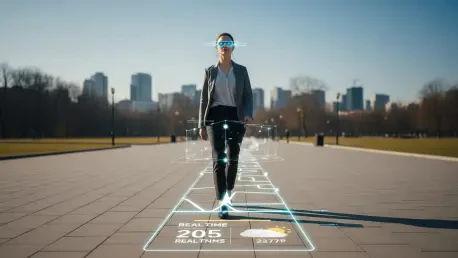

The long-standing dominance of the handheld smartphone is finally beginning to wane as a new generation of sophisticated augmented reality eyewear integrates seamlessly into daily life. For years, the digital experience was confined to a glass rectangle in a pocket, requiring users to disengage from their physical surroundings to access information. This dynamic has shifted dramatically as wearable technology now offers a more natural, persistent connection to the internet without the need for manual intervention. By embedding advanced vision-based artificial intelligence directly into the user’s field of vision, manufacturers have effectively removed the barrier between the physical and digital worlds. This transition represents a significant milestone in personal computing, moving away from reactive tools toward proactive assistants that understand context and intent. As the industry matures, the reliance on traditional mobile devices is decreasing, replaced by a hands-free alternative that enhances rather than distracts from reality.
Strategic Movements of the Tech Giants
Google and Apple: Contrasting Philosophies in Wearable Design
Google has taken an information-centric path by leveraging its massive search infrastructure to turn the physical world into a searchable interface. By integrating Gemini AI into their latest wearable hardware, they have enabled a system where users can receive instant context about objects or locations simply by looking at them. This utility-first strategy focuses on practical applications, such as real-time language translation appearing as subtitles during conversations or turn-by-turn navigation overlaid directly onto the pavement. The hardware serves as a cognitive overlay, providing data that was previously buried in apps and menus. This approach transforms the environment into a living document, where historical facts, business reviews, and social connections are pinned to specific geographic coordinates. By prioritizing utility over pure entertainment, Google has established its glasses as an essential tool for navigation and discovery, ensuring that users remain informed without ever having to look down at a phone screen.
MetDriving Consumer Adoption Through Social Scale
Meta has positioned itself as an aggressive player in the consumer market, committing massive resources to ensure that augmented reality glasses become a social and fashion staple. By partnering with iconic eyewear brands, they have successfully normalized the presence of cameras and sensors on the face, making technical hardware feel like a standard accessory. This strategy focuses on hands-free content creation and instant sharing, capturing a segment of the market that values connectivity and entertainment. Their hardware functions as a powerful hub for spatial audio and immersive social feeds, ensuring that the user remains present in their physical surroundings while simultaneously engaging with a digital layer. This heavy investment in mass-market appeal has accelerated the decline of the traditional smartphone as a primary communication tool. By focusing on social presence rather than just data retrieval, Meta has made wearable computing a lifestyle choice that resonates with a broad demographic of global users.
Market Diversification and the Path to Mass Adoption
Niche Innovators and the Democratization of AR
Beyond the established giants, companies like Snap have carved out a significant niche by focusing on the creative and expressive potential of augmented reality. By prioritizing lightweight designs and playful interfaces, they have appealed to a younger demographic that views AR as a tool for personal expression rather than high-end computing. These social-first devices avoid the complexities of professional productivity, focusing instead on shared experiences that transform the user’s environment in real time. Concurrently, value-driven manufacturers like Vuzix and Xreal have played a crucial role in bringing the technology to a broader audience. By offering competitive pricing and focusing on specific use cases like portable media consumption, these firms have driven rapid innovation in hardware efficiency and display technology. Their presence ensures that augmented reality is not a luxury restricted to the wealthy, but a diverse ecosystem that offers varying entry points for different consumer needs and budgets.
The Maturation of Spatial Software and Hardware
The successful transition to augmented reality eyewear was finalized when the industry addressed the critical balance between biometric convenience and user privacy. As spatial computing became the standard, developers focused on creating interfaces that prioritized meaningful interaction over the constant bombardment of digital noise. The resulting ecosystem moved toward specialized applications that enhanced professional productivity and personal connectivity without the physical burden of a handheld device. Looking back, the shift represented a fundamental change in how digital information was integrated into the human experience, moving from an external tool to a seamless sensory extension. The industry established robust frameworks for data ethics, ensuring that the persistent vision required by these devices remained under the control of the user. By the end of this transformative period, the smartphone had been relegated to a niche role, while the eyes became the primary gateway to a unified digital and physical reality.