
Imagine the frustration of looking at your own hand and feeling as though it belongs to a stranger or has somehow shrunk to half its size. For many individuals navigating the long road of stroke recovery, this disconnect between the mind and the body is a daily reality that physical exercise alone cannot fix. While traditional rehabilitation focuses heavily on regaining strength and mobility, it frequently overlooks the vital sensory feedback that informs how the brain controls movement. The emergence of the MultiSensy platform represents a major shift in neuro-rehabilitation by specifically targeting the restoration of the sense of touch. By creating a unified experience where movement and feeling are reunited, this technology seeks to bridge the gap between mechanical function and actual bodily awareness. This approach moves beyond the simple repetition of tasks to address the underlying neurological pathways that allow a person to truly feel and control their limbs again.
The Hidden Deficits: Challenges in Conventional Recovery
Most current therapeutic interventions prioritize motor skills, such as rebuilding grip strength or practicing the repetitive reaching motions required for activities of daily living. However, this narrow focus ignores the reality that nearly half of all stroke survivors suffer from significant sensory impairments, including a loss of touch or a distorted sense of proprioception. Without the ability to feel where a limb is in space, the brain struggles to execute even the most basic motor commands effectively. This sensory-motor disconnect often results in a plateau where patients stop making progress because their brains have essentially “forgotten” how to integrate sensory data with movement. Consequently, even if muscle strength returns, the lack of tactile feedback makes the limb feel heavy, awkward, or entirely alien. Addressing these deficits requires a move away from isolated muscle training toward a more holistic model that treats the sensory and motor systems as an inseparable unit.
A particularly challenging aspect of post-stroke recovery is the phenomenon where patients perceive their affected arm as being much smaller or shorter than it actually is. This distorted body image is not just a psychological quirk but a physiological response to the lack of neural input reaching the somatosensory cortex. When the brain stops receiving regular signals from a limb, it begins to reorganize its internal map, effectively shrinking the representation of that body part. Traditional therapy, which relies on visual observation and physical guidance from a therapist, often fails to correct these deep-seated neurological distortions. As a result, the survivor may develop “learned non-use,” a condition where they subconsciously stop using the affected limb because the mental effort required to overcome the sensory confusion is too great. Breaking this cycle requires a technological intervention that can force the brain to re-evaluate its internal body map through intense, synchronized sensory stimulation.
Sensory Integration: Merging Virtual Reality and Neural Stimulation
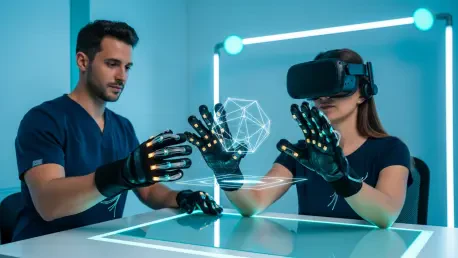
The MultiSensy system addresses these challenges by integrating immersive virtual reality with sophisticated, non-invasive nerve stimulation techniques. When a patient puts on the VR headset, they enter a controlled digital environment where they can see a virtual representation of their affected arm performing various tasks. This visual immersion is the first step in re-engaging the brain’s attention and encouraging it to “claim” the limb during therapeutic exercises such as pinching, reaching, or rotating objects. Unlike looking at a real arm that might feel disconnected, the virtual arm provides a clean, predictable visual stimulus that the brain can more easily process. This environment allows for the safe practice of complex movements that might be too difficult or discouraging in the physical world. By providing a clear visual target, the system lays the foundation for more advanced neurological retraining that goes far beyond simple physical therapy.
The core innovation of this platform lies in its ability to provide synchronized touch, where electrodes deliver precise electrical pulses to the nerves at the exact moment a virtual object is contacted. This real-time feedback loop is essential because it mimics the natural timing of sensory-motor interactions that occurs in a healthy body. When a patient sees their virtual hand touch a digital block and simultaneously feels a pulse in their physical fingertips, the brain begins to reconnect the dots between sight and sensation. This synchronization is critical for neuroplasticity, as it encourages the formation of new neural pathways that bypass damaged areas of the brain. By merging these two distinct streams of information, the technology effectively rebuilds the internal neural maps that were disrupted by the stroke. This process does more than just restore feeling; it provides the brain with the necessary data to refine motor control and improve the overall fluidness of movement in everyday life.
Clinical Breakthroughs: Evaluating Data and Future Care
Clinical trials conducted through 2026 provided compelling evidence that this integrated sensory-motor approach was significantly more effective than traditional methods. Participants who had previously reached a recovery plateau—where no further progress was expected—showed remarkable improvements when using the MultiSensy platform. Data indicated that motor skill gains were nearly double those seen in control groups receiving standard care, with every participant achieving improvements that clinicians classified as meaningful. Perhaps more importantly, the therapy successfully corrected the distorted body perceptions that had plagued many of the survivors for months or years. By narrowing the gap between where a patient thought their hand was and its actual physical location, the system restored a sense of bodily integrity. These results suggested that the “plateau” in stroke recovery was often an artifact of incomplete therapy rather than a permanent limitation.
Looking back at the implementation of these technologies, the broader adoption of the platform suggested a move toward a more decentralized model of healthcare where the home served as the primary site of recovery. Stakeholders in the medical device industry focused on refining the user interface to ensure that individuals with limited mobility could operate complex VR systems without assistance. This democratization of high-tech therapy meant that geographic location and socio-economic status played a smaller role in determining the quality of a patient’s recovery journey. As researchers explored the application of these sensory-motor loops to other conditions, such as phantom limb pain or spinal cord injuries, the lessons learned from stroke rehabilitation served as a foundational pillar. The shift in perspective from treating symptoms to restoring the brain’s internal communication network paved the way for a more resilient and effective healthcare system for all survivors.