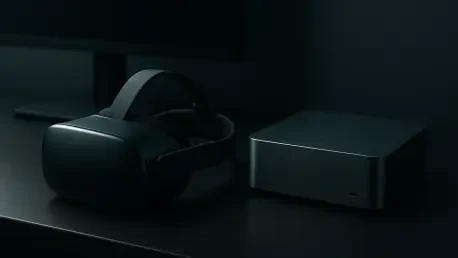

Alongside the headset, Pimax announced the Spation mini-PC, a dedicated VR station equipped with high-end components like the AMD Ryzen 7 9800X3D processor. Building on this hardware foundation, the brand introduced its latest flagship, the Crystal Pro, which marks a significant shift in how enthusiasts interact with virtual environments. This device enters a competitive landscape where the demand for wireless freedom often clashes with the necessity for high-resolution visual fidelity. By integrating a dedicated mini-PC into its ecosystem, the manufacturer ensures that the hardware barrier is lowered for users seeking a turn-key solution for professional-grade simulation and gaming. The Spation serves as the backbone of this system, utilizing next-generation graphics processors to push the limits of what a compact form factor can achieve. This strategic move highlights a broader trend in the industry toward specialized, integrated hardware stacks that prioritize stability and high-bandwidth data transmission.
Visual Engineering: Achieving Unprecedented Clarity
The optical performance of the headset is anchored by dual QLED panels that deliver a resolution of 2,880 x 2,880 pixels per eye, ensuring that the screen-door effect is virtually imperceptible. This high-density display is complemented by Mini-LED local dimming technology distributed across 576 independent zones, which allows for deep black levels and a contrast ratio that rivals organic light-emitting diode displays. With a pixel density of 35 pixels per degree and a 110-degree horizontal field of view, the device provides a level of immersion that is necessary for flight simulators and racing games. This visual stack is designed to render fine details, such as cockpit instruments or distant environmental textures, with extreme precision. The inclusion of advanced glass lenses minimizes internal reflections and chromatic aberration, maintaining a sharp image across the entire viewing area regardless of where the user is looking within the immersive virtual space.
To maintain this visual quality without the constraints of a physical cable, the hardware utilizes a proprietary technology known as Native Foveated Streaming. This approach leverages eye-tracking sensors to prioritize rendering resources on the area where the user is currently focusing, significantly reducing the amount of data that needs to be transmitted at once. When paired with the optional 60G AirLink kit, the headset achieves a massive bandwidth of up to 6 Gbps with latency levels dipping below 2 milliseconds. This performance metric is critical for competitive gaming, where even a slight delay can break immersion or lead to motion sickness. By offering both a standard Wi-Fi 6E adapter and the high-performance 60G solution, the system provides flexibility for different home networking environments. This dual-path connectivity ensures that users can achieve uncompressed, native-quality images that were previously only possible through a heavy and restrictive copper tethering system.
Modular Architecture: Strategic Implementation and Versatility
One of the most distinctive features of this new hardware is its modular faceplate system, which allows users to customize the headset based on their specific tracking needs or environmental requirements. For instance, a dedicated Lighthouse faceplate can be attached to enable compatibility with external base stations, providing the sub-millimeter precision required for professional software. Alternatively, a full-color passthrough faceplate can be swapped in for mixed-reality tasks. The device retains standalone functionality through the Snapdragon XR2 Gen 1 chipset, which provides enough power for mobile applications when a PC is unavailable. The input experience is further enhanced by ringless controllers that utilize SLAM for internal tracking. These controllers can be joined together to function as a standard Windows gamepad. This versatility, combined with a 16,000mAh external battery to counterbalance the front weight, makes the device a highly adaptable tool for various professional and enthusiast-grade tasks.
As the market for high-end virtual reality continued to evolve from 2026 to 2028, the introduction of this $1,400 solution established a new benchmark for enthusiast hardware. Professional users and simulation fans found that the combination of uncompressed wireless streaming and modular tracking justified the premium investment compared to more consumer-oriented devices. The integration of the Spation mini-PC proved to be an effective strategy for overcoming hardware fragmentation, providing a guaranteed performance level right out of the box. Looking forward, organizations interested in adopting this technology should focus on upgrading their local wireless infrastructure to support 60GHz transmission protocols to fully realize the benefits of the AirLink system. Integrating such high-fidelity tools into a workflow required a clear understanding of data throughput and space requirements. The device successfully paved the way for more widespread adoption of wireless professional-grade optical systems.