
Siri now draws from a user’s Reading List and Calendar events to provide tailored assistance, creating a more holistic understanding of a person’s daily schedule. This release of iOS 27.2 represents a pivotal shift in mobile computing, moving beyond standard software updates to deliver a fundamental transformation of the Apple ecosystem by embedding sophisticated generative AI into the system’s core. This update is not merely a collection of minor bug fixes but a comprehensive overhaul of system-wide functionalities, ranging from the conversational depth of Siri to hardware-specific optimizations for the iPhone Duo. By synthesizing advancements in machine learning, hardware synergy, and user privacy, the operating system reimagines how users interact with their devices, focusing on context-aware assistance that anticipates needs before they are explicitly stated. It sets a new benchmark for digital assistants, creating a more intuitive and fluid relationship between the user and their smartphone.
Personalized Intelligence and Hardware Evolution
Contextual Interaction: The Advanced Siri Framework
The most striking change in iOS 27.2 is the evolution of Siri from a basic command processor into a context-aware partner capable of maintaining a persistent memory across multiple conversations. Users no longer need to repeat specific details from previous queries to receive accurate answers, as the assistant successfully retrieves information from past dialogues to provide continuity. For example, if a user discussed restaurant recommendations several days prior, they can simply ask for “that place” to get the relevant result. Furthermore, Siri’s utility is bolstered by its ability to scan a wider array of data points, including Messages, Photos, and Safari history, to develop a comprehensive understanding of a person’s social life and schedule. Language support has also seen a significant expansion to include French, Japanese, Korean, Portuguese, and Spanish, though ongoing regulatory considerations mean these features remain unavailable in mainland China and the European Union.
Hardware Synergy: Optimizing the iPhone Duo
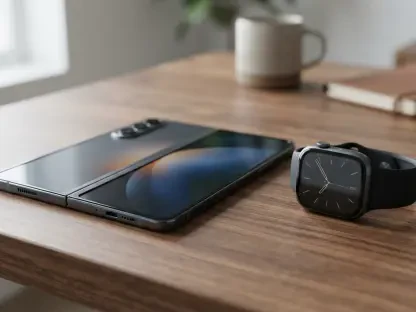
Specialized features for the iPhone Duo highlight a major shift in how the operating system handles foldable form factors, effectively bridging the gap between mobile phones and creative workstations. For the first time, the iPhone Duo gains support for the Apple Pencil (USB-C version), enabling high-precision sketching and document markup across both the inner and outer displays. The stylus connects directly via cable for pairing, emphasizing a highly functional workflow for artistic endeavors and professional tasks. Additionally, video conferencing receives a professional-grade upgrade with the “Edge Light” feature, which transforms the edges of the inner screen into a soft-box light to illuminate the user’s face. Users can manually adjust brightness and color temperature or allow the system to automatically activate the lighting in low-light conditions. These hardware optimizations demonstrate a commitment to making the dual-screen experience practical and efficient for daily use.
Digital Ecosystems and System Integrity
Media Personalization: Entertainment and Communication
Apple Intelligence is now deeply embedded within the Messages app, where it analyzes text conversations to suggest proactive “Siri Actions” like tracking flights or scheduling lunch dates mentioned in a thread. This predictive feature minimizes the friction of switching between apps, allowing the system to handle administrative tasks in the background while the user focuses on the dialogue. In the realm of entertainment, the Apple TV app now supports individual user profiles, each with its own recommendation engine and watch history. This is a significant improvement for households, as it prevents a child’s viewing habits from influencing an adult’s suggestions. Furthermore, the “Multiview” feature allows sports fans to stream up to four live events simultaneously on one screen. These functional overhauls are complemented by a minimalist monochrome version of the Apple Music icon, creating a cohesive and modern aesthetic that feels refined and tailored to individual preferences.
Digital Security: Ethical AI and System Protection
The implementation of iOS 27.2 successfully introduced the “SynthID” system to maintain transparency as generative AI tools became more prevalent in digital photography. This invisible watermark was embedded within an image’s pixels, allowing for the verification of AI-generated content without ruining the visual experience. Beyond these creative tools, the update included critical security patches for the system kernel and WebKit, protecting users against arbitrary code execution. For smart home enthusiasts, the Home app provided proactive security alerts through “Lock After Closing” and “Door Left Open” settings, which notified users if a lock remained open for a specific duration, ranging from 5 to 30 minutes. Additionally, the HomePod received “Lock Controls” to disable the touch-sensitive panel. Moving forward, users adopted immediate installation to leverage these safeguards while utilizing new automation triggers that adjusted system settings based on the physical state of the iPhone Duo.