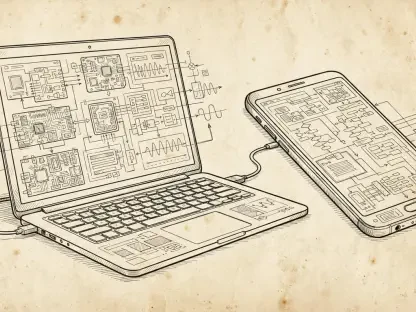

The rapid proliferation of handheld technology has fundamentally altered the way humanity interacts with capital, turning the smartphone from a supplemental tool into the primary interface for the global marketplace. By the middle of this decade, the mobile application market has already reached a staggering valuation of approximately $145 billion, but current economic projections indicate a massive surge to over $776 billion by 2035. This projected nearly sixfold increase represents a paradigm shift where a “mobile-first” philosophy is no longer a strategic option but an absolute necessity for corporate survival. Organizations across all sectors are aggressively migrating away from legacy desktop software in favor of agile, app-based architectures that serve as the central nervous system for both customer engagement and backend operational efficiency. This evolution signifies that the digital economy is being rebuilt from the ground up to prioritize mobility, accessibility, and real-time data flow. This trajectory is fueled by deep integration into every facet of human life, transforming apps into the essential conduits for global trade, governance, and social interaction.
The Technological Backbone: Connectivity and Infrastructure
This economic surge is deeply underpinned by the rapid maturation of high-speed connectivity and the hardening of global digital infrastructure. The ubiquitous rollout of 5G networks, which is now being augmented by the earliest implementations of 6G, has effectively removed the technical bottlenecks that once hindered complex mobile interactions. When combined with the distributed power of edge computing, these networks allow for data processing to occur closer to the end user, drastically reducing latency and enabling sophisticated applications that were previously the domain of high-end desktop workstations. This shift allows for an environment where complex simulations, high-fidelity augmented reality, and massive data sets can be accessed and manipulated on the fly. As these technological frameworks become more seamlessly integrated into the fabric of daily life, the speed of global commerce is expected to accelerate significantly, making the mobile application ecosystem an indispensable part of the core infrastructure for every modern corporation.
Beyond mere speed, the evolution of infrastructure has enabled a completely frictionless environment for financial transactions and service delivery across international borders. The convergence of cloud-native architectures with mobile interfaces ensures that every interaction, from a micro-payment in an emerging market to a high-level corporate data audit, occurs with near-instantaneous efficiency. This level of connectivity allows businesses to maintain a continuous, real-time pulse on their operations and customer behaviors, regardless of physical location. The resulting transparency and speed have created a new standard for economic participation, where the traditional delays associated with banking and logistics are being systematically eliminated. As mobile apps continue to serve as the primary gateway for these services, they are effectively redefining the velocity of money on a global scale. This transformation is not merely about convenience but about creating a more resilient and responsive economic system that can adapt to shifting market conditions with unprecedented precision and agility.
Advanced Intelligence: Redefining Development and Design
Artificial Intelligence is fundamentally changing the methodology of application development, moving from a decorative feature to the foundational engine of the entire creation process. By automating the most labor-intensive and repetitive aspects of software engineering, such as debugging complex codebases, generating boilerplate logic, and conducting rigorous quality assurance testing, AI allows human developers to elevate their focus toward high-level architectural design and creative user experiences. This transition has drastically shortened the development lifecycle, allowing a new product to transition from a conceptual whiteboard to a live, functional application in a fraction of the time previously required. This increased speed of innovation allows the global economy to react with much greater sensitivity to the rapidly changing needs of consumers. Furthermore, AI-driven development tools are democratizing the ability to create high-performance software, ensuring that the next generation of economic solutions can be built with greater efficiency and fewer technical barriers.
In conjunction with automated intelligence, the development landscape is being further democratized through the sophisticated rise of low-code and no-code platforms. These advanced tools empower professionals without traditional computer science backgrounds to construct functional, enterprise-grade applications, effectively addressing the persistent talent shortage that has long plagued the technology sector. This empowerment of “citizen developers” allows departments across an organization to build bespoke tools that solve specific operational challenges without waiting for a dedicated engineering queue. Meanwhile, a strategic tension persists between native application development and hybrid frameworks, as businesses weigh the benefits of maximum performance and security against the cost-effectiveness of cross-platform compatibility. This balance is crucial for companies aiming to maintain a presence across diverse operating systems while managing budgets. The ongoing maturation of these development strategies ensures that the barrier to entry for digital entrepreneurship continues to decline.
Market Dynamics: Sector Evolution and Regional Growth
The impact of this mobile-centric evolution is most visible in the reinvention of key economic sectors such as retail, banking, and healthcare. Traditional e-commerce has transitioned into a highly personalized experience where predictive analytics and augmented reality allow consumers to visualize products before making a purchase. In the financial sector, the movement toward a branchless future is accelerating as digital wallets become the primary means of handling wealth and investment portfolios. This shift has not only reduced overhead costs but has also opened new avenues for financial inclusion in previously underserved regions. Meanwhile, healthcare is undergoing a similar transformation as telehealth and wearable technology create a massive sub-market for remote diagnostics and monitoring. These applications allow for constant tracking of patient biometrics, enabling professionals to manage conditions with precision. This fundamental change in service delivery is creating a new economy that prioritizes remote accessibility and patient outcomes over physical facility visits.
The geographic distribution of the mobile economy reveals a fascinating divergence between established technological hubs like North America and the high-growth engines of the Asia-Pacific region. While North America maintains a significant share of the market through its concentration of tech giants and advanced infrastructure, the primary growth for the next decade is centered in nations such as India and China. These regions are leveraging massive smartphone penetration and a thriving startup culture to bypass legacy systems in favor of sophisticated mobile-first consumer spending. Government-led digital initiatives in these emerging markets are integrating millions of new consumers into the digital economy through mobile financial services and digital identity systems. This rapid expansion is not limited to consumer apps but includes robust business applications that streamline manufacturing and supply chains. As these markets mature, they are poised to become the central hubs for next-generation app development, redefining the global economic balance toward the East.
Strategic Conclusions: Navigating the Future Economic Landscape
Success in this hyper-connected global economy required a fundamental shift in how organizations viewed their digital assets and user interactions. To thrive in the lead-up to 2035, industry leaders prioritized the deep integration of artificial intelligence, cloud scalability, and user-centric design to ensure their platforms remained relevant. Those who succeeded understood that a mobile application was not just a secondary service channel but the very foundation of their corporate identity and operational reach. By investing in highly secure and scalable ecosystems, companies provided the safety and reliability that high-value transactions demanded. Furthermore, the focus shifted toward creating intuitive experiences that leveraged augmented reality and personalized data to maintain deep user engagement. Strategic expansion into high-growth geographic regions became a cornerstone of long-term planning, as the center of gravity for mobile commerce moved toward more dynamic markets. These forward-thinking initiatives ensured that organizations were prepared for a future where mobile apps were the primary engine for growth.
Building on these foundations, the most resilient enterprises focused on the long-term sustainability of their digital ecosystems by fostering cross-platform interoperability and data sovereignty. This strategy emphasized the importance of giving users control over their information while maintaining a seamless experience across various hardware environments. Organizations also explored the integration of decentralized technologies to enhance security and transparency in financial dealings, reflecting a broader trend toward more autonomous and trustworthy digital systems. The conclusion of this era of digital transformation demonstrated that the most effective solutions were those that prioritized human experience alongside technical efficiency. By anticipating the needs of a more mobile-dependent population, businesses successfully navigated the transition into a truly globalized digital economy. These actions solidified the role of mobile applications as the definitive interface for modern society, proving that the move toward a mobile-first world was not just a trend but a total restructuring of value.