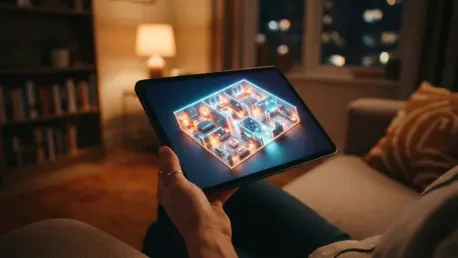

Smart home users often struggle to manage dozens of connected devices when their only interface is a basic list of text-based tiles. This frustration often peaks when a homeowner is trying to find a specific light among dozens of identical icons while standing right in front of the physical object. Amazon has addressed this friction by introducing the Alexa Home Map, a sophisticated tool designed to replace abstract lists with a digital twin of the user’s actual living environment. This technology transforms the smartphone or smart display into a virtual window, allowing individuals to navigate their residence in three dimensions. By moving away from the conventional dashboard, the system provides a spatial context that significantly lowers the cognitive load required to manage a complex ecosystem of appliances. Instead of deciphering names and room assignments, users can simply look at a representation of their couch or kitchen counter and interact with the devices placed there. This shift marks a pivotal evolution in how humans perceive and interact with their automated surroundings.
1. Spatial Awareness in Smart Home Management
Traditional systems from major tech competitors have long relied on a card-based architecture, where every light, thermostat, and lock is represented as a static tile. While functional for small setups, this approach becomes increasingly unwieldy as the number of connected devices grows into the dozens or hundreds. Users are forced to organize their dashboards meticulously, pinning favorites or creating complex room hierarchies that are often difficult to navigate in a hurry. The Alexa Home Map bypasses these organizational hurdles by utilizing a visual blueprint that mirrors the physical layout of the building. This orientation allows users to instantly identify a device based on its physical location rather than its assigned name, which is especially beneficial in large households where generic names like “Floor Lamp” are repeated across multiple rooms. By placing control within a spatial framework, the interface becomes more intuitive, mimicking the natural way people interact with their physical space daily.
Beyond simple placement, the interface utilizes real-time dynamic rendering to provide an at-a-glance status of the entire property. When a smart bulb is activated, its virtual counterpart on the map glows with the specific color and brightness level set by the user, creating a living picture of the home’s ambiance. Speakers currently playing audio are accompanied by animated music notes, providing immediate visual feedback without the need to open a separate playback menu. These small yet significant visual cues transform the map from a static diagram into a responsive dashboard that reflects the current state of the environment in real time. The integration of local weather patterns further enhances this immersion, as the map can display falling rain or snow outside the virtual walls when such conditions occur in the real world. This level of detail ensures that the digital representation is not just a control panel but a comprehensive reflection of the home’s atmosphere, making the management experience feel more connected and responsive.
2. Technical Implementation and Hardware Compatibility
Creating this high-fidelity digital twin involves a streamlined setup process that leverages advanced sensors found in modern mobile hardware. Homeowners begin by inputting their address, which allows the system to automatically generate the exterior proportions of the residence. The interior mapping, however, requires a more hands-on approach using the LiDAR scanners integrated into compatible smartphones. By walking through each room, users can capture the dimensions and layout of their space, which the app then translates into a navigable 3D model. Once the architectural foundation is established, the user manually places their smart devices on the map exactly where they are located in reality. This initial investment in time creates a permanent and accurate reference point for all future interactions. While the scanning process is currently limited to high-end devices with depth-sensing capabilities, it ensures that the resulting map is precise and reliable, providing a solid foundation for more complex automation routines and spatial interactions.
The successful rollout of the Alexa Home Map established a new benchmark for how users interacted with complex home automation systems. To maximize the benefits of this 3D interface, homeowners were encouraged to perform scans during daylight hours to ensure the LiDAR sensors captured the most accurate spatial data possible. This precision proved vital for the later placement of sensors and actuators, which functioned more reliably when their digital coordinates matched the physical world exactly. Developers also prioritized the expansion of the platform to a wider range of hardware, including the scheduled release for Android users in early 2027. This move suggested that the industry was moving toward a universal spatial standard for the internet of things. By adopting this visual-first approach, the community addressed the long-standing issue of device fatigue, turning a cluttered list of gadgets into a cohesive and manageable environment. These advancements paved the way for more sophisticated automation that relied on the physical proximity of users to their devices.