
Nia Christair is a leading voice in the evolution of mobile technology, bringing over a decade of expertise in hardware design and app development to the forefront of the consumer electronics industry. With a background that spans from perfecting mobile gaming interfaces to architecting robust enterprise mobile solutions, she understands the delicate balance between high-performance engineering and consumer desire. As the industry pivots from handheld devices to wearable technology, Nia provides an insider’s perspective on the logistical and social hurdles that companies must overcome to make smart eyewear a staple of modern life.
In this conversation, we explore the engineering realities of offloading processing power to iPhones, the aesthetic shift toward premium materials like acetate, and the strategic roadmaps required to disrupt a market currently dominated by a single player.
As smartphone market growth levels off, the focus is shifting toward smart glasses that act as iPhone accessories rather than standalone enterprise tools. What are the primary engineering trade-offs when offloading processing to a handheld device, and how does this approach affect battery life and heat management?
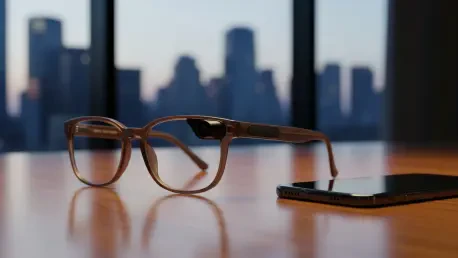
When you shift the heavy lifting to an iPhone, you are essentially treating the glasses as a remote sensor array rather than a standalone computer. This is a brilliant move for comfort because it allows the frames to remain light and slim, but it requires a constant, high-bandwidth wireless link that can drain the glasses’ small internal battery quite rapidly. By offloading the main processor, we significantly reduce the heat generated near the user’s temples, which is a major tactile comfort win since nobody wants warm electronics touching their face. However, the engineering challenge then moves to the smartphone side, as the handheld device must manage its own thermal output while processing real-time data from the glasses’ cameras and microphones.
Current designs for wearable tech are moving away from plastic in favor of premium materials like acetate to achieve an iconic, high-end look. How does material selection influence consumer adoption, and what specific steps are required to balance luxury aesthetics with the weight of cameras, speakers, and microphones?
Moving to acetate is a critical step in making these devices feel like “eyewear” first and “tech” second, which is essential for reaching a mass audience that values personal style. Acetate provides a depth of color and a tactile warmth that plastic simply cannot replicate, but it is also denser, meaning every gram of internal hardware must be scrutinized. Engineers have to strategically hollow out portions of the frame to nestle the speakers and microphones without compromising the structural integrity of the luxury material. It’s a game of millimeters where you are trying to hide a 2-megapixel sensor or a sophisticated microphone array inside a frame that looks just as sleek as a pair of designer Wayfarers.
The smart glasses market is surging, with projections reaching $40 billion by 2030, yet one competitor currently holds over 80% of the market share. What specific strategies can a late entrant use to disrupt such a dominant lead, and what metrics indicate a product has reached true mass-market appeal?
To disrupt a market where one player holds 82% of the share, a late entrant must focus on ecosystem integration and superior industrial design rather than just raw specs. We look for metrics like the “daily wear rate” rather than just initial sales; if a user keeps the glasses on for 12 hours a day even when the battery dies, that indicates true mass-market appeal. Success is also measured by how quickly the technology disappears into the background of social interactions without causing friction. With global shipments already jumping 210% to 2 million units in 2024, the strategy should be to capture the segment of the population that rejected earlier, “geekier” iterations in favor of something that mirrors classic fashion.
While full augmented reality displays are still years away, “smart spectacles” with integrated sensors and Siri functionality are arriving sooner. Why is this tiered release strategy beneficial for long-term product roadmaps, and how do you anticipate users will integrate these specific audio-and-photo features into their daily routines?
A tiered release allows the public to get comfortable with the idea of wearing a camera and a smart assistant on their face before we introduce the visual complexity of full AR. By starting with audio and photography, users can integrate the device into simple moments, like asking Siri for directions or taking a hands-free photo at a concert, without the “uncanny valley” feel of digital overlays. This approach builds a massive library of user behavior data that will inform how we eventually design the visual UI for those future AR displays. It’s about social conditioning; we are teaching people to talk to their glasses and trust the sensors in small, manageable steps.
Public concerns regarding surveillance and privacy have previously derailed wearable tech, leading to social friction in sensitive areas like schools. What specific hardware or software protocols must be implemented to reassure the public, and how can a brand avoid the negative social labels associated with early smart glasses?
To avoid the “glasshole” stigma, hardware must include highly visible physical indicators, like a bright LED that turns on whenever the camera is active, so bystanders aren’t left guessing. Software protocols should prioritize on-device processing, ensuring that sensitive audio and video never leave the local connection to the phone unless explicitly shared by the user. We also need to see geofencing features that could automatically disable recording functions in sensitive locations like schools or locker rooms to prevent social backlash. Branding is equally important; positioning these as “accessories” for your phone rather than “surveillance tools” helps shift the narrative from intrusion to personal convenience.
New product announcements often occur years before they actually ship to customers. What are the most common production bottlenecks that cause these multi-year delays, and how can a company maintain consumer momentum during a long wait? Please provide examples of the logistical challenges involved in global hardware rollouts.
The biggest bottleneck is often the miniaturization of the battery and the yield rate of high-end materials like acetate when they are being molded around delicate electronics. If a design is teased in 2024 but doesn’t ship until 2027, the company must maintain momentum by releasing software updates to the existing ecosystem that “prime” the user for the new hardware. Logistically, a global rollout is a nightmare because you have to navigate different privacy laws and radio-frequency certifications in every single country. For instance, getting a pair of camera-equipped glasses cleared for sale across the EU involves meeting much stricter data protection standards than in other regions, which can delay a launch by months or years.
What is your forecast for the smart glasses industry?
I believe we are on the cusp of a total transformation where smart glasses will eventually become the primary interface for our digital lives, potentially reaching that $40 billion valuation by 2030. In the next three to five years, you will see a massive shift where people stop pulling their phones out of their pockets for basic tasks like navigation or notifications, choosing instead to rely on the subtle audio cues and “glanceable” data from their eyewear. While one company might hold the lion’s share of the market today, the entry of a design-focused giant will split the industry into “utilitarian tech” and “fashion-first wearables.” Ultimately, the winner will be the brand that makes you forget you are wearing a computer at all.