
Traditional vacuuming has long been a chore defined by mechanical repetition and human oversight, but the arrival of the Narwal Flow 2 signals a shift toward a domestic environment where machines possess genuine situational awareness. The home robotics market reached a saturation point where incremental increases in suction power no longer provided meaningful improvements in daily life. Instead, the focus shifted toward the integration of cognitive processing and sensory precision. This device serves as a benchmark for this transition, moving away from the era of “automated tools” into the realm of “autonomous agents.” By prioritizing artificial intelligence as the primary navigator rather than a secondary feature, the technology attempts to resolve the persistent frustrations of modern homeowners: tangled brushes, stained corners, and the constant need for manual intervention.
The landscape of 2026 demands more than just a cleaning device; it requires an ecosystem that integrates seamlessly into a smart home without requiring a secondary job in maintenance. The Narwal Flow 2 addresses this by combining a high-performance suction system with a revolutionary mopping architecture that challenges the status quo of spinning pads. This review explores whether the sophisticated hardware justifies its premium positioning or if the complexities of high-level AI introduce new hurdles for the average user. Through a detailed analysis of its optical systems, mechanical engineering, and software capabilities, a clearer picture emerges of how robotic floor care is evolving to meet the demands of increasingly complex living spaces.
The Evolution of AI-Driven Floor Care
The emergence of the Narwal Flow 2 marks a departure from the “blind” navigation that characterized earlier generations of robotic vacuums. Historically, these devices relied on basic infrared sensors and rudimentary bumpers to navigate around obstacles, often resulting in inefficient cleaning patterns and frequent entrapment. The current era, however, is defined by “AI-forward” cleaning, a philosophy where the robot treats the home as a dynamic, ever-changing environment rather than a static map. This approach allows the unit to process visual data at a granular level, enabling it to distinguish between a harmless piece of furniture and a potential hazard like a discarded power cable or a wet spill.
In the broader technological landscape, this evolution represents a convergence of computer vision and machine learning. As smart homes become more interconnected, the expectation for localized intelligence has grown. The Narwal Flow 2 responds to this by utilizing an onboard processor capable of running complex algorithms locally, ensuring that the robot’s decisions are instantaneous and do not rely on a constant cloud connection. This shift toward intelligent, sensor-based navigation ensures that the cleaning process is not just a scheduled task but a responsive behavior that adapts to the specific conditions of a household on any given day.
Furthermore, the context of this technological leap involves a total re-imagining of what “clean” actually means. In previous years, success was measured by the amount of dust in a bin; today, success is measured by the hygiene of the floors and the absence of human labor. By moving beyond traditional repetitive patterns, the Flow 2 avoids the “cleaning for the sake of cleaning” trap, instead focusing its energy on areas that actually require attention. This intentionality is the hallmark of the new generation of floor care, where the machine is capable of assessing the success of its own work and adjusting its strategy without needing a prompt from a smartphone app.
Technological Infrastructure and Design Philosophy
The AI-Forward Optical System: Real-Time Perception
At the heart of the robot’s environmental awareness is the LM OmniVision AI Model, supported by a high-definition dual 1080p camera system. This is not merely a camera used for mapping; it is a sophisticated perceptual array that grants the unit a 136-degree field of vision. This wide-angle perspective is critical for depth perception and the categorization of objects in three-dimensional space. While traditional LIDAR systems excel at identifying walls and large furniture, they often struggle with low-profile items like socks or small toys. The dual-camera setup provides the stereoscopic vision necessary to judge distances accurately, allowing the robot to navigate within millimeters of an obstacle without making physical contact.
The true innovation lies in the dirt detection algorithms that work in tandem with the optical hardware. As the robot traverses the home, the AI analyzes the floor surface for visual inconsistencies. If it identifies a concentrated area of dust or a dried liquid stain, it can autonomously decide to increase its suction power or slow down its travel speed to ensure a more thorough pass. This real-time recognition of “grime levels” transforms the device from a passive sweeper into an active investigator. By prioritizing areas that are objectively dirtier, the system optimizes its battery life and reduces wear and tear on the mechanical components, ensuring that the most intensive cleaning is reserved for where it is truly needed.
This optical system also plays a vital role in privacy and security, a major concern for consumers in the modern era. The LM OmniVision model is designed to process image data on the device itself, reducing the amount of sensitive information transmitted to external servers. This localized processing is a significant selling point for those who are wary of having cameras in their private living spaces. Moreover, the cameras provide a secondary function as a mobile security tool, allowing users to remotely view their homes through the app. The combination of high-resolution optics and ethical data management reflects a mature design philosophy that balances functional power with user safety.
Hardware Architecture and Suction Mechanics: Power and Precision
To complement its intelligent navigation, the Narwal Flow 2 features a robust hardware architecture headlined by a 30,000Pa suction motor. In the world of robotic vacuums, suction metrics are often touted as the primary indicator of performance, yet raw power is meaningless without effective delivery. This device utilizes a sealed airflow system that minimizes pressure loss between the intake and the dustbin, ensuring that the full 30,000Pa is concentrated on the floor surface. This level of power is particularly effective for extracting heavy debris, such as sand or small pebbles, that often settle in the crevices of hardwood floors or deep within carpet fibers.
Central to the vacuuming system is the zero-tangling floating brush, which addresses one of the most persistent mechanical failures in the industry. Traditional brushes are prone to hair wrap, which requires frequent manual cleaning and degrades the motor’s efficiency. The Flow 2 utilizes a conical brush design that naturally migrates hair toward the suction inlet, preventing it from winding around the central axle. The “floating” nature of the brush allows it to maintain constant contact with uneven floor surfaces, such as the transitions between tile and wood, ensuring that no debris is left behind due to a lack of physical engagement.
The structural integrity of the unit is designed for longevity, using high-impact polymers and reinforced joints to withstand the rigors of daily use. Despite the high-power motor, the internal acoustics are engineered to dampen high-frequency whines, resulting in a more tolerable sound profile than many of its competitors. This balance between extreme suction and operational refinement demonstrates a commitment to a high-quality user experience. Whether it is dealing with fine pet dander on a rug or larger organic debris in a kitchen, the mechanical core of the machine is built to deliver consistent results across a diverse range of residential environments.
The Crawler Mop Innovation: A New Standard for Hygiene
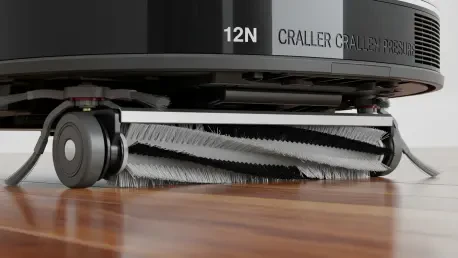
While vacuuming is a solved problem for many manufacturers, mopping remains a significant challenge. The Narwal Flow 2 moves away from the common dual-spinning pad design in favor of a “crawler mop,” which functions similarly to a tank tread or a continuous roller. This innovation provides a significantly larger surface area in contact with the floor at any given moment. Unlike spinning pads that can occasionally leave circular streaks or “miss” small gaps between the rotors, the crawler mop ensures a continuous, uniform cleaning path that covers the entire width of the mopping assembly.
To tackle stubborn, dried-on stains, the system applies 12N of downward pressure. This is a critical metric because most robotic mops simply “wipe” the floor with the weight of the water tank; the Flow 2 actively “scrubs” the surface. This downward force, combined with the high-speed rotation of the roller, mimics the manual effort required to lift sticky substances like spilled juice or muddy footprints. Moreover, the mop features an active self-cleaning mechanism during the cleaning cycle. Instead of dragging a dirty cloth across the entire home, the robot continuously flushes the roller with clean water and extracts the wastewater into an internal reservoir, ensuring that the leading edge of the mop is always fresh.
The design of the crawler mop also allows for superior edge cleaning. By extending the roller slightly beyond the side profile of the robot, the device can reach the very edges of baseboards and cabinetry. This eliminates the “dead zone” often found with circular mopping pads that cannot physically reach into 90-degree corners or tight edges. This mechanical advantage is further enhanced by the AI’s ability to recognize floor types, allowing the mop to automatically lift when it detects a rug or carpet. This prevents cross-contamination and ensures that moisture is only applied to surfaces that can safely handle it, showcasing a thoughtful integration of mechanical and digital engineering.
Emerging Trends in Automated Home Maintenance
The current direction of the industry is moving toward “hands-free” ecosystems that require minimal human interaction for weeks or even months at a time. This trend is exemplified by the evolution of the docking station from a simple charger into a comprehensive maintenance hub. Modern consumers are no longer satisfied with emptying a dustbin every two days; they expect the system to manage its own waste, sanitize its cleaning components, and replenish its water supply autonomously. The shift toward high-temperature sanitation in these docks is particularly noteworthy, as it addresses the bacterial growth and odors that plagued earlier self-cleaning models.
Another significant development is the integration of unified smart home protocols, such as Matter. This allows robotic vacuums to act as part of a larger, cohesive system rather than an isolated appliance. For instance, a robot could be programmed to start its cleaning cycle only when the smart lock indicates that the residents have left the house, or it could coordinate with smart air purifiers to manage dust levels more effectively. This interoperability is essential for the long-term viability of home automation, as it reduces the friction of managing multiple proprietary apps and creates a more intuitive living environment.
Water management is also seeing a shift toward total autonomy. Some high-end configurations now offer the option to plumb the docking station directly into the home’s water lines and drainage system. This eliminates the need for the user to manually fill clean water tanks or empty dirty ones, effectively making the floor care process invisible. As these technologies become more accessible, the robotic vacuum is transforming from a luxury gadget into a standard household utility, much like a dishwasher or a washing machine. The Narwal Flow 2 stands at the forefront of this movement, pushing the boundaries of how much labor can truly be offloaded to an intelligent machine.
Real-World Applications and Performance Metrics
In practical application, the Narwal Flow 2 demonstrates an impressive ability to handle the “messy reality” of a lived-in home. On hard floors, the combination of the crawler mop and intelligent dirt detection proves to be highly effective. During testing on laminate and wood surfaces, the unit successfully identified and removed dried spills that would typically require manual scrubbing. The 12N pressure is not just a theoretical number; it translates into a visible difference in floor shine and the removal of the thin film of grime that often accumulates in high-traffic areas like kitchens and entryways.
One of the most notable performance metrics is the robot’s ability to traverse high thresholds. Many homes feature transition strips or decorative moldings between rooms that can be up to 2 inches high, acting as a barrier for many standard robotic cleaners. The Flow 2 utilizes a reinforced suspension system and high-traction wheels that allow it to climb over these obstacles with ease. This capability is vital for maintaining a “whole-home” cleaning schedule without the risk of the robot getting stuck in a single room or requiring the user to physically carry it over a doorway.
The introduction of specialized cleaning modes, such as Pet Care and Baby Care, further illustrates the practical utility of the AI. In Pet Care Mode, the robot uses its optical sensors to actively avoid pets, preventing the stress of a mechanical intruder chasing an animal. It also identifies high-shedding areas and increases suction accordingly. In Baby Care Mode, the focus shifts to noise reduction and the avoidance of designated “play zones” where small toys might be scattered. These targeted applications show that the technology is maturing to meet the specific demographic needs of various households, rather than offering a one-size-fits-all solution that often falls short in complex environments.
Challenges and Technical Hurdles
Despite the significant advancements, the Narwal Flow 2 is not without its limitations. The physical dimensions of the unit, particularly its 3.7-inch height, present a challenge in homes with low-clearance furniture. While the height is necessary to accommodate the advanced optical array and the powerful suction motor, it means the robot cannot reach under certain sofas, dressers, or kitchen toe-kicks. This leaves “dust islands” that still require manual cleaning, reminding the user that while the robot is highly capable, it cannot yet fully replace traditional cleaning tools in every nook and cranny of a house.
Mechanical limitations also persist in the deepest recesses of 90-degree corners. Although the crawler mop extends to the edges, the circular chassis of the robot itself prevents it from getting into the very apex of a corner. While the side brushes attempt to sweep debris out of these areas, they are not always 100% effective, especially with heavier particles or sticky residue. This is a common hurdle for nearly all robotic vacuums, but it is one that users must consider when setting their expectations for a “perfect” clean. Ongoing development in D-shaped chassis designs or more flexible brush arms may eventually solve this, but for now, it remains a trade-off for the superior navigation offered by the circular form factor.
Technical hurdles also remain in the realm of software and user interface. While the Flow 2 supports a wide array of voice commands, it still struggles with complex, multi-step instructions. For example, asking the robot to “vacuum the kitchen then mop the hallway with extra water” may confuse the current NLP (Natural Language Processing) engine. Furthermore, while the AI is excellent at identifying common objects, it can still be fooled by mirrors, glass doors, or highly reflective surfaces, which can sometimes lead to navigational errors. These are areas where continuous firmware updates and more robust training of the AI models will be necessary to achieve the next level of operational seamlessness.
The Future of Robotic Environmental Awareness
Looking ahead, the trajectory of Narwal’s AI and optical technology points toward a future where robots are not just cleaners, but proactive guardians of the home environment. The next logical step for this technology is more granular room customization and “event-driven” cleaning. Instead of a set schedule, a robot might use its cameras to detect when a meal has ended in the dining room and automatically deploy to clean up crumbs before they are tracked elsewhere. This level of proactive awareness would represent a significant leap in domestic automation, turning the robot into a “ghost” worker that anticipates the needs of the household.
There is also immense potential for the integration of robotic vacuum sensors with proactive home security systems. Since the Flow 2 already possesses a high-definition camera and sophisticated object recognition, it could theoretically be used to detect anomalies like a water leak under a sink or an open window. By patrolling the home while the residents are away, the robot provides a mobile, 360-degree security perspective that stationary cameras cannot match. This dual-purpose functionality would increase the value proposition of the device, making it a central pillar of the smart home infrastructure rather than a single-purpose appliance.
Finally, the long-term impact of high-autonomy maintenance docks will likely lead to a “zero-labor” domestic environment for floor care. As the reliability of self-emptying and self-washing systems improves, the psychological burden of home maintenance will decrease. We are moving toward a reality where the floor is simply always clean, and the machine responsible for it is an invisible, reliable utility. The Narwal Flow 2 serves as a critical stepping stone in this journey, proving that the combination of high-pressure mechanical cleaning and advanced AI perception can overcome the vast majority of daily cleaning challenges.
Final Assessment of the Narwal Flow 2
The development of the Narwal Flow 2 has successfully addressed several of the most significant pain points in the robotic floor care industry. Its transition to a crawler mop system represents a meaningful improvement in mopping hygiene, moving away from the inefficiency of dragging soiled pads across a home. By applying consistent downward pressure and utilizing an active self-cleaning cycle, the device has demonstrated that it can handle more than just surface-level dust; it can manage the actual grime of a busy household. This mechanical prowess, paired with the 30,000Pa suction motor, established it as a formidable competitor in the premium flagship market.
The integration of the LM OmniVision AI model proved to be the defining characteristic of the unit’s performance. The ability to distinguish between different types of obstacles and floor surfaces meant that the robot spent more time cleaning and less time waiting for human rescue. While the physical height of 3.7 inches and the inherent limitations of a circular chassis in 90-degree corners remained minor drawbacks, they were largely outweighed by the unit’s superior navigation and threshold-climbing abilities. The intelligence of the system allowed it to adapt to specific household demographics, such as pet owners and families with young children, through targeted software modes that prioritized safety and noise management.
In the final analysis, the Narwal Flow 2 functioned as more than just a vacuum; it operated as a sophisticated maintenance tool that redefined the standards of autonomous floor care. The all-in-one docking station, with its hot-water washing and hot-air drying capabilities, effectively reduced the frequency of human intervention to a matter of minutes per month. While there was still room for growth in the complexity of voice commands and the extraction of fine powders from thick carpets, the overall package set a high benchmark for the industry. It was a clear indication that the future of home automation lay in the seamless marriage of powerful hardware and perceptive artificial intelligence.