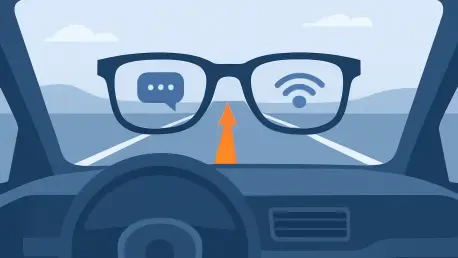

The promise of “eyes-up” navigation via smart glasses is often undermined by the reality that digital notifications can distract a driver more than traditional handheld devices. As these wearable units become standard equipment for the tech-savvy commuter, the line between helpful assistance and dangerous interference continues to blur. Modern systems now project everything from text messages and social media updates to turn-by-turn directions directly onto the user’s retina or a transparent lens. While manufacturers market these features as a safer alternative to looking down at a smartphone, the fundamental problem of divided attention remains unresolved. The human brain is not naturally wired to process two distinct layers of visual information simultaneously without a significant drop in situational awareness. When a driver is navigating a complex intersection while an incoming call notification pulses in their peripheral vision, the risk of a misjudgment spikes. This tension between the desire for constant connectivity and the biological limits of human focus has turned a once-futuristic accessory into a primary concern for road safety experts. As the prevalence of these devices continues to grow, there is a serious re-evaluation of what it means to be fully present behind the wheel.
Device Categorization: Part 1. Augmented Reality Complexity
Understanding the nuances of modern smart eyewear is essential for identifying specific risks associated with different hardware designs. Currently, the market is divided into several primary categories, with augmented reality glasses being the most complex due to their active overlay of digital graphics and text onto the physical environment. This category presents the highest risk of cognitive interference because it forces the wearer’s eyes to constantly adjust between the focal depth of the road and the focal depth of the digital display. Even if the information is transparent, the brain must decide which layer of reality to prioritize, often leading to a momentary lapse in environmental processing. Research into human-computer interaction suggests that these visual layers compete for the same neural resources, making it impossible to truly multitask without performance degradation. For a driver, this means that while they are reading a weather update or a map notification, they may be less likely to notice a subtle change in the behavior of the vehicle ahead of them. The illusion of transparency creates a false sense of security, encouraging users to engage with digital content more frequently than they would with a traditional screen.
Device Categorization: Part 2. Camera and Audio Hardware
Beyond augmented reality, camera-focused models and audio-centric frames introduce their own unique sets of challenges for modern motorists. Camera-focused units, while primarily used for hands-free recording and photography, still involve a light-up interface or status indicators that can catch a driver’s eye at a critical moment. The act of framing a shot or checking a recording status requires a shift in mental focus that is incompatible with high-speed vehicle operation. Even the seemingly benign audio-only versions, which use bone conduction or tiny speakers to deliver information, can sap mental energy through complex voice-command menus and constant interaction with artificial intelligence. Each of these form factors introduces a unique layer of abstraction from the task of driving, leading to a fragmented mental state where the digital world competes with the physical responsibilities of operation. The subtle nature of this technology makes it far more difficult to detect than a phone held to an ear, making the distraction nearly invisible to outside observers and law enforcement. This invisibility complicates the job of traffic safety officers, who must now look for small physical gestures or eye movements to identify distracted drivers.
Legislative Response: The Scope of Illinois House Bill 4843
Legislators are rapidly catching up to the realities of wearable technology, shifting from reactive laws to proactive frameworks that define distraction more broadly than ever before. Illinois has emerged as a leader in this area with the implementation of House Bill 4843, which specifically classifies smart glasses as restricted electronic devices alongside smartphones and tablets. This legal pivot is designed to close the “hands-free” loophole that many drivers previously exploited to justify using internet-connected eyewear. By explicitly naming wearable tech in the traffic code, the state has removed any ambiguity regarding the legality of checking digital updates through a lens while in motion. The bill reflects a broader trend among state governments to treat the display of non-navigational data as a per se violation of safety standards, regardless of whether the device is handheld or head-mounted. This shift acknowledges that the danger lies in the mental diversion itself, not just the physical act of holding a phone. As more jurisdictions look to Illinois as a model, the expectation for drivers is becoming increasingly clear: any digital interface that overlays the windshield view is subject to the same scrutiny as traditional screen use.
Enforcement Standards: Red Lights and Stationary Vehicles
The enforcement of these new rules often catches drivers by surprise due to the lack of exceptions for stationary vehicles or slow-moving traffic. Under the latest guidelines, a driver who activates a smart-glass interface while stopped at a red light or idling in heavy congestion is just as liable as someone speeding down a highway. This strict interpretation is based on research showing that cognitive distraction does not vanish the moment a car stops moving; rather, the mental “hangover” from checking a message can persist for several seconds after the light turns green. Lawmakers have opted for a tiered fine system to discourage the habit of periodic digital checking during a commute. First-time offenders face significant penalties, but subsequent violations can lead to license suspensions and mandatory safety courses. By eliminating the “stopped at a light” defense, authorities are emphasizing that driving is a continuous task that requires mental readiness from the moment the engine starts until the vehicle is parked. This approach aims to break the psychological compulsion to stay connected during every quiet moment of a trip. The message is intended to be uncompromising, forcing users to treat their car as a tech-free zone where the only relevant data is the environment surrounding the vehicle.
Cognitive Hazards: The Look-But-Fail-To-See Phenomenon
One of the most dangerous phenomena associated with smart eyewear is the “look-but-fail-to-see” effect, a cognitive lapse where the eyes are directed at an object but the brain fails to process it. When a driver is wearing augmented reality glasses, their visual field is technically unobstructed, yet their brain is preoccupied with the digital layer of information. This creates a cognitive blind spot that is often more hazardous than a physical obstruction because the driver believes they are being attentive. Studies in neuro-ergonomics suggest that the brain’s processing power is a finite resource; as the demand for digital interpretation increases, the capacity for environmental hazard detection decreases proportionally. A pedestrian stepping into a crosswalk or a lead vehicle braking suddenly may be physically visible on the retina, but the driver’s internal threat assessment system is bogged down by the notification they just received. This delay in reaction time, even if it lasts only a fraction of a second, can be the difference between a near-miss and a fatal collision. The illusion of safety provided by a clear, eyes-up view is precisely what makes this technology so deceptive. Drivers often overestimate their ability to multitask, failing to realize that their primary task—safe navigation—is being relegated to a background process.
Mental Load: AI Interaction and Cognitive Tunnel Vision
Interacting with advanced artificial intelligence through wearable frames adds another layer of complexity known as cognitive tunnel vision. Even without a visual overlay, the act of dictating a long email or navigating a complex voice menu requires a level of mental visualization that pulls the driver’s focus away from the road. When the brain is engaged in generating language or solving a technical problem with a voice command, the field of peripheral awareness narrows significantly. This reduction in the useful field of view means that a driver is less likely to notice subtle cues, such as a changing road surface or the erratic behavior of a nearby motorist. The mental exertion required to correct a misunderstanding or to process a synthesized voice response creates a bottleneck in the central nervous system. This state of hyper-focus on the internal digital dialogue makes the driver less adaptable to the unpredictable nature of real-world traffic. Furthermore, the emotional impact of a stressful communication can trigger a physiological stress response that further impairs motor skills and decision-making. By the time the digital interaction ends, the driver may have traveled several hundred feet with almost no memory of the road they just covered.
Legal Accountability: Telemetry Logs and Insurance Liability
In the aftermath of a traffic incident, the presence of smart glasses quickly became a central point of legal and financial contention. Modern insurance adjusters and forensic investigators began routinely examining the digital logs and telemetry data from wearable devices to determine if they were active at the time of a crash. Because these units were often synced with cloud accounts, they left a permanent and verifiable trail of activity that was difficult to dispute in a courtroom. A driver found to be interacting with a visual display or a voice assistant during a collision often found their insurance claim denied under negligence clauses. Furthermore, the legal threshold for reckless driving evolved to include the use of unapproved wearable interfaces, which led to criminal charges in severe cases. This digital accountability meant that the convenience of the device was heavily outweighed by the potential for lifelong financial liability and legal repercussions. Attorneys successfully used device timestamps to prove that a driver’s attention was compromised, often securing higher settlements for victims by highlighting the defendant’s choice to prioritize a gadget over public safety. The transparency of the technology, which was intended to make life easier, ultimately acted as a witness against the user when tragedy struck.
Operational Safety: Practical Habits and Technological Lockouts
The regulatory shift toward limiting wearable technology reflected a broader societal realization that visual transparency did not equate to cognitive availability. Drivers who successfully transitioned through this era of rapid innovation were those who established a firm boundary between their digital and physical worlds before turning the ignition key. Authorities eventually standardized biometric monitoring to ensure that a wearer’s focus remained on the external environment, proving that personal responsibility remained the most effective safety tool available. These measures collectively ensured that the integration of smart eyewear became a controlled evolution rather than a chaotic disruption of public safety standards. By adopting a zero-notification policy while in motion, the driving population significantly reduced the frequency of cognitive-based collisions that had initially surged with the release of first-generation devices. The industry eventually moved toward minimalist designs that prioritized haptic feedback over visual clutter, allowing for a safer balance of utility and awareness. Looking back, the successful management of smart glasses in vehicles was achieved through a combination of strict legislation, forensic accountability, and a fundamental shift in driver behavior. This era taught that while the lenses through which the world was viewed could change, the human requirement for undivided attention remained a constant necessity.