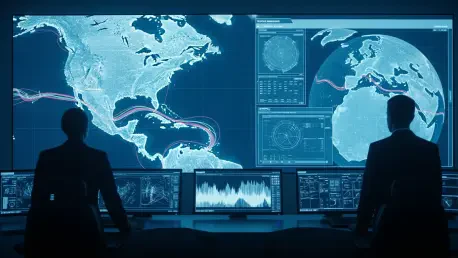

The silent depths of the North Atlantic recently became the stage for a high-stakes maritime confrontation that underscores the fragile nature of the global digital infrastructure. While international attention remained preoccupied with the volatile developments in the Middle East, the United Kingdom successfully disrupted a sophisticated Russian naval mission designed to compromise vital subsea fiber optic cables. This covert operation was not merely a routine patrol but a calculated attempt to map and potentially sabotage the very conduits that facilitate the vast majority of international financial transactions and communication. By leveraging regional instability as a geopolitical smokescreen, Moscow sought to exploit perceived gaps in Western surveillance, highlighting a shift toward hybrid warfare where the battlefield is invisible and submerged. This incident serves as a stark reminder that the security of the undersea network is no longer a peripheral concern but a central pillar of modern national defense strategies.
Tactical Deception and the British Naval Interception
The Russian operation relied on a classic tactical ruse involving an Akula-class nuclear-powered attack submarine, which served as a highly visible distraction to occupy British monitors. As this vessel made its way toward United Kingdom territory, specialized units from the Main Directorate of Deep Sea Research, known as GUGI, were simultaneously deployed from the secretive naval base at Olenya Guba in the Arctic. These elite units represent a specialized branch of the Russian military that operates independently of the standard navy, focusing exclusively on deep-water engineering and intelligence gathering. Their objective was to move undetected into position to survey the specific seabed coordinates of fiber optic cables that carry the bulk of Western internet traffic. By splitting their forces, the Russian command hoped that the attention focused on the larger attack submarine would provide the GUGI vessels with the necessary cover to conduct their surveys without any interference.
The Royal Navy response was a textbook demonstration of multi-domain anti-submarine warfare, utilizing a combination of surface ships, helicopters, and advanced aerial surveillance. The Type 23 frigate HMS St Albans and the Royal Fleet Auxiliary tanker RFA Tidespring were deployed to track the Russian movements, supported by Merlin helicopters equipped with dipping sonar. Crucially, the operation was bolstered by the Royal Air Force’s P8 Poseidon aircraft, which provided persistent overhead monitoring that stripped away any chance of Russian anonymity. This robust presence forced the Russian vessels into a situation where their mission could no longer be considered covert, effectively neutralizing the tactical advantage they sought to gain. By shadowing the vessels so closely, the British military sent a clear signal that the underwater environment was being watched with a level of precision that precluded any chance of secret tampering or unobserved intelligence gathering.
Specialized Assets and the Gray Zone Challenge
A major concern for Western intelligence agencies is the unique technical capability possessed by the GUGI organization, which maintains a fleet of specialized research vessels. These platforms are equipped with deep-submerging manned submersibles and autonomous underwater vehicles that can reach depths far exceeding those of standard military submarines. Their operations involve more than just mapping; they are capable of installing physical taps on cables to intercept data or placing sensors to monitor the movement of NATO vessels across the seafloor. This ability to operate at extreme depths makes detection and intervention significantly more challenging for conventional naval forces. The sophistication of these tools indicates a long-term investment by Moscow in the ability to interfere with civilian infrastructure during periods of heightened tension. Such capabilities allow for the manipulation of the global information environment from the shadows, away from public view.
This type of maritime activity falls into the category of gray zone warfare, where state actors conduct aggressive operations that stop just short of triggering a full-scale military conflict. By targeting subsea cables, Russia creates a persistent threat to the economic stability of Western nations without firing a single shot or violating traditional territorial boundaries in a way that demands an immediate kinetic response. The ambiguity of these operations allows for a degree of plausible deniability, making it difficult for international bodies to coordinate a unified legal or military reaction. However, the UK’s proactive stance in this instance demonstrated that the gray zone can be contested through superior surveillance and strategic communication. By making the Russian movements public, the British government effectively raised the political cost of the mission, proving that transparency is a potent weapon against covert aggression that relies on secrecy and geopolitical distractions.
Global Trends in Infrastructure Sabotage
The vulnerability of undersea networks is a global issue that extends well beyond the North Sea, with critical maritime corridors in the Middle East facing similar threats. In the Strait of Hormuz and the Red Sea, vital cable systems such as the Gulf Bridge International and the SeaMeWe-6 project are situated in shallow, high-traffic waters that are easily accessible to regional proxies. Ongoing instability has already impacted major commercial endeavors, including Meta’s 2Africa project, where specific segments like the “Pearls” section have faced significant delays due to the risk of interference. These regions represent a different kind of challenge, as the threat often comes from less sophisticated but equally effective actors using local maritime assets to disrupt connectivity. The proximity of these cables to conflict zones means that even minor tactical shifts in the region can have immediate and far-reaching consequences for the speed and reliability of global data transmission.
Evidence suggests that high-tech submersibles are not the only tools used for infrastructure sabotage, as low-tech methods have proven to be highly effective and difficult to attribute. In the Gulf of Finland, recent incidents involving civilian vessels dragging anchors across subsea cables have demonstrated how easily connectivity can be severed under the guise of maritime accidents. This approach provides a layer of deniability that high-tech military operations cannot always maintain, as it mimics common commercial mishaps. The challenge for defense forces is to distinguish between genuine accidents and coordinated hybrid attacks that aim to degrade national communication networks. As maritime traffic increases, the opportunity for such deniable operations grows, requiring a new level of cooperation between civilian port authorities and military intelligence. Ensuring the integrity of the seabed now requires monitoring not just military fleets, but also the thousands of commercial vessels.
Future Strategic Initiatives for Subsea Security
The resolution of the Russian incursion established a new baseline for maritime security strategies that prioritized the integration of commercial and military monitoring. Analysts identified that the most effective deterrent involved a permanent, 24/7 surveillance presence over critical cable landing points and transit corridors. Governments moved toward implementing mandatory tracking for all vessels operating near sensitive zones, supported by automated systems that flagged anomalous behavior in real time. The focus shifted toward building redundancy into the global network, ensuring that the loss of a single cable would not result in significant data outages for entire regions. Defense planners emphasized the importance of international cooperation, leading to the creation of shared seabed intelligence databases among NATO allies. This coordinated approach ensured that the protection of the digital backbone was treated as a collective responsibility, successfully deterring future covert operations.